
A professional roof inspection in the U.S. typically costs between $125 and $376, with a national average of about $247. What you actually pay depends on who does it, how they get on the roof and what the report is for. In Arizona, a roofing contractor will often inspect a home’s roof for free, while drone, thermal and certification inspections cost more.
This guide breaks down roof inspection cost by type, explains what a free inspection should and shouldn’t include, and shows when paying for an inspection makes sense for Arizona tile, shingle, foam and metal roofs.
Key takeaways
- National average roof inspection cost: about $247, typical range $125–$376 (Angi, 2025 data).
- A walk-on (physical) inspection runs $75–$200; drone $150–$400; infrared/thermal $400–$600.
- A roof certification for a home sale is commonly $75–$200 on top of any repairs needed to pass.
- Many Arizona roofing contractors, including us, inspect residential roofs for free with photos and a written report.
- Pay for an inspection when you need an independent opinion, a thermal moisture scan or a document a lender or insurer will accept.
Roof inspection cost by type
“Roof inspection” covers several different services. The method and the paperwork drive the price far more than the size of the house.
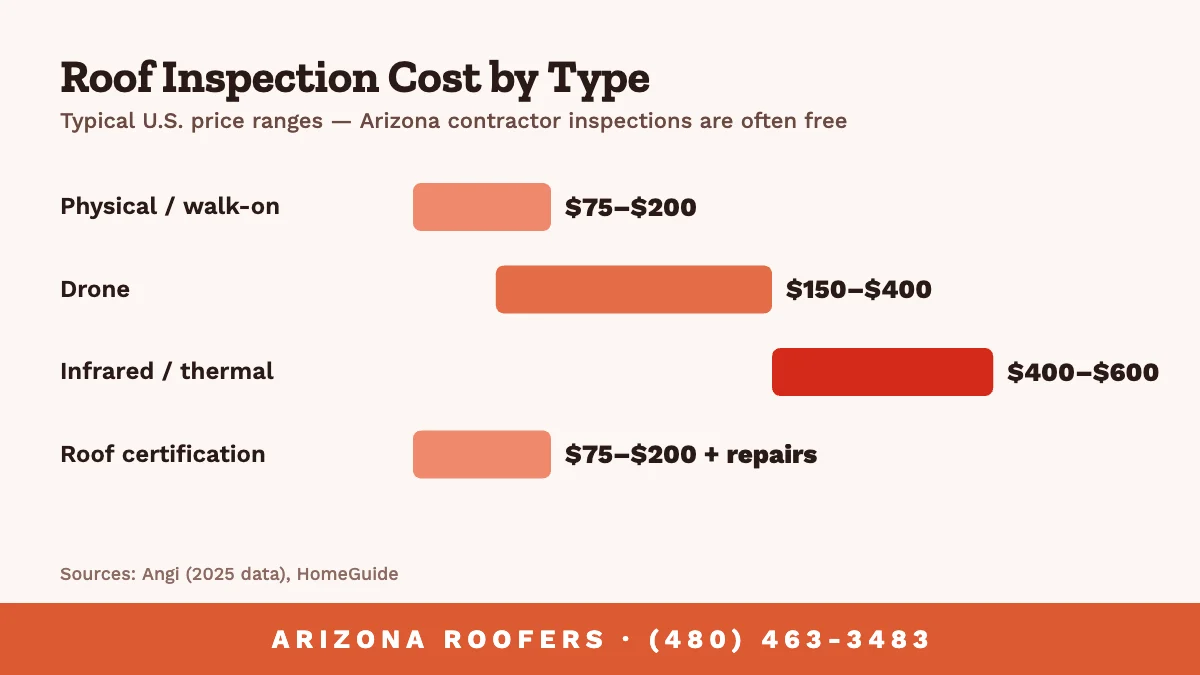
| Inspection type | Typical cost | What you get | Best for |
|---|---|---|---|
| Roofing contractor inspection | Often free | On-roof check, photos, written findings and a repair or replacement estimate | Leaks, storm damage, “how much life is left?” |
| Physical (walk-on) inspection | $75–$200 | Inspector walks the roof and checks covering, flashing, penetrations and drainage | Routine condition checks |
| Drone inspection | $150–$400 | Aerial photos and video of every slope | Steep, fragile or hard-to-reach roofs |
| Infrared (thermal) inspection | $400–$600 | Thermal imaging that finds trapped moisture under the surface | Flat and foam roofs, hidden leaks |
| Roof certification | $75–$200 + repairs | Signed certificate that the roof should stay leak-free for a set term | Home sales, FHA/VA loans, insurers |
| Home inspection (roof included) | $250–$400 | Whole-house report with a roof section | Buyers during the inspection period |
National ranges come from Angi and HomeGuide cost data. Arizona prices land inside these ranges for most single-family homes; large, steep or multi-level tile roofs sit at the top.
Physical (walk-on) inspection
The inspector gets on the roof and looks at the covering, flashing, vents, skylights, valleys and drainage. On Arizona tile roofs a good inspector also lifts tiles in a few areas, because the underlayment underneath is what actually keeps water out, and it usually wears out before the tile does.
Drone inspection
A drone photographs the roof from above without anyone walking on it. That’s useful on steep roofs and on concrete or clay tile that can crack underfoot. The limit: a drone can’t lift a tile, feel a soft spot in the decking or look inside the attic, so it works best alongside a hands-on check, not instead of one.
Infrared (thermal) inspection
Thermal cameras pick up the temperature difference between wet and dry roofing after sunset. It’s the most reliable way to map trapped moisture on foam and other flat roofs, where a leak can travel a long way before it shows on a ceiling. Our thermal roof inspections are scoped and quoted before we schedule them.
Roof certification
A certification is a roofing contractor’s written promise that the roof should stay watertight for two to five years. It is common in Arizona resales and with FHA or VA loans. The certificate itself is inexpensive; any repairs needed to qualify are priced separately. See our guide to roof certification in Arizona.
What affects the price of a roof inspection
- Roof size and pitch. Larger and steeper roofs take longer and may need extra safety equipment.
- Roof type. Tile takes more time than shingle because tiles have to be lifted to check the underlayment. Foam and flat roofs may need core samples or a thermal scan.
- Access. Two-story homes, parapet walls and solar arrays add time.
- Report type. A verbal summary costs less than a written report for an insurer, a lender or escrow.
- Who orders it. A roofer who expects to quote repairs may inspect for free. An independent inspector who will never do the work charges for their time.
Free vs paid roof inspections: which do you need?
A free inspection from a roofing contractor and a paid inspection from an independent inspector answer slightly different questions.
A free contractor inspection is the right first step when you have a leak, you suspect monsoon or hail damage, or you want to know whether to repair or replace the roof. The roofer is the person who would fix the problem, so the findings come with a price.
A paid inspection makes sense when you need a neutral third party (for example, to settle a dispute with a seller or contractor), when you need thermal imaging, or when a lender, insurer or escrow officer needs a specific document.
What a legitimate free inspection includes
- Someone actually on the roof (or a drone flight plus an attic check where walking isn’t safe)
- Dated photos of every issue, not just a verbal summary
- A written list of what needs attention now versus what can wait
- A licensed contractor: check the ROC number at the Arizona Registrar of Contractors
- No pressure to sign anything on the day
Red flags with “free” inspections
Door-to-door crews offering free inspections after a storm are a known problem in Arizona. Be wary of anyone who finds major damage nobody else can see, won’t show you photos, asks you to sign a contract or an insurance assignment on the spot, or wants a large payment up front. Our guide to roofing scams in Arizona lists the warning signs.
What a roof inspection checks
- Roof covering: cracked, slipped or missing tiles; worn or blistered shingles; foam coating thickness and UV wear; metal panel fasteners.
- Underlayment: on tile roofs, the felt or synthetic layer under the tiles, which is the usual failure point in Arizona heat.
- Flashing: walls, chimneys, valleys, skylights and every transition between roof planes.
- Penetrations: plumbing vents, HVAC curbs, evaporative cooler stands and solar mounts.
- Drainage: scuppers, gutters, downspouts and ponding on flat sections.
- Decking and attic: soft spots, water stains, daylight or rot.
- Remaining life: an honest estimate of how many years the roof has left.
For a full walkthrough, see our roof inspection guide for Arizona homes.
How often to have your roof inspected in Arizona
Plan on a professional inspection about once a year, and ideally right after monsoon season (June 15 – September 30), when wind, hail and heavy rain have had their chance at the roof. Also book one:
- After any severe storm, before you file an insurance claim
- When you buy or sell a home
- When a tile roof reaches about 20 years, the point where Arizona underlayment typically starts to fail
- Before installing solar panels
- When you notice signs of a roof leak, such as ceiling stains or a musty attic
Is a roof inspection worth the cost?
Almost always. Small problems found early, such as a cracked tile, a lifted flashing or a worn pipe boot, are inexpensive to fix. The same problems left through a monsoon season can soak the underlayment and decking and turn a repair into a much larger job. An inspection also gives you dated photos of your roof’s condition, which helps with insurance claims and home sales.
Roof inspection cost FAQ
How much does a roof inspection cost in Arizona?
Most paid roof inspections fall between $125 and $376, with a national average of about $247. Drone inspections run about $150–$400 and infrared inspections about $400–$600. Many Arizona roofing contractors, including Arizona Roofers, inspect residential roofs for free.
Are free roof inspections legitimate?
Yes, when they come from a licensed local roofer who gets on the roof, gives you photos and a written report, and doesn’t pressure you to sign anything. Be cautious with unsolicited door-to-door offers after storms, especially if the crew can’t show a valid ROC license.
Is a drone roof inspection as good as a walk-on inspection?
Not on its own. A drone is excellent for photographing steep or fragile roofs, but it can’t lift tiles to check the underlayment, find soft decking or look inside the attic. The best results come from combining a drone flight with a hands-on check.
Does a home inspection include the roof?
A standard home inspection includes a visual roof check, but home inspectors often don’t walk tile roofs and usually recommend evaluation by a licensed roofer when they see a problem. If the roof is older or the report flags it, have a roofing contractor inspect it during your inspection period.
How long does a roof inspection take?
Most residential inspections take 45 minutes to two hours, depending on the roof’s size, pitch and type. Tile roofs take longer because tiles are lifted to check the underlayment. Thermal inspections are done around sunset and can take longer.
Does homeowners insurance pay for a roof inspection?
Usually not. Insurers send their own adjuster after a claim is filed, but a routine inspection is the homeowner’s cost. A free inspection from a roofer before you file helps you decide whether the damage is worth claiming at all.
Price ranges are national figures from Angi (2025 data) and HomeGuide and are shown for comparison. Your price depends on the roof and the report you need.

Guides written and reviewed by the licensed roofers at Arizona Roofers (ROC#356304 · ROC#356639), a GAF Master Elite® contractor and 2026 GAF President’s Club Residential Award winner. About our team →