
For building owners, selecting the right roofing system is a critical decision that impacts everything from structural integrity to monthly energy bills. Among the modern solutions available, spray polyurethane roofing (SPF) stands out as a high-performance option that offers a unique combination of seamless waterproofing, superior insulation, and long-term durability. Unlike traditional materials that are rolled out in sheets, an SPF roof is created on-site, forming a custom-fit, monolithic shield that protects your investment for decades.
This guide provides a comprehensive look at spray polyurethane roofing, exploring how it works, its significant impact on energy efficiency, and why the quality of the installation is paramount.
Key Takeaways
- Seamless and Waterproof: SPF is applied as a liquid that expands, creating a single, continuous surface with no seams, which eliminates the most common source of roof leaks.
- Superior Insulation: With an R-value of around R-6.5 per inch, SPF provides exceptional thermal resistance, drastically reducing heating and cooling costs.
- Long-Term Durability: A properly maintained spray foam roof can last for 50 years or more, thanks to a renewable topcoat that protects it from UV damage.
- Lightweight and Strong: The foam is light enough for most structures but strong enough to withstand regular foot traffic and harsh weather conditions.
- Installer Skill is Crucial: The quality of an SPF roof is entirely dependent on the expertise of the installation crew, making contractor selection the most critical step.
Understanding Spray Polyurethane Foam Roofing
Imagine giving your commercial building a custom-fit, high-performance thermal cooler as its roof. That's really the heart of spray polyurethane roofing. It isn't rolled out in sheets or laid down in sections; it's manufactured right on-site, perfectly conforming to every vent, pipe, and weird angle of your roof's unique geometry. The result is a single, solid surface—a monolithic layer that acts as both a powerful insulator and a rock-solid waterproof shield.
SPF Roofing at a Glance
To put it simply, here’s a quick rundown of what makes SPF roofing stand out. This table breaks down the core features and the real-world benefits they deliver for building owners.
| Feature | Description | Primary Benefit |
|---|---|---|
| Seamless Layer | SPF is applied as a liquid that expands, creating a single, continuous surface with no joints or seams. | Superior Waterproofing – Eliminates the most common points of failure where leaks typically begin. |
| High R-Value | Delivers exceptional thermal resistance, typically around R-6.5 per inch of thickness. | Massive Energy Savings – Significantly reduces HVAC workload and lowers heating and cooling costs. |
| Lightweight Strength | The foam is incredibly light yet strong enough to withstand foot traffic and harsh weather. | Structural Integrity – Adds minimal weight to the building, making it ideal for retrofitting older structures. |
| Long-Term Durability | With periodic recoating, an SPF roof can last for 50 years or more, offering a sustainable solution. | Excellent ROI – The initial investment is offset by decades of energy savings and low maintenance costs. |
As you can see, the combination of waterproofing, insulation, and longevity is what makes this system such a smart investment for commercial properties.
The Science Behind the Spray
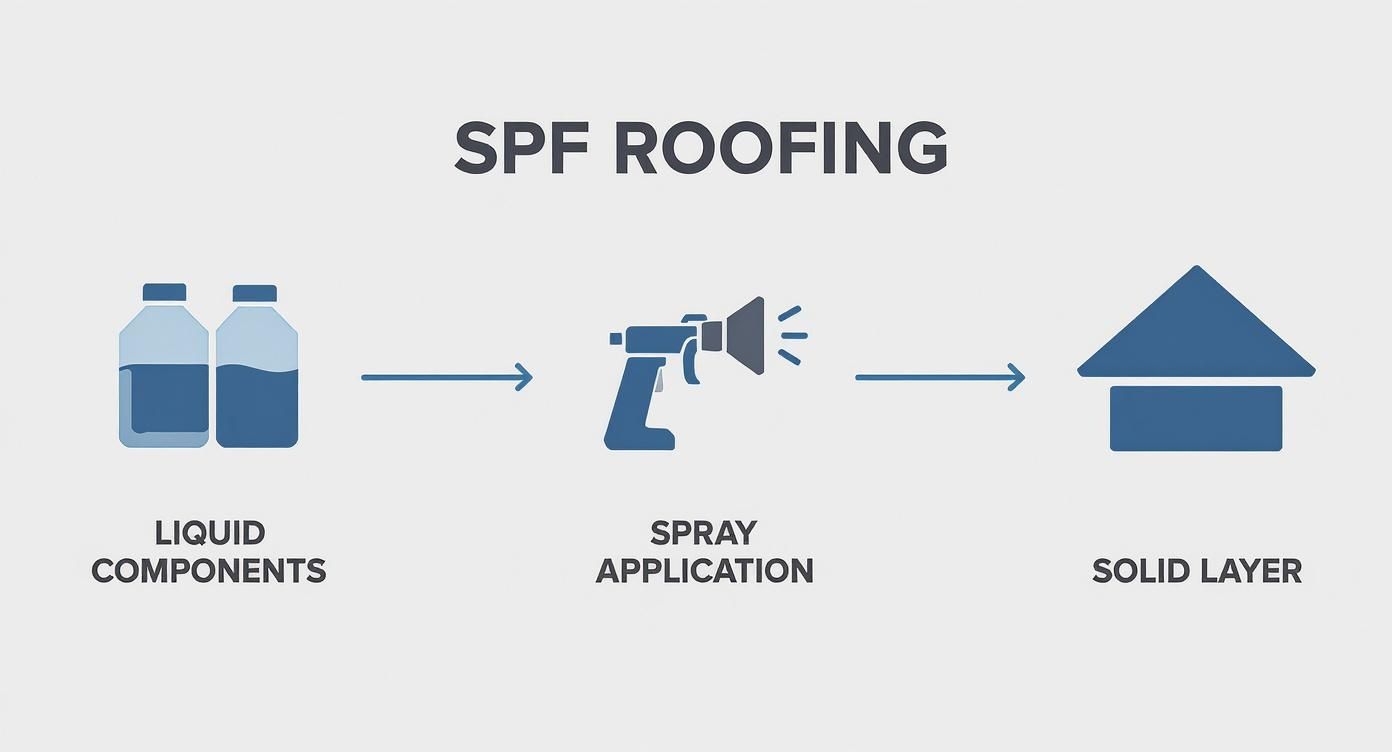
So, how does this all work? At its core, an SPF roof is the product of a chemical reaction happening in real-time. Two liquid components, an isocyanate and a polyol resin, are heated and pumped through separate hoses to a spray gun.
The magic happens when they mix at the nozzle. As the combined liquid is sprayed onto the roof, it reacts and expands up to 30 times its liquid volume in just a few seconds. This incredible expansion is what allows the foam to fill every single crack and crevice, creating that impenetrable, airtight seal we're after.
Once the foam cures, we apply a final protective layer—usually a silicone or acrylic coating. This topcoat shields the foam from UV rays and adds another layer of tough, weather-resistant protection.
This isn't just some niche product; it's a major force in the construction world. The global spray polyurethane foam market was valued at a whopping $4.7 billion in 2024 and is set to grow, thanks to rising energy costs and stricter building codes. SPF roofing is leading the way, making up about 42.8% of that market revenue as more and more building owners see the undeniable value. If you want to dive deeper into the specifics, you can check out our guide on polyurethane foam roofing benefits.
How an SPF Roof System Is Installed
Unlike traditional roofing materials that arrive in rolls or shingles, a spray polyurethane foam roof is essentially created right on top of your building. Think of it less like construction and more like chemistry in action. We transform two liquid components into a solid, seamless, and incredibly tough protective layer.
Getting a feel for this process helps you understand what separates a a high-quality, long-lasting SPF roof from a shoddy one. It's far more than just spraying a coating; it's a precise, multi-step method that ensures the system will perform for decades to come.
The Critical Preparation Phase
You can't build a strong house on a shaky foundation. That same logic applies perfectly to SPF roofing. In fact, proper surface preparation is non-negotiable—it's the single most important factor for a successful installation.
First, we get to work cleaning the existing roof surface with meticulous detail. That means removing every bit of dirt, dust, loose gravel, and debris, often using high-powered air blowers or pressure washers. Critically, the surface must be bone dry, because SPF needs a completely moisture-free deck to bond correctly.
If we find any blisters, damaged sections, or waterlogged insulation, we deal with those first. The end goal is a clean, dry, and structurally solid base that the foam can grab onto and never let go.
The Application and Expansion Process
With the surface prepped and ready, the real show begins. Our specialized roofing rig heats and pumps two separate liquids—an isocyanate and a polyol resin—through dedicated hoses up to a spray gun.
The magic happens right at the tip of that gun. The two liquids mix and trigger an instant chemical reaction. As we spray this mixture onto the roof, it expands to nearly 30 times its liquid volume in just a few seconds.
This incredible expansion is what makes SPF so effective. It allows the foam to:
- Fill every last crack and crevice, creating a truly airtight and watertight seal.
- Mold itself perfectly to the roof’s shape, flowing seamlessly around vents, pipes, and HVAC units.
- Form a single, monolithic layer with no joints or fasteners—the typical failure points on other roofs.
The whole thing is a carefully controlled process. Our certified applicators apply the foam in "lifts," usually building it up to a thickness of 1 to 1.5 inches. This ensures we hit the targeted R-value for insulation and get the necessary structural strength.
Applying the Final Protective Topcoat
On its own, the polyurethane foam is a waterproof and durable beast. But it has one weakness: the sun's ultraviolet (UV) rays. Constant UV exposure would eventually cause the foam to break down, which is why this final step is so vital.
Once the foam has cured, we apply a protective elastomeric topcoat over the entire surface. This is usually a silicone or acrylic coating that acts as the roof's armor. It serves a few key purposes:
- UV Protection: It acts like a powerful sunblock, shielding the foam from solar radiation.
- Added Durability: It creates a tough, weather-resistant finish that can easily handle foot traffic.
- Reflectivity: We often use bright white coatings that reflect the brutal Arizona sun, giving the roof's energy efficiency an extra boost.
Of course, installing any roof system requires a serious commitment to safety. Our crews are rigorously trained in all essential safety strategies for working at heights to protect our team and your property. This dedication to safety, combined with our meticulous process, is how we build a roof that truly performs.
The Real Impact on Energy Efficiency and Costs
Sure, SPF roofing is fantastic at stopping leaks, but its biggest superpower is how it slashes your building's energy consumption. This is where the initial investment really starts to pay you back, often way faster than most people think. Think of an SPF roof as a custom-molded cooler lid for your entire building, giving your HVAC system a much-needed break.
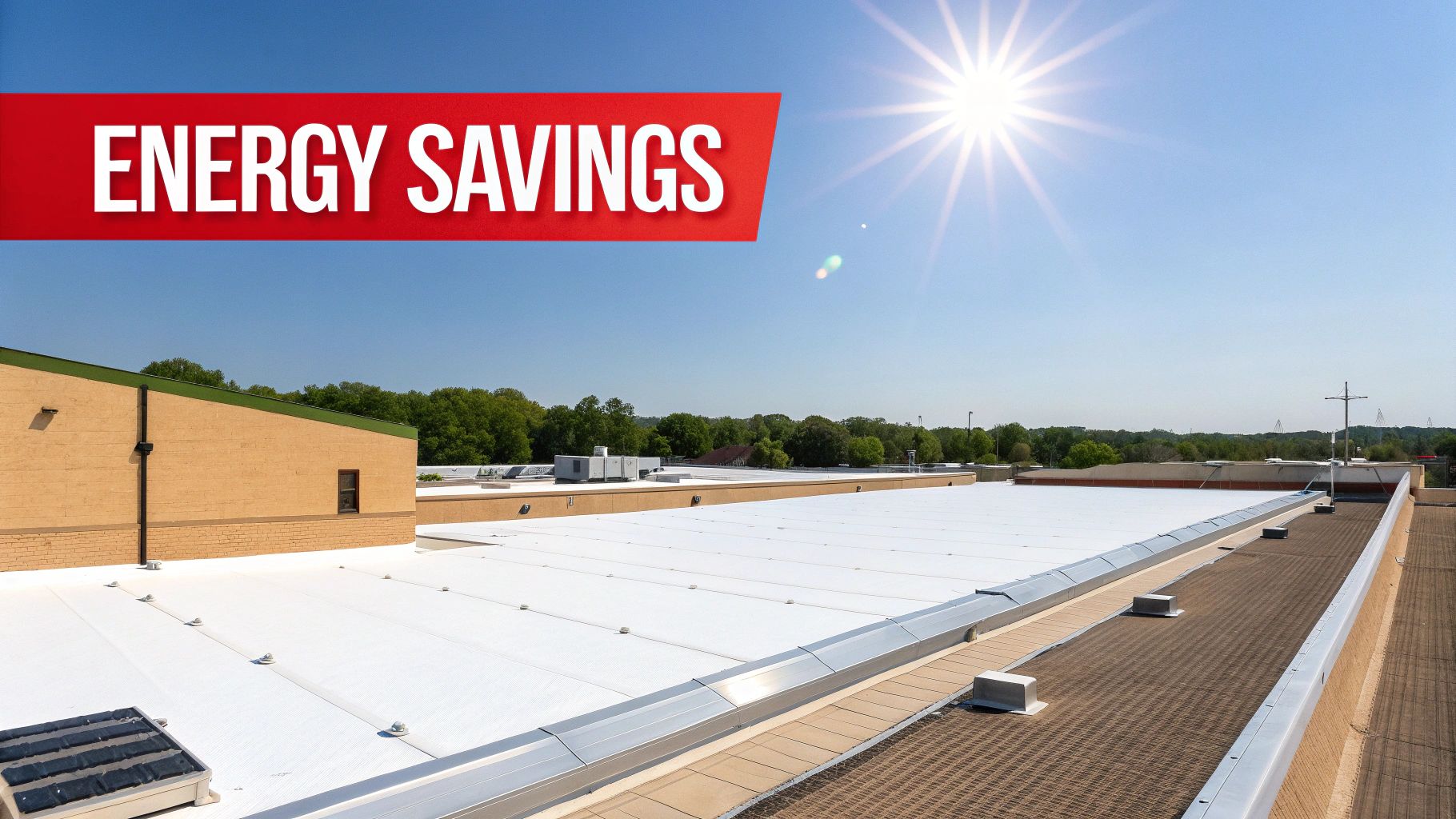
The result? Lower energy bills are just the start. You also get a more stable and comfortable indoor environment all year long. In the middle of an Arizona summer, that kind of thermal performance is an absolute game-changer for any commercial property.
Unpacking R-Value and Thermal Resistance
You hear the term R-value thrown around a lot when talking about insulation. So what does it actually mean for your wallet? Simply put, R-value measures how well a material resists heat flow. The higher the number, the better the insulation.
Spray polyurethane foam boasts one of the highest R-values out there, clocking in at around R-6.5 per inch of thickness. That’s a huge leap over most traditional insulation materials.
To put it in perspective, your roof is like a winter coat for your building. A thin windbreaker offers very little protection (low R-value). But a thick, down-filled parka traps your body heat and keeps you toasty (high R-value). An SPF roof is that high-performance parka, creating a powerful barrier that stops heat in its tracks.
We've seen studies where commercial buildings with new SPF roofs cut their energy costs so dramatically that the roof paid for itself in as little as five years just from the savings. That really drives home the long-term financial benefit of its insulating power.
This incredible thermal resistance means less of the blistering Arizona sun gets into your building during the summer, and less of your expensive heated air escapes in the winter. Your HVAC unit doesn't have to fight a constant battle, which translates directly to lower utility bills.
Eliminating The Hidden Energy Thief: Thermal Bridging
The real genius of SPF roofing is in its seamless, one-piece application. Traditional roofing systems are a patchwork of seams, joints, and thousands of metal fasteners. Every single one of those components creates a tiny superhighway for heat to travel right through your insulation—a problem we call thermal bridging.
Imagine you have a thick, warm blanket. Now, imagine someone drives hundreds of metal screws right through it. Each screw becomes a tiny heat conductor, completely undermining the blanket's ability to keep you warm. That's exactly what happens with the fasteners in most conventional roofs.
Because SPF is sprayed on as a liquid that expands into a solid, continuous layer, it has zero seams and needs no fasteners. It completely eliminates thermal bridging, creating an airtight, unbroken thermal envelope. This means you get 100% of the insulation performance you paid for, without the hidden energy leaks that plague other systems.
This isn't just a small detail; it's a factor recognized by the highest construction standards. In fact, the 2024 International Energy Conservation Code (IECC) highlights closed-cell spray foam as a top-tier air-barrier material, pushing for even stricter R-value and moisture control requirements.
Long-Term Savings and Your Return on Investment
When you combine a massive R-value with the total elimination of thermal bridging, you get a powerful one-two punch for energy savings. While the upfront cost of an SPF roof might be in the same ballpark as other commercial systems, its lifecycle cost is almost always lower.
The savings just keep adding up over time:
- Lower Monthly Bills: From day one, your heating and cooling costs drop.
- Less HVAC Strain: Your air conditioning units run less often and more efficiently, which means they last longer and need fewer costly repairs.
- Sustainable Performance: An SPF roof's insulating power doesn't break down over time, locking in those savings for decades.
Of course, the material itself is just one part of the equation. To see how different options stack up, take a look at our guide on the top efficient roofing options to lower your energy bills. At the end of the day, an SPF roof isn't just an expense—it's a smart investment in your building's long-term financial health.
Comparing SPF with Traditional Roofing Materials
When you're looking at options for a commercial roof, the choices can feel overwhelming. You’ve got traditional materials like TPO, EPDM, and Modified Bitumen, and then you have spray polyurethane foam (SPF). It's easy to get lost in pros and cons, but what really matters is how these systems hold up in the real world, year after year, under the Arizona sun.
The decision really boils down to long-term value. Sure, the upfront cost is part of the equation, but it’s the waterproofing reliability, sustained energy savings, and ease of installation that truly define the total cost of owning a roof. For any building owner, understanding these differences is the key to making a smart investment, not just a purchase.
The Critical Difference Seams Make
Here’s the single biggest distinction between SPF and just about everything else: seams.
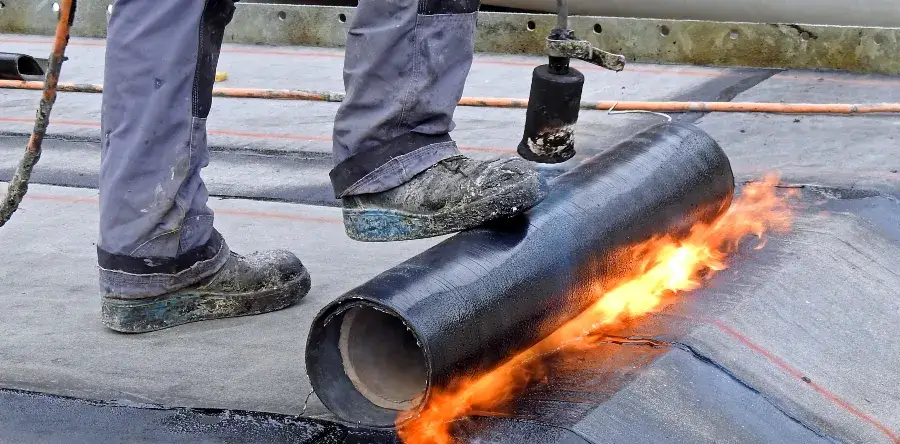
Traditional systems like TPO, EPDM, and Mod-Bit all arrive at the job site in large, factory-made rolls. The crew rolls them out, fastens them down, and then has to connect every single sheet. This process creates hundreds, sometimes thousands, of feet of seams across your roof.
And where do 90% of all roof leaks occur? You guessed it—at the seams. Over time, constant UV exposure, wild temperature swings, and the natural settling of a building all work together to weaken, separate, and crack those seams. They become the perfect entry points for water.
An SPF roof, on the other hand, is completely different. It’s applied as a liquid that expands and cures into a single, seamless, monolithic layer. It’s one solid piece from edge to edge, completely eliminating the weakest link found in almost every other roofing system. This inherently makes it a more robust and reliable waterproofing solution right from the start.
A Side-by-Side Performance Breakdown
Let’s get down to the brass tacks and see how these systems really stack up against each other. The table below breaks down the practical differences that matter most to property managers and building owners here in Arizona.
Roofing System Comparison: SPF vs. Traditional Options
| Attribute | Spray Polyurethane Foam (SPF) | TPO Membrane | EPDM (Rubber) | Modified Bitumen |
|---|---|---|---|---|
| Waterproofing | Seamless and monolithic; self-flashing around penetrations, offering superior leak protection. | Seamed system; vulnerable at welds and flashing details, especially with building movement. | Seamed system; requires adhesive at seams, which can degrade over time and cause failures. | Seamed system; torch-applied seams can be strong but are still potential points of failure. |
| Energy Efficiency | Highest R-value (R-6.5/inch); eliminates thermal bridging for maximum energy savings. | Moderate insulation value; fasteners create thermal bridging, reducing overall efficiency. | Poor insulator (typically black, absorbs heat); requires separate insulation board underneath. | Low reflectivity (dark surface); absorbs significant heat, increasing cooling costs. |
| Installation | Sprayed directly onto the roof, conforming to any shape; ideal for complex roofs with many penetrations. | Mechanically fastened or adhered sheets; installation can be complex around vents and HVAC units. | Rolled out and adhered; requires precise seam work and can be slow to install properly. | Often requires torches for application, introducing fire risk and requiring specialized labor. |
| Lifespan | 50+ years with periodic recoating every 15-20 years; fully sustainable and renewable system. | 15-25 years; seams can degrade, often requiring full replacement at the end of its life. | 20-30 years; susceptible to punctures and seam failure over its lifespan. | 10-20 years; becomes brittle with age and requires frequent maintenance and eventual replacement. |
This comparison really highlights why so many people are making the switch to spray foam. It's not just a trend; the market itself tells the story. The global SPF roofing market was valued at around $2.1 billion in 2024 and is projected to more than double to $4.3 billion by 2033. That kind of growth is driven by smart property owners looking for a roof that delivers on both energy efficiency and long-term reliability. For a deeper dive into these numbers, you can explore the market growth data on researchintelo.com.
The Self-Flashing Advantage
One of the most practical—and frankly, brilliant—advantages of SPF is its self-flashing ability. Think about a typical commercial roof. It's not just a flat, empty space. It's cluttered with HVAC units, pipes, vents, and drains.
With a traditional membrane roof, every single one of those penetrations requires custom cutting, fitting, and sealing separate flashing pieces. This creates even more seams in the most vulnerable areas. It’s tedious work, and if it isn’t perfect, it’s going to leak.
SPF technology turns this complex process into a simple one. The liquid foam is sprayed directly around each penetration, where it expands and hardens to form a seamless, waterproof seal that's fully integrated with the rest of the roof.
There’s no need for separate boots, counter-flashing, or gobs of sealant that will inevitably dry out and fail. For any roof with a lot of equipment on it, this feature alone makes SPF the most logical and durable choice, saving you from a future of maintenance headaches and leak-chasing.
How Long Does a Foam Roof Really Last?
When we talk about spray polyurethane foam (SPF) roofing, we're not talking about a quick fix. This is a long-term investment in your building, a system engineered to perform for decades. With the right care, an SPF roof can easily protect your property for 50 years or more.
What truly sets it apart is how it achieves that incredible lifespan. Unlike many traditional roofs that end up in a landfill after 15 or 20 years, an SPF system is fully renewable. You avoid the massive cost, waste, and disruption of a full tear-off, instead relying on a simple, predictable maintenance cycle.
The Secret to a 50-Year Lifespan
So, what’s the trick? It all comes down to the protective topcoat. Think of this elastomeric coating as the roof's shield, taking the brunt of Arizona's intense UV rays, foot traffic, and monsoon storms. Over the years, this coating is designed to wear down slowly and sacrificially.
The maintenance is brilliantly simple. Every 15 to 20 years, we come in, professionally clean the surface, and apply a fresh layer of coating. That's it. This recoat process restores the roof to its original, fully-protected state and essentially resets the clock on its life. It's a proactive "tune-up" that costs a fraction of a full replacement.
Built Tough for Real-World Conditions
I get asked all the time: "Is foam strong enough to walk on?" The answer is an emphatic yes. The closed-cell foam we use has a compressive strength between 40 and 60 PSI (pounds per square inch).
What does that mean for your building?
- Foot Traffic: It can easily handle HVAC technicians and maintenance crews walking on it without any issue.
- Weather Resistance: The seamless, monolithic nature of an SPF roof means there are no edges for high winds to catch and lift. It holds up exceptionally well against our harsh weather.
- Easy Repairs: While a dropped tool could create a puncture, fixing it is unbelievably simple. For minor damage, a little bit of specialized caulk is all it takes to make a permanent, watertight seal.
An SPF roof's durability comes from its solid, seamless design. By eliminating the seams and fasteners that cause most traditional roof failures, we're getting rid of the weak points from the very start.
Of course, even the toughest roof can face extreme weather. If you ever have to deal with significant storm damage, knowing how to navigate a hail damage roof insurance claim is crucial to getting things back in order quickly.
Why Your Choice of Installer Is Critical
When you buy traditional roofing materials like shingles, you're buying a finished product. It's made in a factory, you see what you get, and then it's installed. A spray polyurethane roofing system is completely different.
It’s not a pre-made material at all. It's a sophisticated chemical system that is literally manufactured, live, right on top of your building. This simple fact changes everything. It means the success or failure of your new roof—your entire investment—hinges almost entirely on the skill of the installation crew.
You aren't just hiring a roofer; you're bringing on a team of on-site chemical processing experts. The equipment is complex, the mixing ratios are precise, and even Arizona's weather conditions have to be managed perfectly. A crew that doesn't have this down to a science can leave you with an uneven mess, poor bonding, or inconsistent thickness, all of which lead to leaks and premature failure.
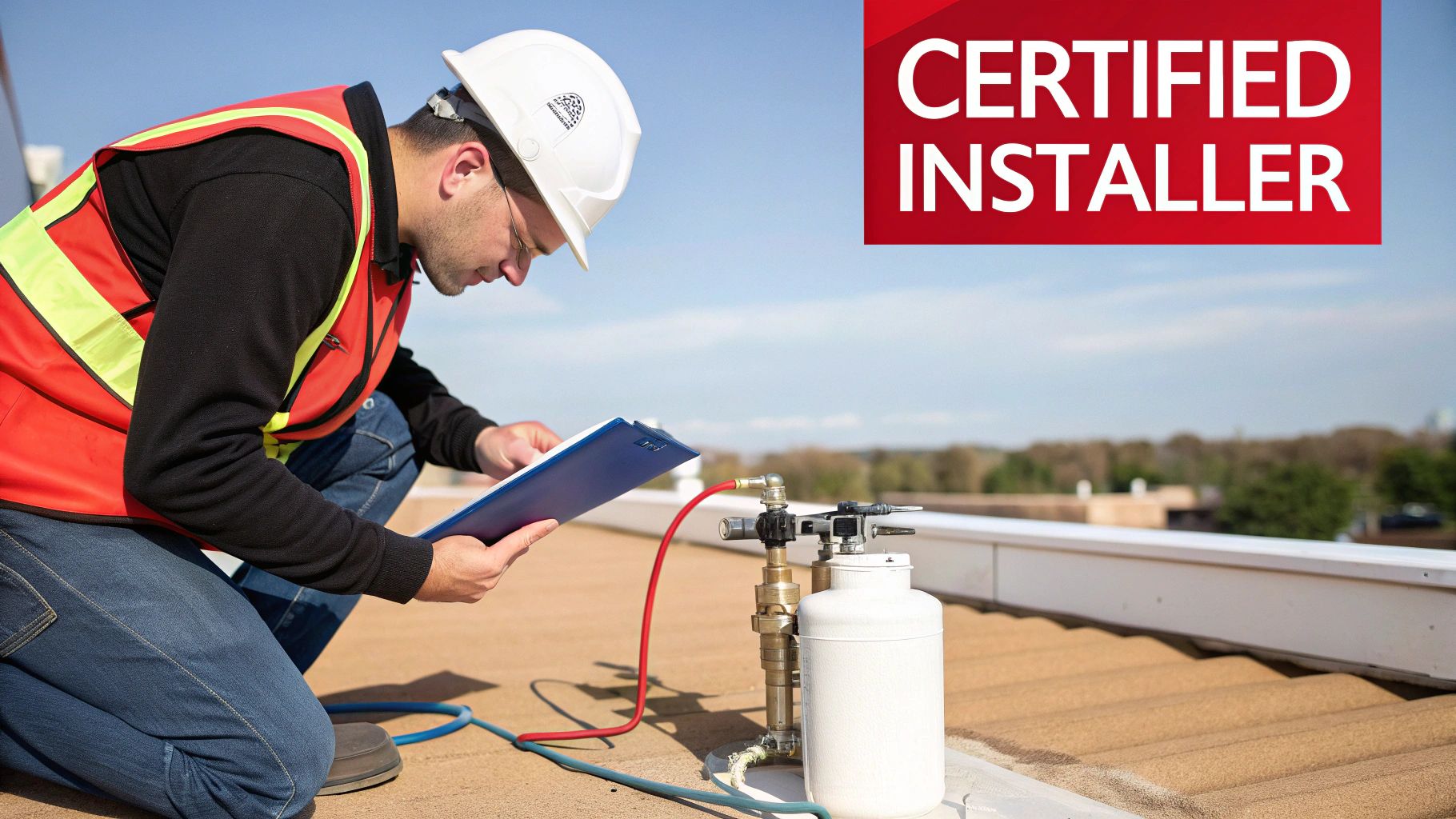
A top-tier SPF contractor transforms two drums of liquid into a seamless, waterproof, and hyper-efficient roofing asset. A subpar one just makes an expensive mess.
Credentials That Matter
When you're evaluating installers, a basic contractor's license just isn't enough. For something as specialized as SPF, you need to dig deeper for credentials that prove they've truly mastered this technology. Cutting corners on vetting your installer is a gamble you don't want to take.
Here’s what you should be looking for:
- SPFA Certification: The Spray Polyurethane Foam Alliance (SPFA) offers a Professional Certification Program, and it’s the undisputed gold standard. It proves an applicator has passed tough written exams and has documented, hands-on experience.
- A Strong Local Portfolio: Don’t just take their word for it. Ask to see their work on buildings like yours, right here in Arizona. A contractor who’s proud of their work will have a list of projects and references ready to go.
- Comprehensive Warranties: A solid warranty that covers both the materials and the workmanship is non-negotiable. It’s the company's way of telling you they stand behind the quality of their installation for the long haul.
These qualifications are your best defense against a bad installation, ensuring the team you hire understands the science and is committed to getting it right.
Vetting Your Potential Partner
Picking the right installer is the single most important decision you'll make in this entire process. You have to ask the right questions to make sure you're getting a true professional who can deliver a roof that performs for decades.
A great SPF installation is a perfect blend of science and craftsmanship. The installer must manage precise temperatures, pressures, and application speeds, all while navigating the unique challenges of your specific roof. It's a technical skill that takes years to perfect.
Before you sign anything, get clear answers about their safety protocols, how they maintain their equipment, and what their quality control process looks like on the job. For a complete rundown, our guide on how to find a good roofer offers a great checklist. It’s all about protecting your investment from day one.
Got Questions About Spray Foam Roofing? We've Got Answers.
Choosing a new roof is a big deal, and when you're looking at something as unique as spray foam, it’s only natural to have a few questions. We get it. You want to make sure you're making a smart investment for your building.
Let's walk through the most common questions we hear from property owners just like you, so you can feel confident about your decision.
The Short Answers
- How long does it last? A long, long time. With basic upkeep, an SPF roof can easily last 50 years or more. It’s a true long-term solution.
- What about repairs? Simple. Minor dings or punctures are easily patched with a specialized caulk, keeping the roof's waterproof seal intact.
- Can you walk on it? Absolutely. The foam is tough enough to handle regular foot traffic from HVAC technicians and maintenance crews.
- What roofs is it for? SPF is a rockstar on flat and low-slope commercial roofs, but it's flexible enough to handle all sorts of tricky designs and layouts.
About Installation and Timing
Can you install an SPF roof any time of year?
Not quite. Spray foam application has a sweet spot. For the chemicals to mix and cure perfectly, we need the temperature to be above 50°F. More importantly, the roof surface has to be bone-dry. That means we have to dodge rain, and even heavy morning dew can cause delays.
How long does it take to install?
This is one of the biggest wins for spray foam. Because we can often apply it directly over your existing (and properly prepped) roof, we get to skip the messy, time-consuming tear-off process. We can typically get a commercial roof done much, much faster than it takes to roll out and weld a traditional membrane roof.
On Durability and Repairs
How does a foam roof hold up against Arizona hail?
It performs incredibly well. Think of it like a dense cushion. When hail hits, the foam's high-density structure absorbs the blow, usually leaving just a small dent instead of a crack or puncture you'd see on other materials. The tough topcoat adds another layer of armor against impacts.
What if something does manage to puncture the roof?
Even though the foam is tough, a sharp, heavy object could get through. But here's the good news: the fix is unbelievably easy. A small puncture can be permanently sealed with a bit of specialized caulk in minutes—no complex welding required.
Plus, the foam itself has a closed-cell structure. This is a game-changer. It means water can't travel sideways through the foam. So, a small puncture stays a small, localized issue; it won't lead to a massive, hidden leak.
The closed-cell nature of the foam is its secret weapon. If the surface gets breached, water is trapped right there. It can't spread, which dramatically minimizes the potential damage and buys you time for a simple repair.
On Performance and Fit
Is there a strong smell during installation?
Yes, while we're spraying, there is a distinct odor as the two components react. Our crews are pros who use proper ventilation and safety gear to manage it. But once the foam cures—which happens almost instantly—it becomes completely inert and has no smell at all.
Is spray foam a good fit for any flat roof?
It’s an outstanding choice for the vast majority of commercial flat and low-slope roofs. Where it truly shines is on complex roofs—the ones covered in pipes, vents, skylights, and HVAC units. Its liquid-applied, seamless nature lets us form a perfect, monolithic seal around every single penetration. Those tricky spots, where traditional roofs almost always fail first, become completely waterproof.
Frequently Asked Questions (FAQ)
What is the typical cost of a spray polyurethane foam roof?
The cost of an SPF roof typically ranges from $5.00 to $10.00 per square foot. Factors influencing the price include the thickness of the foam required, the condition of the existing roof, ease of access to the roof, and the type of protective coating used. While the initial cost may be comparable to other systems, the long-term energy savings and longevity often result in a lower lifecycle cost.
Can an SPF roof be installed over an existing roof?
Yes, in many cases. One of the major benefits of SPF roofing is that it can be applied directly over most existing roof substrates, including BUR, modified bitumen, concrete, wood, and metal. This avoids the costly and disruptive process of a full tear-off. The key requirement is that the existing roof must be structurally sound, clean, and dry before application.
Is SPF roofing environmentally friendly?
SPF roofing offers several environmental benefits. Its high R-value significantly reduces a building's energy consumption, lowering its carbon footprint. The system is also sustainable; a foam roof can be recoated multiple times, extending its life indefinitely and keeping old roofing materials out of landfills. Additionally, the materials used have low VOCs (Volatile Organic Compounds).
How often does an SPF roof need to be maintained?
Routine maintenance is straightforward. We recommend a professional inspection at least once a year and after any major weather event to check for debris or minor damage. The primary maintenance is the recoating process, which is typically needed every 15 to 20 years to restore the UV-protective layer and ensure the roof continues to perform for another two decades.