
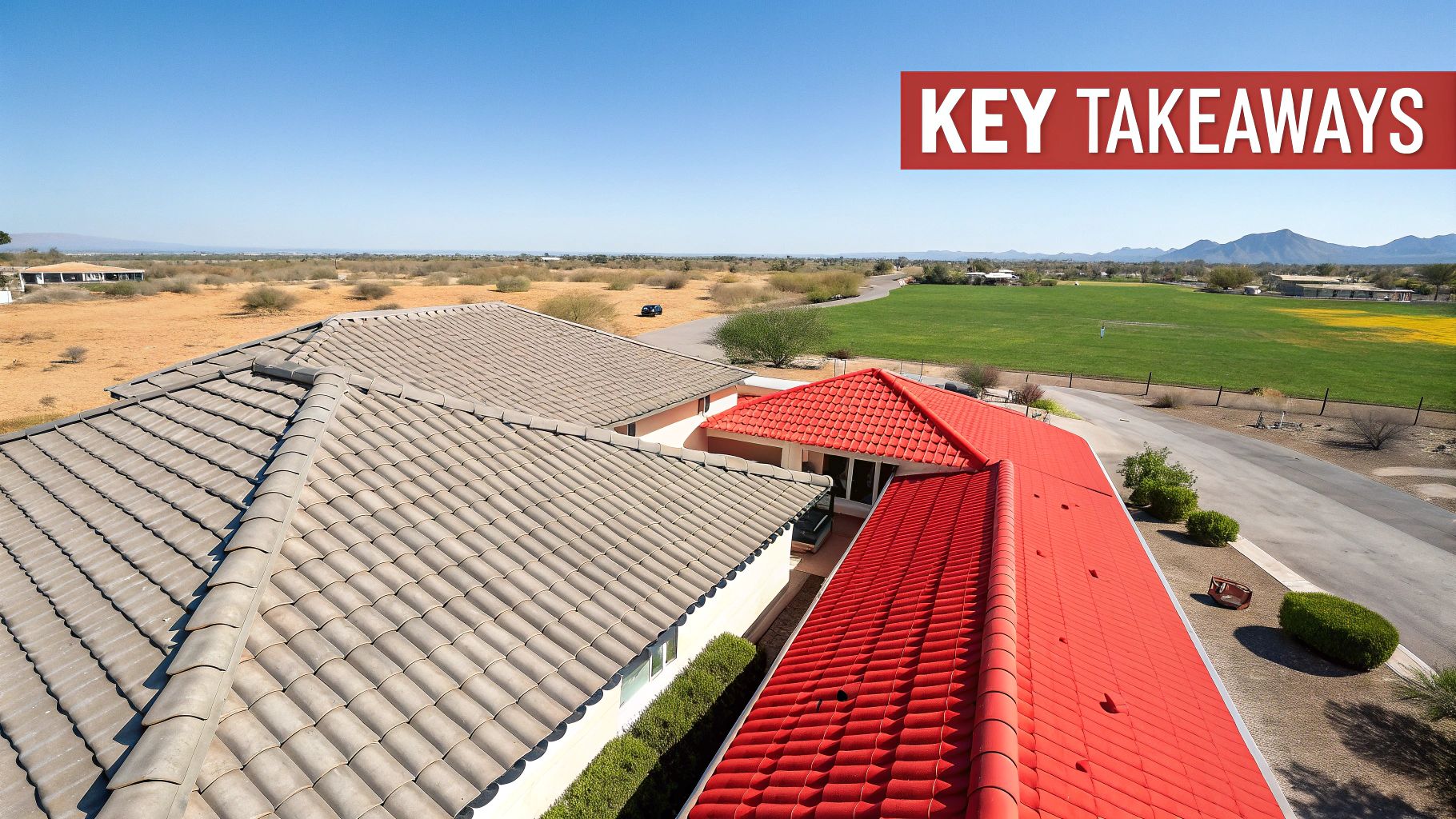
Choosing the right roofing material for your Arizona home is a significant decision. With the relentless sun, dramatic temperature swings, and intense monsoon seasons, your roof needs to be more than just a cover—it needs to be a durable, energy-efficient shield. Two of the most popular and proven options in the Southwest are clay and concrete tiles. While they may look similar from a distance, they offer distinct advantages in durability, cost, and long-term value. This guide will walk you through the critical differences between clay and concrete roof tiles, helping you make an informed investment that protects your home for decades to come.
Key Takeaways
- Longevity: Clay tiles are the long-term champion, often lasting 100+ years. Concrete tiles offer a robust lifespan of around 50-60 years.
- Cost: Concrete tiles have a lower upfront installation cost, making them a more budget-friendly option initially. Clay's higher price reflects its extended lifespan and timeless aesthetic.
- Durability: Concrete is tougher against impact from hail or debris. Clay is more brittle and can crack under direct impact but is exceptionally resistant to fading and thermal stress.
- Weight: Both are heavy materials requiring a structural assessment. Concrete is typically heavier (820-1,200 lbs per square) than clay (600-1,100 lbs per square).
- Aesthetics: Clay offers a classic, natural look with color that never fades. Concrete provides vast versatility in color and shape, though its color may soften over decades.
A Quick Comparison of Clay vs. Concrete Tiles
When you're trying to decide between clay and concrete roof tiles, the conversation almost always boils down to one thing: longevity versus upfront cost. It’s a classic trade-off. Before we get into the nitty-gritty, let’s hit the main points that usually drive the decision one way or the other.
- Aesthetics and Curb Appeal: Clay has that timeless, classic Southwestern look. Its color is baked right into the tile, so it never fades. Concrete is the chameleon, offering a huge variety of shapes and colors that can even mimic slate or wood shakes.
- Longevity and Durability: Clay is the undisputed king here, easily lasting 100 years or more when properly installed. Concrete is no slouch, though, with a solid lifespan of around 50 years.
- Cost vs. Value: Concrete almost always has a lower upfront cost. Clay’s higher initial price tag is a long-term play—its incredible lifespan often makes it a better value over the generations.
- Weight Considerations: Both are heavy, period. Your home’s structure needs to be able to handle the load. As a general rule, concrete tiles tend to be a bit heavier per square foot than most clay profiles.
For many homeowners, the choice hinges on this fundamental trade-off: Are you prioritizing long-term, multi-generational performance and classic beauty (clay), or seeking a balance of modern versatility, strength, and budget-friendliness (concrete)?
To make this even clearer, we've put together a simple table that breaks down how each material performs on the factors that matter most for Arizona homes. Think of this as your cheat sheet as we dive deeper into each topic.
Clay Vs Concrete Roof Tiles At a Glance
Here’s a straightforward breakdown to help you see the core differences in an instant.
| Feature | Clay Roof Tiles | Concrete Roof Tiles |
|---|---|---|
| Average Lifespan | 100+ years | 50-60 years |
| Upfront Cost | Higher | Lower |
| Weight | 600 – 1,100 lbs per square | 820 – 1,200 lbs per square |
| Maintenance Needs | Minimal; brittle and can crack under impact | Low; may require periodic sealing to maintain color |
| Color Fade Resistance | Excellent; color is baked-in and does not fade | Good; pigments can fade over decades of UV exposure |
| Style Options | Traditional (Spanish, Mission), natural earthy tones | Highly versatile; wide range of colors and profiles |
This table gives you a great starting point. Now, let's unpack what these differences actually mean for your home, your wallet, and your peace of mind.
Durability and Lifespan Under The Arizona Sun
How is your roof going to hold up after decades of relentless Arizona sun and punishing monsoon storms? When you're weighing clay vs. concrete tiles, durability isn't just a number on a warranty. It’s about how they age and perform in our extreme climate. The choice really comes down to a trade-off between natural resilience and engineered strength.
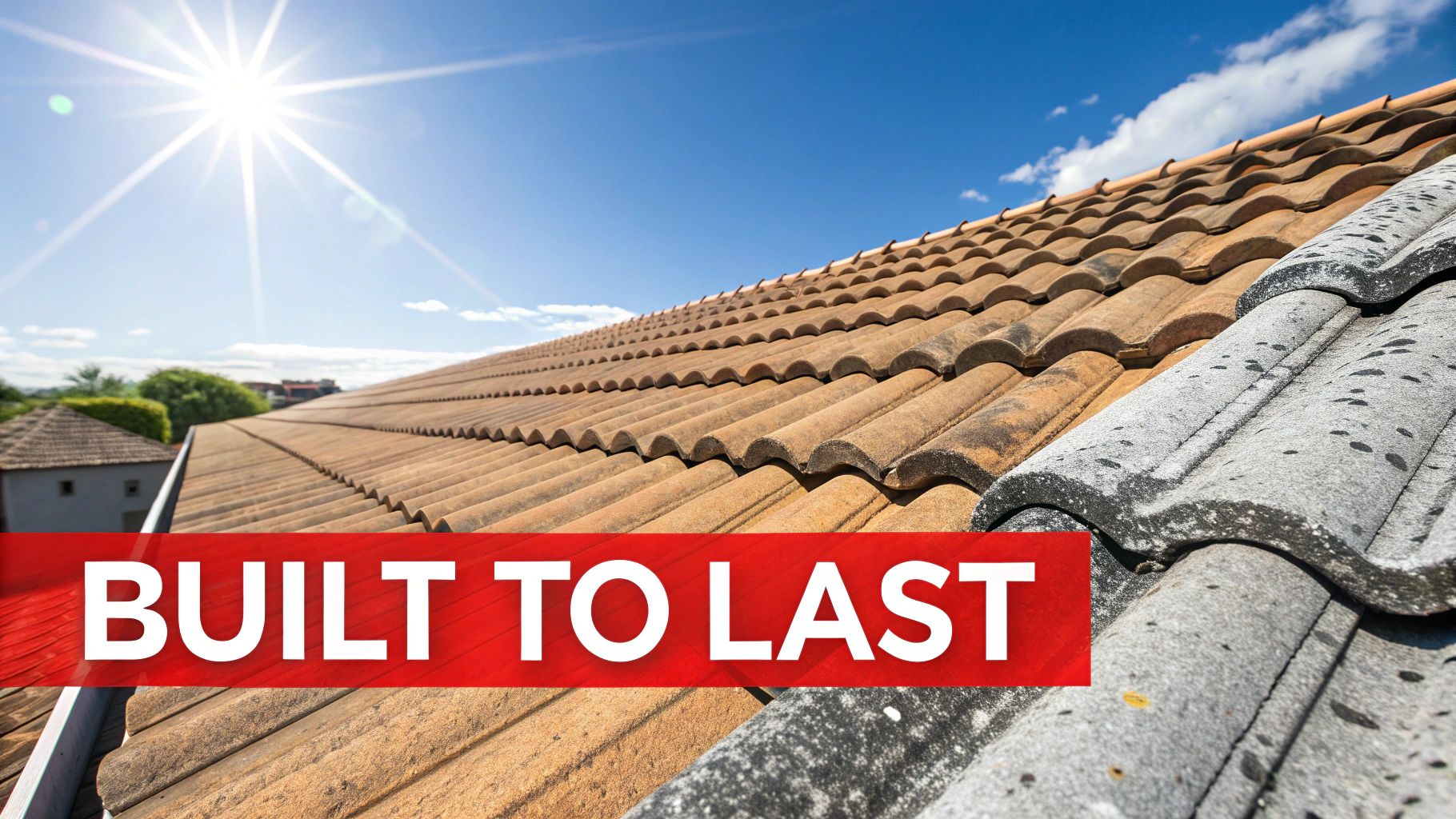
Clay tiles have been proving themselves for centuries. They are fired in kilns at over 1,000°F, a process that bakes the color right into the material itself. This makes them incredibly resistant to fading from UV radiation. A clay roof we install today will keep its rich, earthy color for a century or more.
Concrete tiles, in contrast, are a mix of sand, cement, and water, with pigments added for color. While modern technology has come a long way, the color is either a surface coat or mixed in. After a few decades of our intense sun, you'll likely notice a gradual lightening or "weathering" effect.
Coping With Extreme Thermal Stress
Arizona's climate throws a unique challenge at roofing materials: thermal stress. This is the constant expansion and contraction that happens as temperatures swing dramatically from day to night. Both clay and concrete handle this well, but in different ways.
Clay's natural porosity lets it "breathe," which helps it adapt to these daily heat cycles without cracking. Concrete’s high thermal mass, on the other hand, allows it to absorb and release heat slowly, which is great for temperature regulation. That density, however, means proper installation and spacing are absolutely critical to prevent stress fractures over its 50 to 60-year lifespan. While both are solid performers, clay’s inherent properties give it a slight edge in long-term resilience to thermal cycling.
The core difference lies in how each material ages. Clay maintains its authentic color and character for over 100 years, while concrete offers engineered strength and impact resistance but may show its age through color softening over time.
Impact Resistance from Monsoons and Hail
We don't get hail as often as other places, but when a monsoon rolls in, it can bring a sudden, intense downpour and the occasional hailstorm. This is where the debate over brittleness versus strength gets real.
Clay tiles, for all their durability against heat, are more brittle. A direct hit from a large hailstone or even a misplaced footstep during maintenance can cause a crack.
Concrete is the clear winner here. It boasts superior impact resistance—research shows concrete tiles can be up to 5 times stronger against impact than many clay types, often shrugging off hail up to two inches in diameter. This toughness is a huge plus, especially since clay's brittleness also leads to more breakage during shipping and installation.
And it’s not just your roof that needs protection from the sun. Other parts of your home, like the windows, can also be shielded. For example, a quality UV Blocking Window Film is a great way to protect your interior from damaging solar rays.
A Practical Look at Longevity
The lifespan on the box is only half the story. Real-world longevity boils down to the quality of the installation, the underlayment used, and ongoing maintenance.
- Clay Tiles: With a professional installation, a clay tile roof is genuinely a "lifetime" roof, often outlasting the people who live under it. They degrade so slowly that they need very little upkeep besides checking for cracked tiles every so often.
- Concrete Tiles: A concrete tile roof provides a dependable 50+ year service life. To keep them looking their best, they might need a fresh coat of sealant every decade or two. This helps preserve their color and stops moisture from seeping in, which can cause mildew on shaded parts of the roof.
Understanding these details is the key to knowing how your roof will truly perform over the years. For a deeper dive, check out our guide on how long a roof lasts in Arizona to see what you can expect from different systems in our climate. Ultimately, the best choice depends on what you value more: the unmatched color integrity of clay or the tough, fracture-resistant nature of concrete.
Comparing The True Cost and Long-Term Value
A new roof is a serious investment, and when you’re looking at clay versus concrete, the decision often boils down to upfront cost versus long-term return. To make the right call for your Arizona home, you need to look at the whole financial picture—not just the initial quote, but everything from labor and maintenance to what it means for your property value down the road.
Right out of the gate, concrete tiles are almost always the more budget-friendly option. The manufacturing process is just simpler and less energy-intensive than firing clay, and that translates directly to a lower price per square. It’s why concrete is such a go-to choice for homeowners and builders focused on keeping immediate project costs in check.
Clay tiles, on the other hand, come with a higher price tag. The traditional kiln-firing methods are more involved and take more time, which adds to the material cost. Think of that initial expense as an investment in a roof that can last a century and offers a classic, timeless look.
The Upfront Installation Breakdown
The cost difference isn't just about the tiles themselves; labor is a huge part of the equation. Concrete tiles are made with incredible precision and uniformity, which can make the installation process quicker and more straightforward for an experienced crew.
Clay tiles, especially the more traditional or custom profiles, demand a bit more finesse. They can be more fragile, requiring careful handling and placement to avoid breakage and ensure a perfect, watertight seal. That specialized labor often bumps up the overall installation cost.
While concrete gets you in the door with a lower initial cost, clay’s higher price is directly tied to its 100+ year lifespan and authentic aesthetic. You’re essentially deciding between paying less now or investing in value that could span generations.
Long-Term Value and Return on Investment
This is where the financial comparison really gets interesting. Clay’s ability to last 100 years or more means it can be a one-and-done investment for the entire life of your home. It holds its color beautifully and needs very little maintenance, protecting your property for decades while boosting its resale value with classic charm.
Concrete delivers a solid return with its 50-year lifespan and impressive durability. However, the intense Arizona sun can cause its color to fade over time, and you might need to have it sealed every so often to maintain its look and water resistance. When you're comparing the two, you have to consider the possibility of a whole re-roofing project decades from now, while a clay roof would just be hitting its stride.
If you look at the history, these materials took very different paths. Clay tiles have been around since ancient Roman times (around 1000 BC), valued for their insulation and durability—often lasting over 100 years. Concrete tiles are a more modern invention, really taking off after World War II during the housing boom. By 2024, concrete had captured a 33% market preference in major markets, partly because its faster installation can cut labor costs by up to 20% compared to clay. You can find more details in the roofing tiles market report on marketresearchfuture.com.
Maintenance Costs and Insurance Implications
Thinking about future repairs helps you build a realistic long-term budget. Clay tiles are more brittle, so a heavy impact from something like a falling branch could cause a crack. Replacing a single tile is usually simple, but finding an exact color match for an older, weathered roof can sometimes be tricky.
Concrete, being tougher against impact, means you’ll probably deal with fewer repairs from things like hail or debris. Beyond the initial installation, it’s also smart to review your homeowners insurance policy to understand how your choice might affect coverage. This helps you grasp the true long-term value and protect your investment from unexpected damage.
Ultimately, the best value comes from weighing the upfront savings of concrete against the incredible longevity and enduring appeal of clay.
Analyzing Thermal Performance and Energy Efficiency
Here in Arizona, your roof does a lot more than just keep the rain out—it's your home's first line of defense against the relentless desert sun. A roof that can't handle the heat forces your air conditioner to work overtime, and you see the results on your monthly energy bill. The right tile, whether it’s clay or concrete, can make a world of difference.
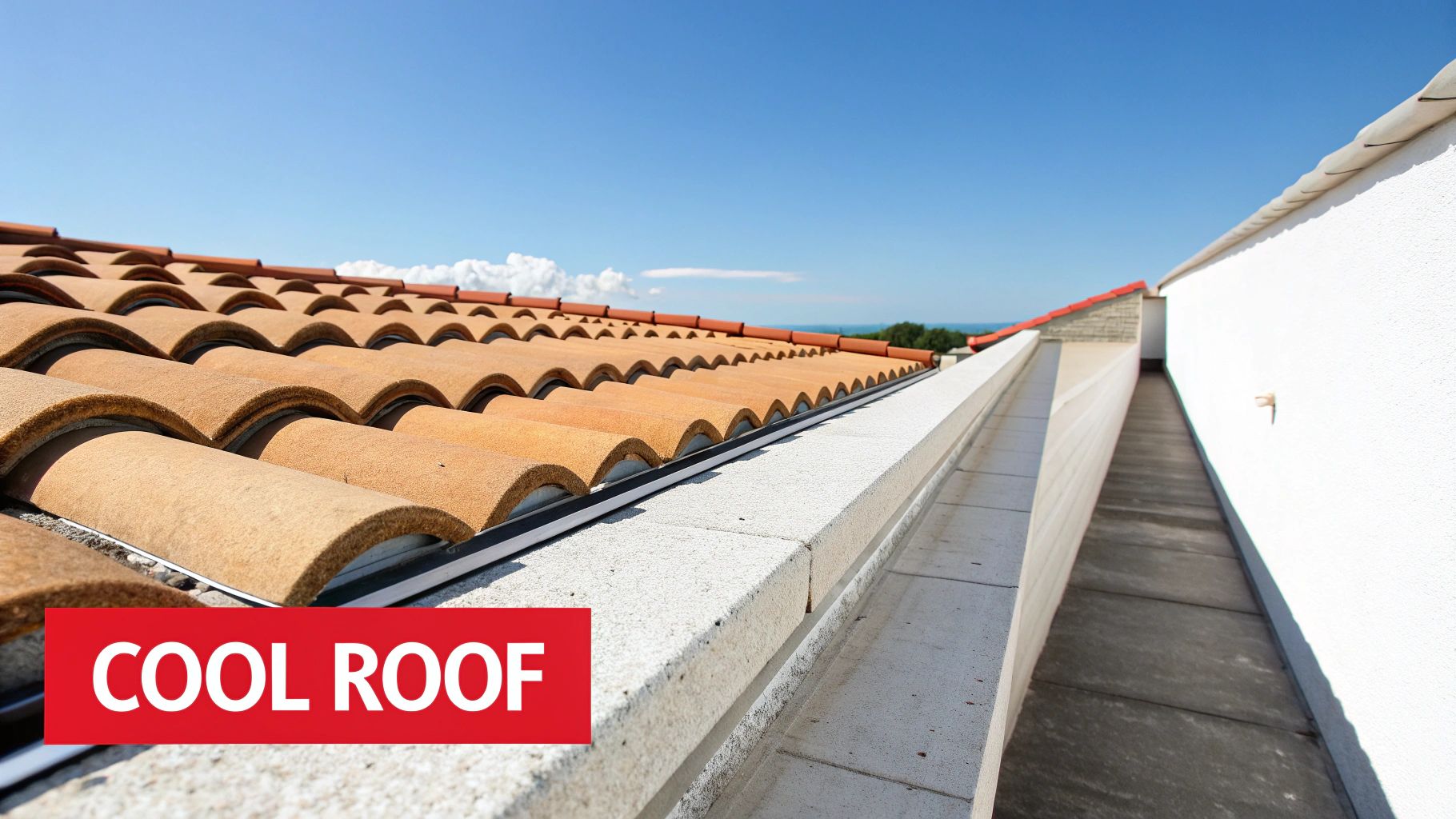
When we talk about thermal performance, we’re really looking at how well a material handles solar heat. It’s a two-part job: reflecting sunlight away from the house and stopping any absorbed heat from seeping into the attic. Both clay and concrete are fantastic at this, but they go about it in very different ways.
Clay Tiles: Natural, Time-Tested Cooling
There’s a good reason clay tiles have been the go-to choice in hot climates for centuries. Their natural properties and classic shape create a highly effective cooling system right on top of your home. It all boils down to two key features.
First, clay has a high thermal mass. That just means it heats up and cools down slowly, which helps regulate your home's internal temperature by delaying the transfer of that intense afternoon heat. Second, and maybe more importantly, is the iconic curved profile of Spanish or Mission-style tiles. That shape isn't just for looks.
That curve creates an air channel between the tiles and the roof deck. This gap is a game-changer for ventilation. As air under the tiles heats up, it naturally rises toward the peak of the roof, drawing cooler air in from the eaves. It’s a constant, passive cooling cycle that drastically cuts down on the heat that ever reaches your attic.
Concrete Tiles: High-Tech Reflectivity
Concrete tiles also have great thermal mass, but their real edge in the energy-efficiency game comes from modern technology. Manufacturers have been able to engineer "cool roof" concrete tiles with special reflective pigments and coatings designed to bounce sunlight right off.
A tile's reflective power is measured by its Solar Reflectance Index (SRI), and today's concrete tiles can achieve incredibly high SRI ratings, even in darker shades. This is possible through a couple of smart innovations:
- Cool Pigments: These are special colorants mixed right into the concrete. They reflect the invisible infrared light spectrum, which is where most of solar heat comes from.
- Reflective Coatings: A factory-applied topcoat gives the tile an extra boost in reflecting solar energy, keeping the roof's surface temperature much lower to begin with.
This technology makes concrete a versatile, high-performance option. If you're looking to dive deeper into how this all ties into your home's overall insulation, our guide explains more about the importance of R-value in roofing systems.
Research shows that clay tiles can reduce the urban heat island effect by 5-10°F more than some standard concrete options, largely due to their superior solar reflectance. In sunny climates like ours, this can translate into energy savings of up to 20% on cooling costs.
Ultimately, both clay and concrete tiles are phenomenal choices for an energy-efficient Arizona roof. Clay offers a classic, natural approach based on ventilation, while concrete brings modern reflective science to the table. Your decision will likely come down to balancing these performance benefits with your budget and the style you want for your home.
Can Your Home Handle the Weight? A Look at Structural Needs
Before you even start thinking about color or style, there's a much more fundamental question to answer: can your home's structure actually support a tile roof? This isn't a small detail—it's a critical safety and engineering checkpoint. Both clay and concrete tiles are significantly heavier than asphalt shingles, and that extra load has serious implications for your home.
For any home, but especially older ones or those switching from a lighter roof, a professional structural assessment is non-negotiable. An engineer needs to verify that your roof framing—the trusses, rafters, and decking—is strong enough to bear the constant, heavy load of a tile system for decades without sagging or failing.
How Much Heavier Are We Talking?
While both are heavyweights in the roofing world, there's a notable difference between them. The exact weight varies based on the specific profile and thickness of the tile.
- Clay Tiles: On average, clay tiles come in at 600 to 1,100 pounds per square (a 10'x10' area). Their natural composition and certain profiles allow them to be on the lighter end of the tile spectrum.
- Concrete Tiles: Concrete is the heavier of the two, typically weighing between 820 and 1,200 pounds per square. This density is great for durability, but it also puts more stress on your home's frame.
That weight difference can be a deal-breaker. A house might be perfectly fine for a lighter-weight clay tile but could require thousands of dollars in structural reinforcement to safely accommodate a heavier concrete tile.
It’s Not Just Weight—Installation Matters, Too
The installation process for clay and concrete isn't one-size-fits-all. Getting a durable, weather-tight roof depends on specialized skills and knowing the unique quirks of each material.
Take the underlayment, for instance. It's the hidden workhorse of any tile roof. Here in Arizona's heat, we always insist on a high-quality, high-temperature synthetic underlayment for either tile. But how the tiles are fastened on top can differ. Clay is more brittle, so installers have to be extra careful to avoid cracking them during installation.
Speed, Design, and Labor
Thanks to modern manufacturing, many concrete tiles are designed for a quicker, more streamlined installation. Their uniformity and interlocking profiles mean an experienced crew can often lay them more efficiently, which can sometimes translate into lower labor costs.
On the other hand, certain clay tile styles—especially historic or custom profiles—require a more methodical, craftsman-like approach. Each tile might need to be placed and checked by hand to get the alignment just right. This delivers an authentic, beautiful result but demands a higher skill level and more time on site.
Getting a handle on these structural and installation realities is key to planning your project. It ensures you choose a tile your home can actually support and helps you budget correctly for the expert labor required to build a roof that lasts.
Choosing The Right Roof Tile For Your Arizona Home
So, you’ve seen the side-by-side comparison. Now it's time to make a decision: clay or concrete? The truth is, there's no single "best" tile. The right choice for your Arizona home really boils down to what matters most to you—your budget, the style you're going for, and how long you want to think about your roof before replacing it again.
Think of it this way. Are you aiming for that timeless, authentic Southwestern look that will literally outlast the house itself? Or is your priority getting a great-looking, durable roof that offers more design flexibility without the premium price tag? Your answers will point you straight to the right material.
A Checklist for Your Decision
Let's cut through the noise. This quick checklist can help you weigh the most important factors and see which tile lines up with your priorities.
- For Classic Aesthetics & Maximum Lifespan: If you want authentic, through-body color that will never fade and a roof that can last 100 years or more, clay is the undeniable champion. It's the go-to for anyone wanting to nail that classic Spanish or Mediterranean vibe.
- For Budget-Friendliness & Design Versatility: If getting a tough, dependable roof without the higher upfront cost is key, concrete is the smarter financial play. Its real advantage is the sheer variety of profiles and colors available, letting you mimic almost any style you can imagine.
- For Ultimate Impact Resistance: Worried about monsoon hail or falling debris from a Palo Verde tree? Concrete's superior strength offers more peace of mind. It’s simply engineered to be a tougher, less brittle material than traditional clay.
- For Energy Efficiency: Both are great performers in the Arizona heat, but they work differently. Clay provides natural cooling because its barrel shape creates air channels for ventilation. In contrast, many concrete tiles use modern "cool roof" pigments to actively reflect solar radiation. It's a choice between a classic, passive cooling method and a more high-tech approach.
This decision tree shows one of the first things we, as roofers, have to consider—can your home's structure even handle the weight?
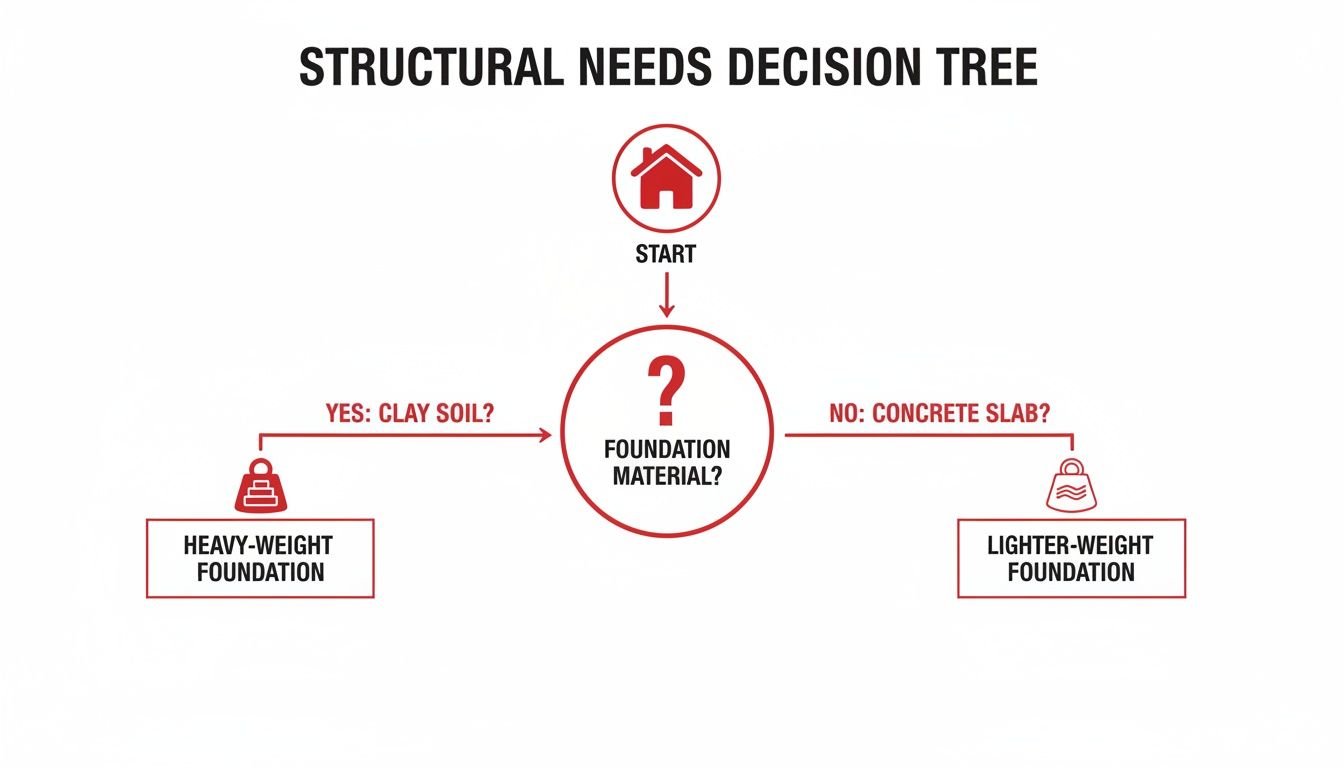
As the graphic shows, a home's foundation and framing can sometimes make the decision for you. A structural assessment is a non-negotiable first step, as the heavier load of concrete might not be an option for every home.
Tying It All Together with Professional Guidance
Of course, the final touch is picking the color and profile that perfectly complements your home. That's often the most exciting part for homeowners, and we have a whole guide dedicated to helping you find the perfect shade among the popular tile roof colors.
At the end of the day, the best roof is one you feel confident about. When you match the unique benefits of clay or concrete to what you want for your Arizona home, you're not just buying a roof—you're making an investment that will pay off for decades.
This is where working with an experienced team like AZ Roof Co makes all the difference. A true professional will start with that crucial structural assessment, give you honest recommendations based on your home and budget, and finish with an installation that’s built to last. That expertise is what ensures your new roof doesn't just look incredible but performs flawlessly under our intense desert sun.
Frequently Asked Questions
When you're deciding between clay and concrete tiles, a few final questions always seem to pop up. Making a choice you'll be happy with for decades means getting straight answers. Let's tackle the most common things we hear from homeowners right here in Arizona.
Can I install a tile roof on any house?
Not necessarily. The single most important factor is weight. Both clay and concrete tiles are substantially heavier than common materials like asphalt shingles, so your home's structure must be able to support the load. A professional structural assessment by an engineer is a mandatory first step to ensure your roof framing is strong enough before proceeding with installation.
Which tile is better for Arizona's monsoon season?
Both tiles provide excellent protection against heavy rain. However, when it comes to impact from hail or wind-blown debris, concrete has the edge. It is a denser, tougher material and less prone to cracking or shattering under impact compared to the more brittle nature of clay. For resisting the physical force of a severe storm, concrete is the more durable option.
Is it true that concrete tiles fade over time?
Yes, it's possible for concrete tiles to show some color softening over several decades. The color comes from pigments that are either mixed into the concrete or applied as a surface coating. After years of intense UV exposure from the Arizona sun, a gradual fading can occur. Clay tiles, by contrast, get their color from the natural minerals baked into them, a process that makes their color permanent and immune to fading.
What kind of maintenance does a tile roof require?
Both clay and concrete are considered low-maintenance roofing options. The best practice is to have an annual inspection, particularly after a major storm, to check for any cracked, slipped, or broken tiles. It's also important to keep roof valleys clear of debris to ensure proper water drainage. For concrete tiles, some manufacturers recommend applying a new coat of sealant every 15-20 years to help preserve the color and enhance water resistance.