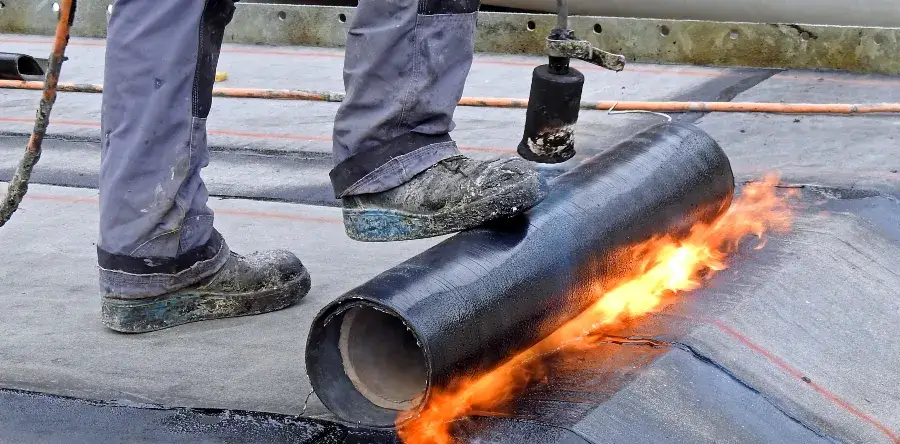

Understanding your roof's energy performance is one of the smartest things you can do as a homeowner. While terms like "R-value" might sound technical, the concept is simple: it's a measure of your roof's ability to resist heat flow. A higher R-value means better insulation, which translates directly to lower energy bills and a more comfortable home. This is especially critical in climates with extreme temperatures, where your roof is the primary defense against the elements.
This guide will break down everything you need to know about R-value roofing. We'll explain what it is, how it's calculated, and why investing in a high-performance roof system is one of the most effective upgrades you can make. By understanding the materials and strategies involved, you can make informed decisions that will pay off for years to come.
Key Takeaways
- Higher R-Value is Better: A higher R-value number indicates greater thermal resistance and better insulation. This means less heat enters your home in the summer and less heat escapes in the winter.
- It's a Complete System: Your roof's total R-value is the sum of all its layers, including shingles, underlayment, decking, and attic insulation. The attic insulation is the most significant contributor.
- Climate is Crucial: The recommended R-value for your roof depends on your specific climate zone. Homes in hot climates like Arizona require higher R-values (R-38 to R-60) to combat heat gain.
- Insulation Type Matters: Different materials offer different R-values per inch. Spray foam and rigid foam boards provide high R-values, while traditional fiberglass and cellulose are cost-effective options for attics.
- Exceeding Code Saves Money: While building codes set a minimum R-value, exceeding this standard leads to greater long-term savings on energy bills and improved home comfort.
What Is R-Value in Roofing?

Here’s a simple analogy I like to use: your roof is like a high-end travel mug for your entire house. A cheap, flimsy cup won't keep your coffee hot for long, and it definitely won't keep your iced tea from turning into a lukewarm mess. But a quality, vacuum-insulated mug works like a charm, holding the temperature for hours because it’s built to resist heat transfer.
That's exactly what R-value in roofing is all about.
A roof with a high R-value is a powerful thermal barrier. It dramatically slows down the heat trying to blast through your roof on a 110-degree summer day, meaning less of that heat ever reaches your living room. Your air conditioner gets a much-needed break and doesn't have to run constantly just to keep up.
When those surprisingly chilly desert nights roll around in the winter, the same principle works in reverse. Your roof's R-value helps trap the cozy, expensive heat your furnace is producing, preventing it from leaking out into the cold. This thermal resistance is the secret to a comfortable home and a more manageable energy bill all year long.
According to the U.S. Department of Energy, a properly insulated attic can save the average homeowner up to 15% on heating and cooling costs. This makes boosting your roof's R-value one of the smartest upgrades you can make.
Understanding R-Value and Its Impact on Your Roof
To get a real grip on why R-value roofing matters so much, you first have to understand how heat behaves. Heat is relentless—it's always on the move, trying to get from a warmer spot to a cooler one. This happens in three key ways, and your roof is the first line of defense against all of them.
Picture your roof on a blazing Arizona summer day. The sun hammers down, sending heat through radiation. Your shingles or tiles absorb that energy and pass it downward through conduction—think of how the handle of a hot skillet heats up. At the same time, the super-hot air in your attic circulates, warming your ceilings through convection.
A high R-value roofing system is built to stop this entire chain reaction in its tracks.
Think of R-Value as a Winter Coat for Your Home
The easiest way to think about R-value is to imagine a puffy winter coat. What makes a down jacket so much warmer than a thin windbreaker? It isn't just the fabric; it's the thousands of tiny air pockets trapped inside the insulation.
Those trapped pockets of air are terrible at transferring heat. When your body heat tries to escape, it gets stuck, unable to easily jump from one pocket to the next. Insulation in your roof and attic works on the exact same principle. Materials like fiberglass, cellulose, and spray foam are specifically designed to create a maze of air pockets that dramatically slows down heat transfer.
The better a material is at trapping air and resisting heat flow, the higher its R-value. It’s a direct measure of its ability to fight conduction and convection, keeping your home’s internal temperature stable regardless of the weather outside.
This resistance is the secret to energy efficiency. When your roof effectively blocks heat from getting in during the summer, your air conditioner doesn't have to run constantly to keep you cool. The same is true in reverse during the winter; that expensive heat from your furnace stays inside instead of leaking out through the ceiling.
From Lower Bills to a More Comfortable Home
A well-insulated roof does a lot more than just cut down your energy bills. It makes your home a far more comfortable place to live by getting rid of those frustrating hot spots on the top floor and reducing the temperature swings that make your HVAC system kick on and off all day. Less strain on your system means lower utility costs and can even help your heating and cooling equipment last longer.
The benefits don't stop at your wallet, either. A more energy-efficient home has a smaller carbon footprint, which is better for the environment. This isn't just a niche idea; it's a global trend. The roof insulation market is already valued at over USD 12.5 billion and is expected to grow as more people focus on sustainable building.
This drive for efficiency is why modern roofing often involves a multi-layered approach. For instance, many Arizona homeowners combine high R-value insulation with a reflective coating. You can check out our guide on elastomeric roof coating to see how these surfaces work hand-in-hand with insulation to fight the sun's heat. At the end of the day, investing in a higher R-value is a direct investment in your home's comfort, performance, and long-term value.
Comparing Common Roofing and Insulation Materials
When it comes to building a high r value roofing system, your choice of materials is everything. Not all insulation is the same; each one brings a different level of thermal resistance to the table, along with its own unique strengths and ideal uses. Getting familiar with these differences is the key to picking the perfect combination for our brutal Arizona climate.
Think of it like you're putting together a specialized team. You wouldn't ask a marathon runner to be a powerlifter. In the same way, the best material for a flat commercial roof isn't necessarily the right choice for a home with a steeply pitched roof and a traditional attic.
The goal here is to create a layered defense against the heat. Each component—from the deep insulation in your attic to the very surface of your roof—has a job to do. Let's get to know the most common players and see how they stack up.
Spray Polyurethane Foam (SPF) Insulation
Spray Polyurethane Foam, or SPF, is a heavy-hitter in the insulation world, especially for the flat or low-slope roofs we see all over Arizona. It starts as a liquid but quickly expands into a solid, seamless layer of insulation that molds perfectly to any surface, sealing every last crack and crevice along the way.
That seamless application is its superpower. SPF goes beyond just insulating; it forms a complete air and moisture barrier, stopping the drafts and leaks that can totally undermine other types of insulation. You’ll generally encounter two main types:
- Closed-Cell SPF: This is the dense, rigid stuff. It delivers a massive R-value, typically R-6 to R-7 per inch. Its tight structure makes it waterproof and actually adds a bit of structural strength to the roof itself.
- Open-Cell SPF: This version is lighter and has a spongier feel, offering an R-value of around R-3.5 per inch. While it isn't waterproof, it's a fantastic air barrier and does a great job of dampening sound.
With its incredible performance, particularly in stopping air from moving where it shouldn't, SPF is an elite choice for anyone serious about maximizing their roof's R-value. To see just how much this technology can change your home's energy use, check out our in-depth guide on polyurethane foam roofs.
Rigid Foam Board Insulation
Rigid foam boards are exactly what they sound like: large, stiff panels of insulation that are a common sight on both commercial and residential job sites. They're popular because they provide a consistent, predictable R-value in a format that's easy to handle and install in clean, uniform layers.
These boards are typically placed on top of the roof deck, right underneath the final roofing membrane. The three you'll see most often are:
- Polyisocyanurate (Polyiso): Often considered the top performer, Polyiso boards frequently come with a reflective foil face that bounces radiant heat away.
- Extruded Polystyrene (XPS): Usually pink or blue, XPS is known for being very strong and resistant to moisture.
- Expanded Polystyrene (EPS): This is the familiar white, lightweight foam you see in things like coffee cups. It’s the most budget-friendly of the three.
Of these, Polyisocyanurate (or polyiso) insulation is a real standout, boasting R-value ratings from R-5.6 to R-6.5 per inch. This makes it one of the most efficient rigid foam options out there, and it has become the go-to for designers who need to pack a lot of insulating power into a slim profile.
Traditional Attic Insulation (Batts and Blown-In)
For the vast majority of homes with sloped roofs, the attic floor is where the main battle against heat is fought. This is where traditional insulation materials like fiberglass and cellulose really get to work, as they are fantastic, cost-effective solutions for filling those big, open spaces.
- Fiberglass: You can get it in pre-cut batts that fit between joists or as a loose-fill material that's blown into place. Made from fine glass strands, it provides an R-value of R-2.9 to R-3.8 per inch.
- Cellulose: This is a fluffy, loose-fill insulation made mostly from recycled paper that’s been treated to be fire-resistant. It's great at conforming around pipes and wiring and offers an R-value of about R-3.1 to R-3.8 per inch.
This chart gives you a sense of just how important insulation is becoming. It shows the projected growth of the roof insulation market, and the trend is sharply upward.
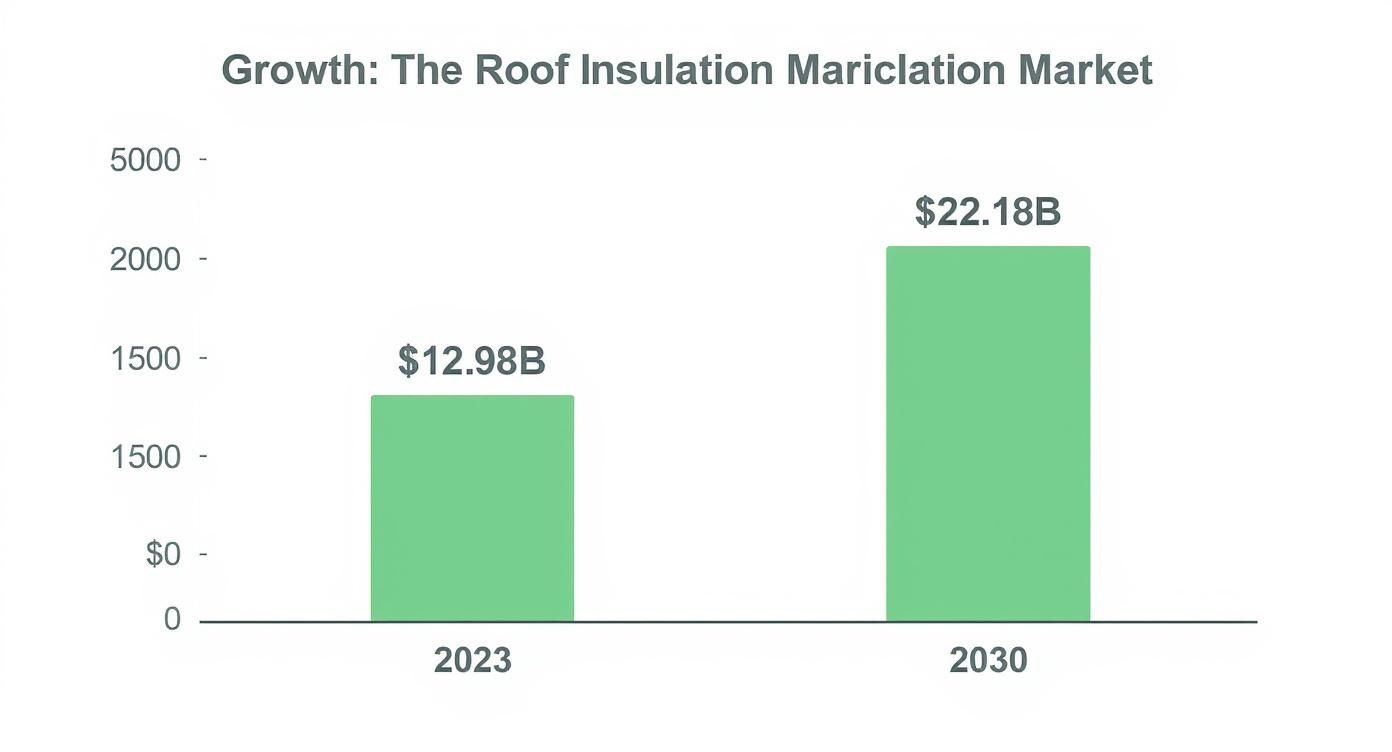
This growing demand makes it clear: homeowners and builders everywhere are realizing that high-performance insulation is a critical part of creating energy-efficient buildings.
Comparing R-Values of Common Roofing and Insulation Materials
To make things a bit simpler, here’s a quick side-by-side look at the common materials. This table breaks down their typical R-values and highlights where each one performs best, helping you see how they might fit into your own roofing project.
| Material Type | Typical R-Value (per inch) | Primary Benefit | Best For |
|---|---|---|---|
| Closed-Cell Spray Foam | R-6.0 – R-7.0 | Seamless air, moisture, and thermal barrier | Flat or low-slope roofs needing maximum insulation and sealing |
| Polyisocyanurate (Polyiso) | R-5.6 – R-6.5 | High R-value in a thin, rigid board | Commercial flat roofs and systems requiring high performance |
| Extruded Polystyrene (XPS) | R-5.0 | Moisture resistance and compressive strength | Applications where moisture or weight are concerns |
| Cellulose (Blown-In) | R-3.1 – R-3.8 | Fills irregular spaces; made from recycled content | Cost-effective attic insulation in residential homes |
| Fiberglass (Blown/Batts) | R-2.9 – R-3.8 | Widely available and budget-friendly | Standard residential attic and wall insulation needs |
Ultimately, the best choice always depends on your specific roof, your budget, and what you’re trying to achieve. Whether you’re looking for the absolute highest R-value for a flat roof or a cost-effective way to beef up your attic, there's a material designed for the job.
How Climate Zones and Building Codes Dictate Your Roof's R-Value
There’s no magic number for the perfect roofing R-value. A roof that keeps a home cozy in rainy Seattle would be completely overwhelmed by the brutal, sun-baked reality of a Phoenix summer. The right amount of insulation for your home is directly tied to where you live, and that's where climate zones and building codes step in.
Think of it like dressing for the weather. You wouldn’t wear a heavy winter coat on a 115-degree day in Tucson, and you wouldn't wear shorts during a blizzard up in Flagstaff. Your roof needs to be "dressed" for its environment to do its job, which is why we have national and local standards to create a clear roadmap for energy efficiency.
These guidelines ensure that new homes and major renovations meet a baseline for thermal performance. They're there to prevent massive energy waste and make sure your home is comfortable and efficient from the get-go.
Understanding the DOE Climate Zone Map
To make sense of insulation needs across the country, the U.S. Department of Energy (DOE) created a climate zone map. It’s a simple but brilliant tool that divides the United States into eight distinct zones based on long-term weather patterns like temperature and humidity.
- Zone 1: This is the hottest region, covering places like South Florida and Hawaii.
- Zone 2: Hot and dry or hot and humid, this zone is home to most of Arizona, including the Phoenix metro.
- Zones 3-8: As the numbers climb, the climate gets progressively colder. Zone 8 covers the most frigid parts of Alaska and northern Minnesota.
This map instantly tells you what your home is up against. Here in a hot climate like Zone 2, our homes are constantly fighting to stay cool, so our roofing R-value recommendations focus on resisting heat gain. Up north in a cold climate like Zone 6, homes are fighting to stay warm, so their codes focus on preventing heat loss.
For most of Arizona, which sits squarely in Climate Zone 2, the DOE recommends an attic R-value between R38 and R60. That high level of resistance is what it takes to create a thermal barrier strong enough to stand up to our relentless summer sun.
Building Codes: The Legal Minimum for R-Value
While the DOE offers recommendations, local building codes turn these guidelines into law. These codes aren't just friendly suggestions; they establish the legal minimum R-value your roof and attic must achieve. If you get a permit for a new roof or a major remodel, your project has to meet or exceed these requirements to pass inspection.
For example, many cities in Arizona adopt a version of the International Energy Conservation Code (IECC). This code sets specific R-value targets for every part of a building's "thermal envelope"—the roof, walls, and floors that separate you from the outdoors.
But here’s the key takeaway: meeting the code is mandatory, but you should view it as the starting line, not the finish line.
Why Exceeding the Code is One of the Smartest Investments You Can Make
The R-values required by building codes are designed to provide a reasonable, baseline level of efficiency. They're often a compromise between what’s ideal and what’s affordable for mass construction. Simply meeting the code is good. Exceeding it is almost always a much smarter long-term investment.
The code ensures your roof isn't failing; exceeding the code ensures your roof is excelling.
By adding more insulation than the minimum required—say, aiming for R-60 in your attic instead of the bare-minimum R-38—you amplify every single benefit of a high-performance roof. The payoff is huge:
- Lower Energy Bills: The upfront cost for that extra insulation is often paid back within a few years through serious savings on your monthly cooling bills.
- A More Comfortable Home: A higher R-value means a more stable indoor temperature. You'll get rid of those frustrating hot spots and notice your AC unit isn't constantly straining to keep up.
- Higher Home Value: An exceptionally energy-efficient home is a massive selling point that makes your property far more attractive to future buyers.
Investing in a higher roofing R-value is one of the most effective upgrades you can make, delivering real, tangible returns in comfort and cost savings for years to come.
How Do You Figure Out Your Roof's Total R-Value?
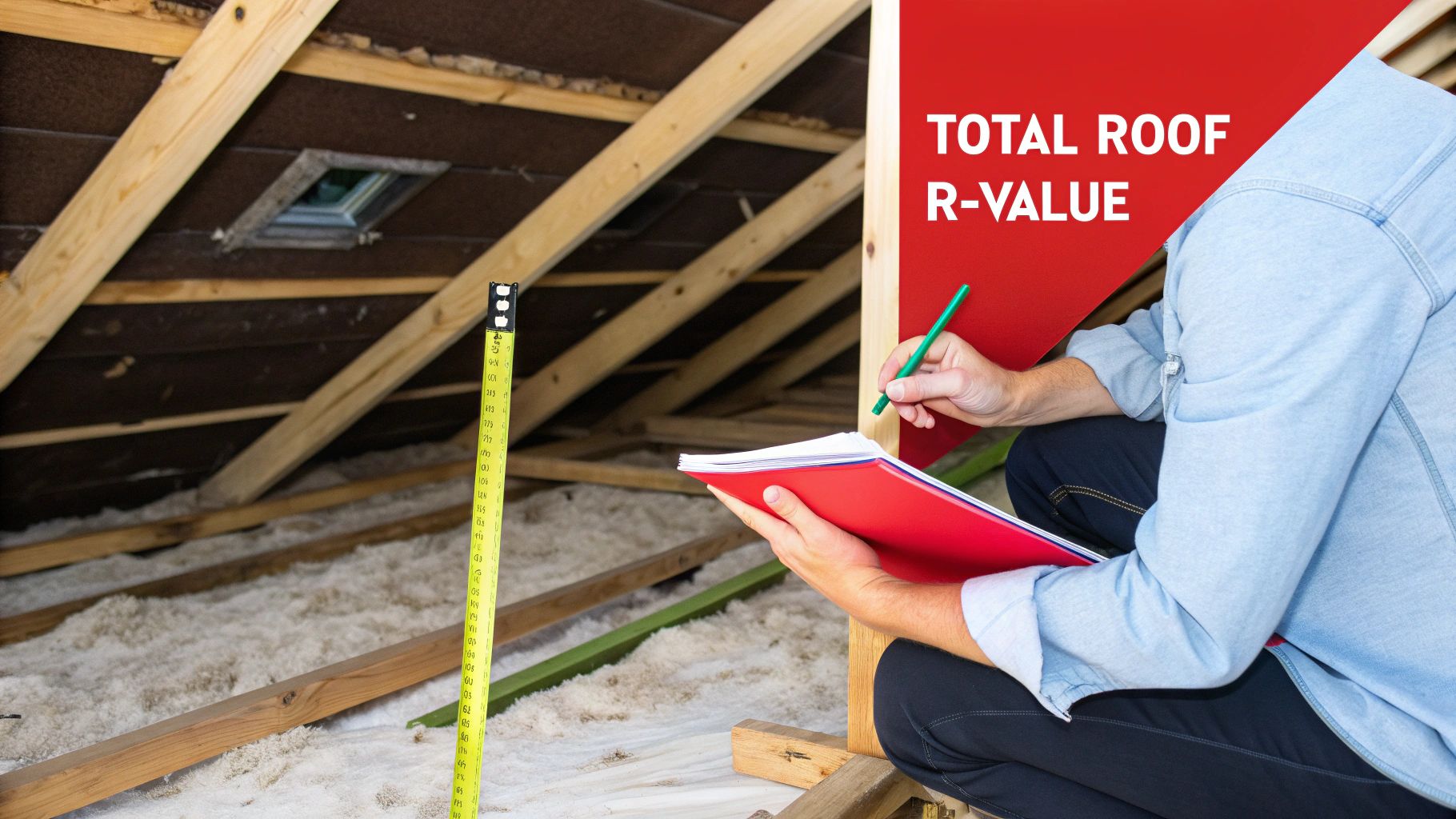
Think of your roof's ability to resist heat as a team effort. It’s not just one material doing all the work; it's a layered system. The total R-value of your roofing is simply the sum of all its parts, from the shingles you see on the outside all the way down to the insulation in your attic.
Figuring out this number is the first step to understanding your home's energy performance. Once you know your roof's total R-value, you'll have a much clearer picture of how well it's defending your home against the brutal Arizona sun and where you can make the biggest improvements.
Adding Up the Layers
Calculating your roof's total R-value is surprisingly straightforward. It's just a matter of adding up the R-value of each layer in your roof assembly.
Here’s how you can break it down:
- List Every Layer: Mentally (or on paper), stack up all the materials from the outside in. This usually includes your shingles, the underlayment, the wood roof deck, and of course, the attic insulation.
- Find the R-Value for Each: Every material has an R-value, though some are much higher than others. Your attic insulation is the powerhouse, but the other layers do contribute.
- Do the Math: Add all those individual R-values together. That final number is your roof's total thermal resistance.
Let's Look at an Example:
- Asphalt Shingles: R-0.44
- Roofing Felt (Underlayment): R-0.06
- 1/2" Plywood Roof Deck: R-0.62
- 10 inches of Fiberglass Insulation (at R-3.0 per inch): R-30.00
Total System R-Value = R-31.12
As you can see, the roofing materials themselves offer a little bit of insulation, but the attic insulation is the real hero here. In this common scenario, it accounts for over 95% of the roof's total insulating power.
How to Check Your Current Insulation
The biggest variable in this equation is your attic insulation, so that's where you need to start. This usually means a quick (and safe!) trip up into the attic. Grab a flashlight and a tape measure, and be extremely careful to only step on the wooden joists. Never put your weight directly on the ceiling drywall below.
Once you’re safely in position, here’s what to do:
- Measure Its Depth: Find a nice, level spot and stick your tape measure straight down through the insulation until you hit the hard surface of the ceiling. Note the depth in inches.
- Identify the Type: What does it look like? Is it the fluffy pink, yellow, or white stuff (fiberglass)? Or is it a grayish, shredded-paper-like material (cellulose)?
- Look for Problems: Keep an eye out for any red flags. Are there areas where the insulation is compressed, damp, or missing altogether? These are thermal weak spots where your conditioned air is escaping.
With the depth measured, you can do a quick calculation. For example, 10 inches of fiberglass with an R-value of R-3.0 per inch gives you a total of R-30. This simple check-up gives you the biggest piece of the r-value roofing puzzle. This focus on thermal performance is a major reason the global roofing materials market is growing, as people everywhere prioritize energy efficiency. You can read the full research about the roofing materials market to learn more about industry trends.
Taking the Next Steps Toward a High-Performance Roof
Alright, you've got the theory down on r value roofing. But knowing what R-value is and actually doing something about it are two different things. Let's walk through how you can turn that knowledge into a more comfortable home and lower energy bills.
The best place to start? Get a professional opinion. You can guess where your roof is failing, but an expert with a thermal imaging camera can show you exactly where you’re bleeding hot or cool air. Scheduling a comprehensive roof inspection or a full energy audit takes the guesswork out of the equation, ensuring you put your money where it'll do the most good.
Common Upgrade Paths
Once you have a clear picture of your roof's weak spots, you can start exploring your options. These can range from simple fixes to a complete overhaul, depending on your needs and budget.
- Boost Your Attic Insulation: This is the low-hanging fruit for most homes. If your attic is under-insulated, having a pro blow in more fiberglass or cellulose is often the fastest and most affordable way to make a huge difference in your roof's overall R-value. It’s a no-brainer.
- Seal Up the Leaks: Before you even think about adding more insulation, you have to plug the holes. Air leaks around recessed lighting, vents, and attic hatches can sabotage even the best insulation. Sealing these gaps is a critical first step.
- Go for a Full Roof Replacement: If your current roof is on its last legs anyway, this is the golden opportunity. When you tear everything off, you can build a truly high-performance system from scratch, layering in rigid foam or using spray foam insulation to create a powerful thermal barrier.
Investing in a higher R-value roof is one of the smartest upgrades you can make for your home's long-term value, comfort, and sustainability. For property owners, understanding how energy efficiency adds value to your premium rental can also be a key factor in maximizing your return on investment.
Don't Forget the Financial Perks
Before you write a check for the full amount, make sure you're not leaving money on the table. Plenty of programs out there are designed to help you pay for these kinds of energy-saving upgrades.
For instance, you might be eligible for the Energy Efficient Home Improvement Credit. This can cover 30% of the cost of your insulation materials, with a cap of $1,200. On top of that, don't forget to check with your local Arizona utility company—they often have their own rebate programs for homeowners who make their homes more energy-efficient.
Stacking these incentives can seriously cut down your out-of-pocket costs, making a top-tier roof much more affordable. To dig deeper into specific materials that can help you save, take a look at our guide on the top efficient roofing options to lower your energy bills.
Frequently Asked Questions (FAQs)
What is the recommended R-value for a roof in a hot climate?
For hot climates like Arizona (DOE Climate Zone 2), the recommended R-value for an attic is typically between R-38 and R-60. This high level of insulation is necessary to effectively resist the intense solar heat gain during the long summer months, keeping your home cooler and reducing the load on your air conditioning system.
Can you have too much insulation in your attic?
Yes, it is possible to have issues if insulation is installed improperly, even with a high R-value. The primary concern is blocking ventilation. Your attic needs proper airflow (e.g., through soffit and ridge vents) to exhaust moisture and excess heat. If insulation is packed too tightly against the roof deck or blocks vents, it can trap moisture, potentially leading to mold, mildew, and rot. The goal is a high R-value combined with a well-ventilated space.
Does insulation's R-value decrease over time?
Unfortunately, yes. The effectiveness of insulation can degrade over time due to several factors. Moisture from a roof leak can saturate insulation, causing it to compress and lose its thermal resistance. Physical compression from storing items on it or pest infestations (rodents, insects) can also create channels and gaps, significantly reducing its R-value. Regular inspections can help identify and address these issues.
What is the difference between R-value and a radiant barrier?
Insulation (measured in R-value) and radiant barriers both improve energy efficiency, but they work differently. Insulation slows down heat transfer through conduction and convection by trapping air. A radiant barrier is a highly reflective material (like foil) that reflects radiant heat. In hot climates, installing a radiant barrier on the underside of your roof deck in combination with high R-value attic insulation provides a powerful one-two punch against summer heat.