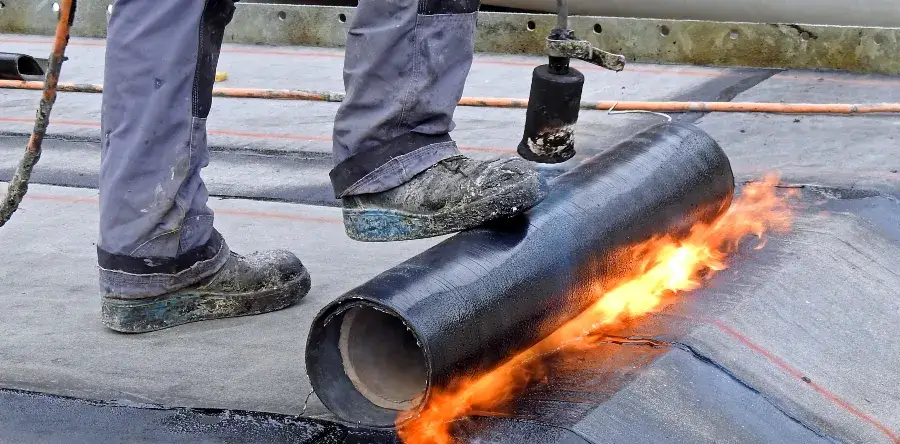

Living in a hot climate means waging a constant battle against the sun. As temperatures soar, your roof takes the brunt of the heat, turning your attic into an oven and forcing your air conditioner to work overtime. While it's easy to get lost in technical terms like R-values, the key to winning this battle isn't just about piling on thick insulation. It's about a smarter, two-pronged approach: reflecting the sun's intense radiant heat away before it gets in, and then stopping any remaining heat with high-performance insulation.
This guide will cut through the confusion, showing you exactly which materials and strategies work best under the relentless sun. We'll break down why a combination of a radiant barrier and an air-sealing insulator like spray foam is the undisputed champion for keeping your home cool and your energy bills down.
Key Takeaways
- Radiant Heat is the #1 Enemy: In sunny regions, a staggering 93% of the heat penetrating your ceiling comes from the sun's radiant energy. The most effective strategy starts with reflecting this heat away.
- A Hybrid Approach is Best: Combining a radiant barrier with a high-performance insulator like spray foam or blown-in cellulose provides the most comprehensive protection against all forms of heat transfer.
- Ventilation is Crucial: Proper attic ventilation is the essential partner to good insulation. It creates airflow that pushes out trapped hot air, preventing your attic from becoming a giant radiator above your living space.
- Air Sealing Stops Leaks: Insulation that also seals air leaks, especially spray foam, is a game-changer. It stops hot air from infiltrating your home through the countless small gaps and cracks in your attic.
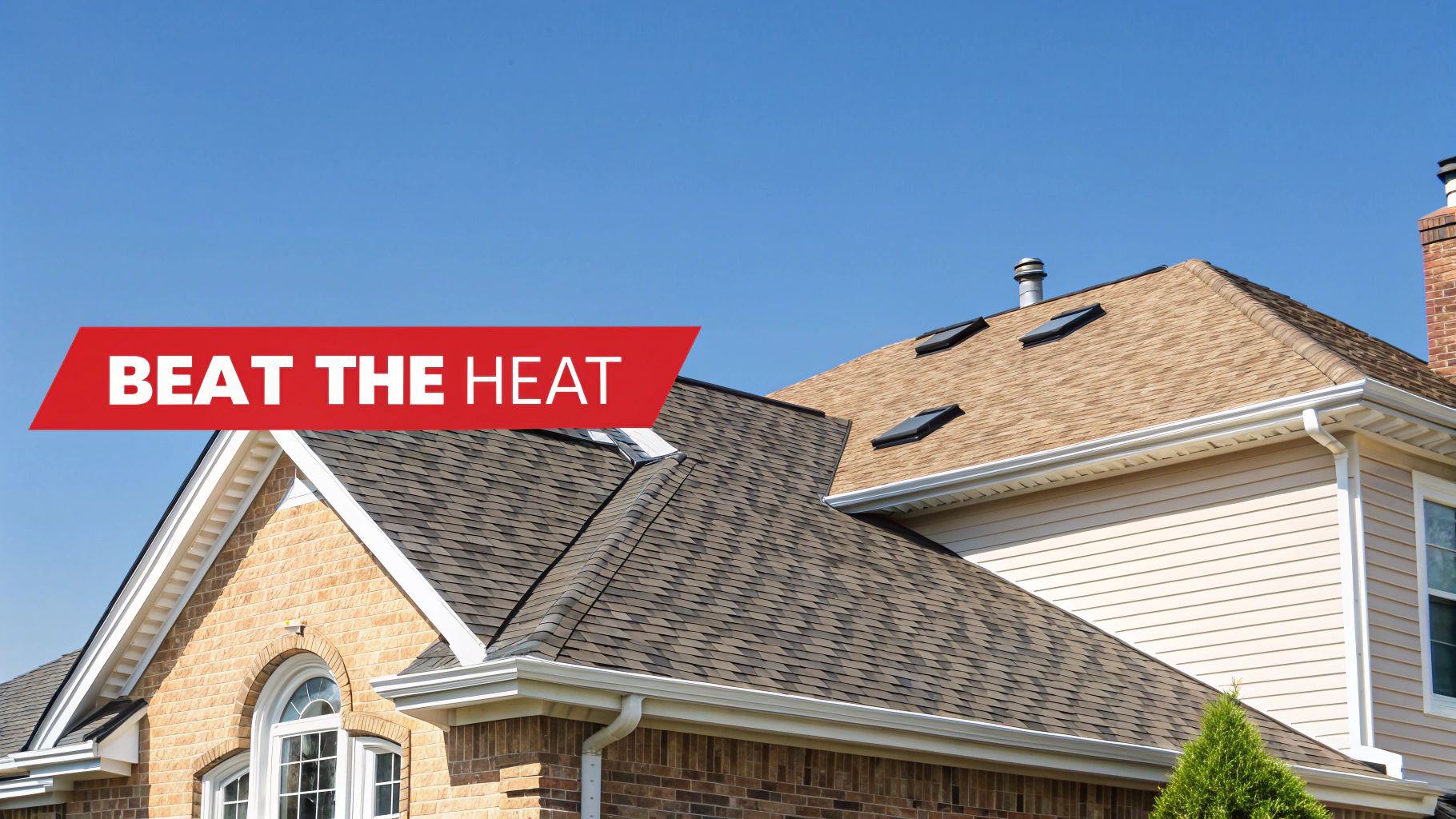
Top Insulation Choices for Hot Climates at a Glance
To cut through the noise, here's a quick look at the most effective insulation types for combating intense heat. This table breaks down what they do best and where they shine.
| Insulation Type | Primary Benefit | Performance Metric | Ideal Scenario |
|---|---|---|---|
| Radiant Barrier | Reflects radiant heat | Reflectivity (up to 97%) | Paired with other insulation in any attic |
| Spray Foam | Insulates & air seals | R-Value & Air Permeability | Complex attics; new construction; whole-home sealing |
| Reflective Coating | Reflects solar energy | Solar Reflectance Index (SRI) | Flat or low-slope roofs |
| Blown-In Cellulose | Resists conductive heat | R-Value (per inch) | Cost-effective upgrade for existing attics |
Each of these plays a specific role, but you can see how combining them—like a radiant barrier with spray foam—creates a truly powerful defense against the heat. And while a well-insulated roof is your top priority, don't forget about other weak points. Simple additions like insulated and thermal curtains can make a surprising difference in rooms that get a lot of direct sun.
Understanding How Heat Actually Enters Your Home
To pick the right insulation for a hot climate, you first have to understand the enemy. Heat wages a three-pronged attack on your home, and knowing how each method works is the key to building an effective defense.
Think of your home as a fortress. Heat is constantly trying to find a way in, especially under the relentless Arizona sun. It uses different tactics, so a one-size-fits-all approach just won’t cut it.
The Three Types of Heat Transfer
Heat makes its way into your home through three distinct mechanisms. Each one requires a different strategy to stop it in its tracks.
- Conduction: This is heat moving through direct contact. It’s why you feel the heat when you touch a hot pan. In your home, the sun bakes your shingles, which then transfer that heat directly to the roof deck, the rafters, and everything else they touch, right down into your attic.
- Convection: This is heat transfer through the movement of air. It’s how a space heater warms up a room—by heating the air, which then circulates. In an attic, this process creates swirling pockets of super-heated air that transfer warmth to your ceiling and the insulation below.
- Radiation: This is the big one for sunny climates. Radiant heat travels in electromagnetic waves, just like the warmth you feel on your face from a distant campfire. The sun bombards your roof with this radiant energy all day long. Your roofing materials absorb it and then radiate it downward into the attic.
In a climate like Arizona's, radiant heat is the primary culprit, accounting for up to 93% of all heat gain through your ceiling. This is exactly why piling on more traditional insulation often doesn't solve the core problem.
Why R-Value Alone Isn't Enough
For decades, R-value has been the standard for measuring insulation. It’s a measure of how well a material resists conductive heat flow. While it's certainly important, it only tells part of the story.
In a battle dominated by radiant heat, relying only on R-value is like bringing a great shield to a fight but having no defense against a volley of arrows. Traditional insulation like fiberglass or cellulose is designed to slow down heat that’s already made its way into your attic through conduction and convection. It does very little to stop radiant heat from getting in to begin with.
This is where you need to start thinking about reflectivity and emissivity. A highly reflective material, like a radiant barrier, literally bounces that solar energy away before it can be absorbed. A material with low emissivity is poor at radiating the heat it does absorb. Together, these two properties create the first line of defense against the sun's most powerful weapon.
Of course, the roof isn't the only entry point. Windows are another huge source of heat gain, but you can combat that with solutions like solar screens for windows.
Once you grasp this science, it becomes clear why a complete system is so crucial. You need something that reflects radiant heat and resists conductive heat. It’s about fighting smarter, not just harder.
Comparing the Leading Roof Insulation Materials
When you're trying to pick the right insulation for an Arizona roof, looking only at the R-value is a rookie mistake. Here, it's a battle against intense radiant heat from the sun, so you need a solution that can handle that specific threat while also managing air leaks and potential moisture. Let's break down the heavy hitters to see how they actually perform in our demanding climate.
Spray Foam Insulation: The Air Sealing Champion
Spray Polyurethane Foam (SPF) is in a class of its own because it acts as both insulation and a powerful air barrier. It’s sprayed on as a liquid that expands on contact, filling every single gap and crack to create a seamless, airtight seal. This unique application makes it fantastic at stopping both air movement (convection) and direct heat transfer (conduction).
But not all spray foam is created equal. The two main types have some critical differences, especially for a hot, dry place like Arizona.
Open-Cell Spray Foam
Think of open-cell foam as a dense sponge. It's lighter and more flexible because its tiny cells are left open. This not only makes it a great sound deadener but also impacts how it handles heat and moisture.
- Thermal Performance: You can expect an R-value of around R-3.5 to R-4.0 per inch.
- Air Sealing: It does an excellent job of stopping drafts and sealing the attic from hot air infiltration.
- Moisture Management: Open-cell is vapor-permeable, which means moisture can pass through it. This can be a good thing, as it allows the home's structure to dry out if a leak ever happens.
Closed-Cell Spray Foam
Closed-cell foam is the tough guy. It’s much denser and more rigid because its cells are completely sealed and filled with a special gas that boosts its insulating power. This makes it a superior thermal barrier and even adds a bit of structural strength to whatever it's applied to.
- Thermal Performance: This is where it shines, with a high R-value between R-6.0 and R-7.0 per inch.
- Air Sealing: It creates a completely impermeable air barrier, shutting down all air movement.
- Moisture Management: Because it's a vapor barrier, it blocks moisture entirely. This is fantastic for preventing moisture issues but requires an expert installation to ensure you don't accidentally trap water where it shouldn't be.
The Real Difference: In a hot climate, the main reason to choose closed-cell foam is its massive R-value in a slim profile. You get maximum insulation without eating up a ton of attic space, making it the undisputed king for sealing tricky rooflines or in homes with limited overhead room.
Many homeowners don't just insulate their attic with spray foam; they make it part of the roof itself. Our guide on polyurethane foam roofing explains how this system applies the insulation to the exterior of the roof deck, creating a truly robust and efficient barrier.
Radiant Barriers: The Radiant Heat Reflector
Traditional insulation works by slowing down heat transfer. Radiant barriers play a different game entirely—they reflect it. Think of it like a giant sheet of aluminum foil for your attic, usually stapled to the underside of the roof rafters.
You don't measure a radiant barrier's performance with an R-value. Instead, it’s all about reflectivity and emissivity. A good radiant barrier can bounce back up to 97% of the sun's radiant energy, stopping it dead in its tracks before it can even start to cook your attic.
- Thermal Performance: It's most effective when facing an air gap. By reflecting so much heat, it can lower attic temperatures by as much as a staggering 30°F.
- Moisture Resistance: It doesn't absorb water, but the installation must be done correctly to allow for airflow and prevent condensation from forming.
- Cost-Effectiveness: Radiant barriers deliver a fantastic return on investment. They're relatively affordable and you'll feel the difference in your cooling bills almost immediately.
The Real Difference: A radiant barrier isn't meant to be your only insulation, but it’s an incredible force multiplier. Its genius is in how it tackles the biggest threat in Arizona—radiant heat—which in turn makes your existing insulation work much, much better.
Rigid Foam Boards: The Flat Roof Specialist
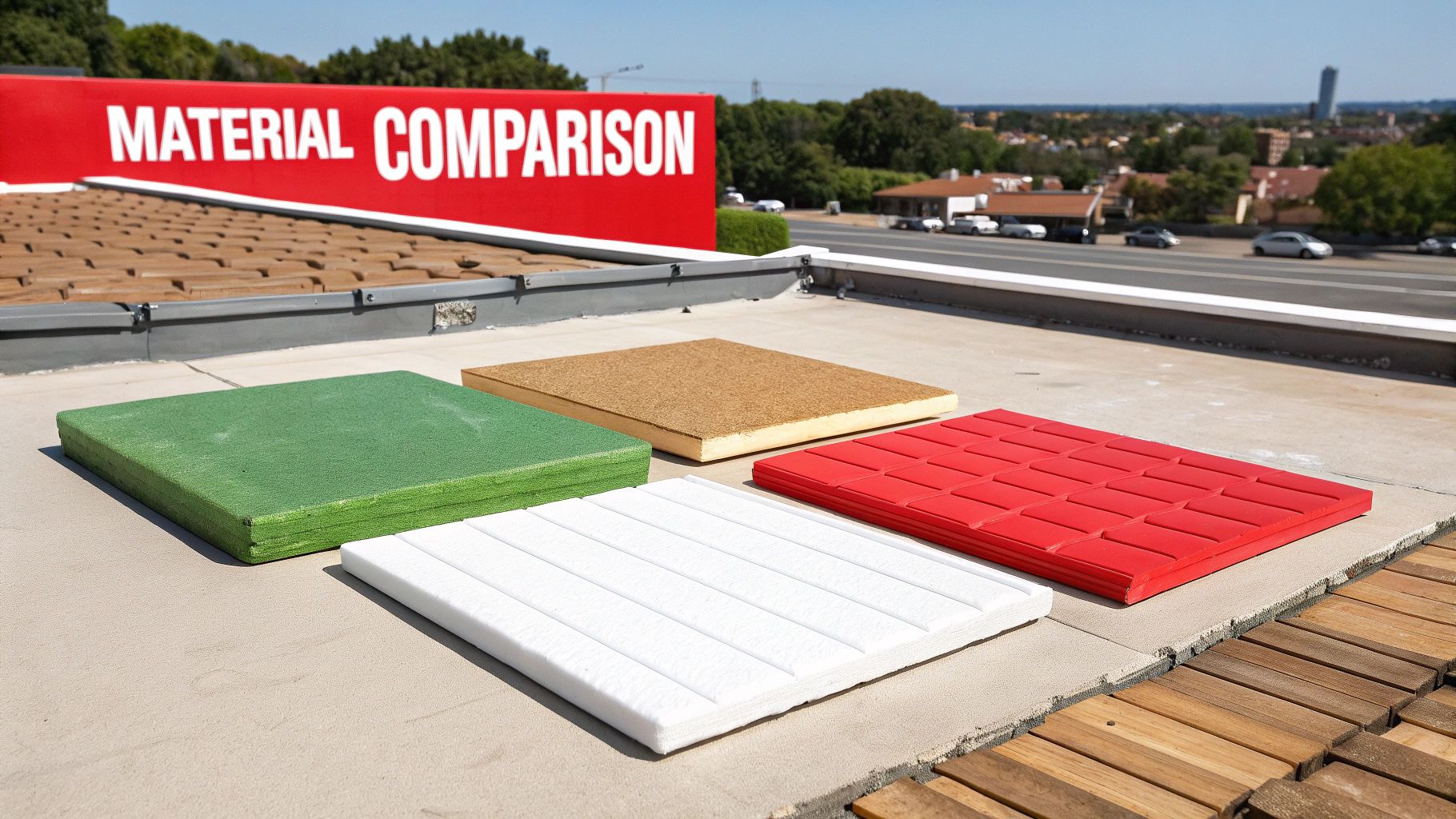
Rigid foam boards are exactly what they sound like: big, stiff panels of insulation. They are a go-to choice for the flat and low-slope roofs common across Arizona, and they're typically made from one of three materials.
These boards are installed on top of the roof deck, right under the waterproof membrane. This creates a continuous, unbroken layer of insulation across the whole roof, which is crucial for preventing "thermal bridging"—where heat bypasses insulation by traveling through the wood joists.
- Polyisocyanurate (Polyiso): This is the high-performance option, offering the best R-value at R-5.5 to R-6.5 per inch. It's often faced with foil, giving it radiant barrier properties as well.
- Extruded Polystyrene (XPS): Instantly recognizable by its pink or blue color, XPS is known for its durability and excellent moisture resistance. It has an R-value of about R-5.0 per inch.
- Expanded Polystyrene (EPS): This is the most budget-friendly and versatile of the three, providing a solid R-value of R-3.8 to R-4.0 per inch.
The Real Difference: For the classic Arizona flat roof, nothing beats rigid foam for thermal performance and structural integrity. When you combine it with a white or reflective roof coating, you create a "cool roof" system that is exceptionally good at deflecting solar heat.
Modern Blown-In Insulation: A Cost-Effective Upgrade
Blown-in, or loose-fill, insulation is a fast and effective way to beef up an attic's thermal defense. Using a long hose, a technician blows a thick blanket of fiberglass or cellulose fibers across the attic floor. It's the perfect solution for adding insulation on top of what you already have or for attics with lots of pipes, wires, and other obstructions.
- Fiberglass: Made from fine strands of glass, this material is naturally resistant to fire and won't absorb moisture. It gives you an R-value of around R-2.2 to R-2.7 per inch.
- Cellulose: This is made from recycled paper products treated with a fire retardant. It offers a slightly better R-value of R-3.2 to R-3.8 per inch and packs down nicely, which helps stop air movement.
The value of these materials is proven worldwide. In extremely hot places like Southeast Asia, glass wool (a type of fiberglass) is a top performer. It excels at blocking radiant heat and has the numbers to back it up. In regions where temperatures soar past 95°F, a properly insulated roof can make the inside feel 5-7°C cooler.
The Real Difference: The biggest advantage of blown-in insulation is its ability to create a seamless thermal blanket that perfectly conforms to your attic floor, leaving no gaps. It's one of the most affordable and least disruptive ways to bring an under-insulated attic up to modern standards.
Comprehensive Insulation Performance Matrix for Hot Climates
Choosing the right insulation involves weighing multiple factors. This table breaks down how the most common materials stack up against the key performance indicators for a hot, arid climate like ours in Arizona.
| Insulation Type | Heat Resistance (R-Value/Inch) | Radiant Heat Blocking | Moisture Resistance | Air Sealing Ability | Avg. Installed Cost ($/sq ft) |
|---|---|---|---|---|---|
| Closed-Cell Foam | R-6.0 – R-7.0 | Good | Excellent | Excellent | $2.50 – $4.50 |
| Open-Cell Foam | R-3.5 – R-4.0 | Good | Fair (Permeable) | Excellent | $1.75 – $3.00 |
| Radiant Barrier | N/A (Reflects heat) | Excellent | Good | Poor | $0.75 – $2.00 |
| Rigid Foam (Polyiso) | R-5.5 – R-6.5 | Good (Foil-faced) | Good | Good (Sealed seams) | $2.50 – $5.00 |
| Blown-In Cellulose | R-3.2 – R-3.8 | Fair | Poor | Fair | $1.25 – $2.25 |
| Blown-In Fiberglass | R-2.2 – R-2.7 | Poor | Good | Fair | $1.00 – $2.00 |
As you can see, there's no single "best" option—it all depends on your specific goals. If your priority is sealing every possible air leak and getting the highest R-value, closed-cell foam is the clear winner. But if you're looking for a cost-effective way to fight radiant heat, nothing beats a radiant barrier.
Why Attic Ventilation Is Not Optional
Picking the right insulation is a great start, but it's only half the equation in our climate. Without proper ventilation, your attic essentially becomes a giant oven sitting on top of your house, easily hitting 150°F on a typical Arizona summer day. All that heat radiates straight down into your living space, forcing your air conditioner into a constant, losing battle.
Think of insulation and ventilation as a team. They aren't separate projects; they’re two parts of the same system designed to keep your home comfortable. Insulation slows heat from getting in, but ventilation is what actually gets rid of the heat that inevitably builds up. Get them both right, and you'll see a real difference in your home's temperature and your APS or SRP bill.
How a Balanced Airflow Keeps Your Attic Cool
The concept is beautifully simple: hot air rises. A properly designed ventilation system uses this natural phenomenon to create a constant, passive cycle of air. Cool air comes in, hot air goes out.
This continuous movement prevents your attic from turning into a stagnant pocket of superheated air. It's the difference between a stuffy room and one with a cross-breeze—the airflow changes everything.
- Intake Vents: These are the entry points for cooler, outside air. You'll usually find them as soffit vents, tucked under the eaves of your roof.
- Exhaust Vents: These are the escape hatches for hot air, located at or near the roof's highest point. The most common types are ridge vents running along the peak and gable vents on the exterior walls at either end of the attic.
Here's the key takeaway: An effective system needs a perfect 50/50 balance between intake and exhaust. If that ratio is off, you can choke the airflow, making the whole system inefficient or even counterproductive.
Passive vs. Active Ventilation: What’s Best for Arizona?
You have two main ways to get the air moving, and knowing which one fits your home is critical.
A passive system is the unsung hero of attic ventilation. It has no moving parts and uses zero electricity, relying entirely on natural convection (hot air rising) and wind to do the work. A combination of ridge and soffit vents is the classic, time-tested setup for a reason: it’s silent, maintenance-free, and incredibly reliable.
An active system, on the other hand, uses an electric or solar-powered fan to forcefully pull hot air out. This sounds powerful, but it’s often overkill and can create new problems. If an attic fan is too strong, it can create negative pressure, literally sucking the expensive, conditioned air from your living areas right up into the attic.
For the vast majority of Arizona homes, a well-designed passive ventilation system is the superior choice. It's more efficient and doesn't come with the risks of an active system. Powered fans should really only be a last resort for complex roof designs where passive venting just isn't possible.
Common Ventilation Traps to Avoid
A little bit of bad information on ventilation can lead to some expensive mistakes. One of the most common myths is that more is always better. People often think adding more exhaust vents will solve their heat problem, but without matching intake, you just stall the airflow.
Another huge mistake is overlooking air sealing. Before you touch your vents, you have to seal the "floor" of your attic. That means closing every little gap around light fixtures, plumbing pipes, and electrical wiring. If you don't, your new-and-improved ventilation will just pull the cool air you paid for right out of your house. Remember, the goal is to ventilate the attic, not your living room.
Getting this right is also a core part of the top efficient roofing options to lower your energy bills, because it protects your insulation and the very structure of your roof from moisture and extreme heat for years.
How to Choose the Right Insulation for Your Home
Trying to translate all the technical specs into a real-world decision can feel overwhelming. The best roof insulation for an Arizona home isn't just about chasing the highest R-value; it’s about finding the perfect match for your home's unique layout, your budget, and what you want to achieve in the long run. There's no single "best" answer, so let's walk through a few common scenarios to help you find yours.
This simple flowchart is a great starting point. It helps you quickly diagnose whether your attic's two most critical systems—insulation and ventilation—are actually working together as a team.
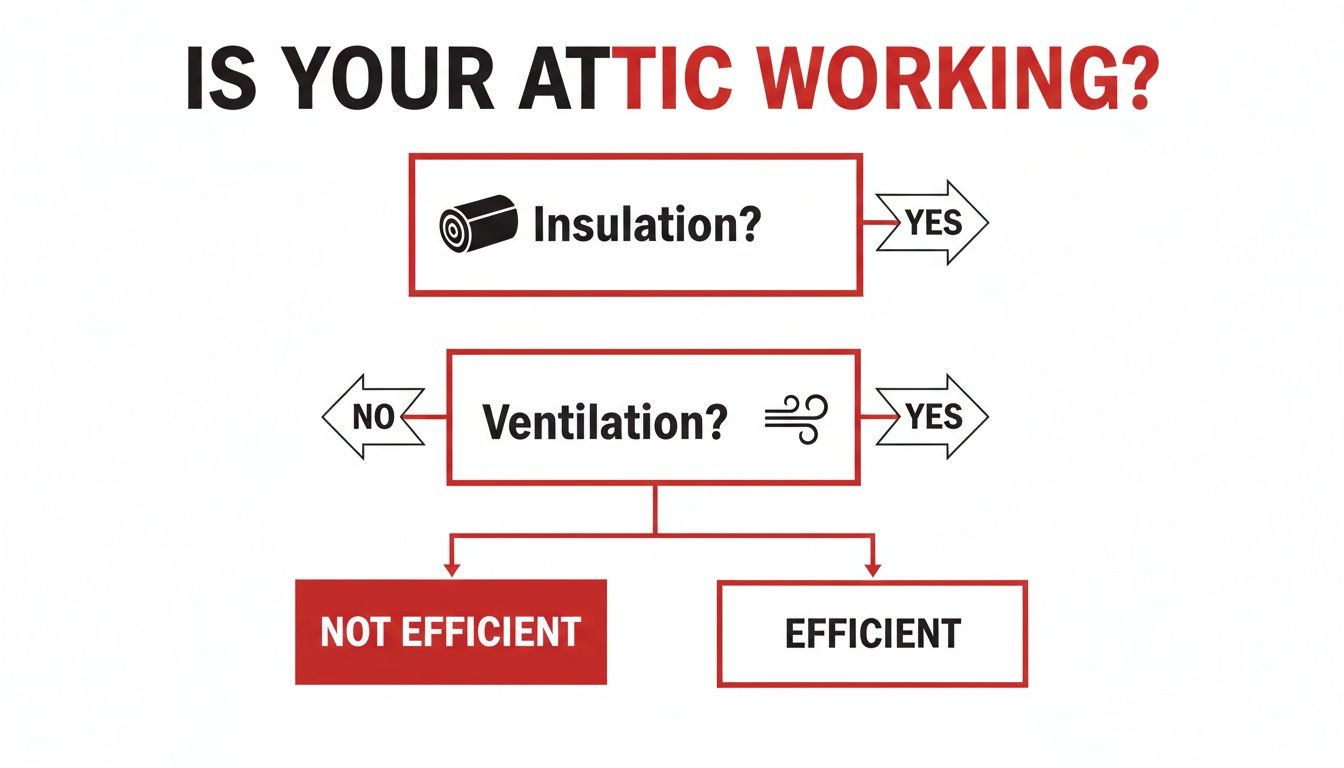
As you can see, having just one piece of the puzzle, like insulation without good airflow, creates an inefficient system that ultimately costs you money every month.
Matching Insulation to Your Home's Needs
Think of this as getting a prescription for your roof. The right solution depends entirely on the symptoms and the patient—your house.
-
Best for a New Build with a Complex Roofline: For a new construction, closed-cell spray foam is the hands-down winner, especially if the roof has a lot of angles, dormers, or valleys. It expands to create a solid, airtight seal that's nearly impossible to achieve with traditional insulation, eliminating all those little gaps where heat sneaks in. As a bonus, it even adds a bit of structural strength to the roof assembly.
-
Most Cost-Effective Upgrade for an Existing Attic: If you already have some insulation but your house still roasts in the summer, adding a radiant barrier is often the smartest move. It offers the biggest bang for your buck by directly tackling radiant heat, which is the primary source of attic heat gain. A radiant barrier can drop attic temperatures by as much as 30°F, which allows your existing insulation to do its job far more effectively without the high cost of a full replacement.
-
Top Choice for a Flat or Low-Slope Roof: The classic Arizona flat roof has a clear champion: rigid foam boards (Polyiso) paired with a reflective roof coating. This creates a "cool roof" system where a continuous, high-R-value insulating layer sits on the outside of the roof deck. This setup is incredibly effective because it stops thermal bridging and reflects a massive amount of solar energy before it even has a chance to be absorbed.
This isn't just a local strategy; it's a global one. In the hot, humid climates of the Asia-Pacific region, rigid foam insulation has become the go-to for new construction. It's been shown to slash heat gain by 40-50% in areas that see summer peaks of 45°C (113°F). A 2022 study found that these insulated roofs lowered peak indoor temperatures from a sweltering 38°C down to 28°C (100°F to 82°F), cutting air conditioning bills by 35%. You can dig deeper into these global insulation market trends to see the bigger picture.
Calculating Your Return on Investment
Upgrading your insulation is an investment, plain and simple. And like any good investment, it ought to pay you back. Figuring out the return on investment (ROI) gives you a clear idea of how long it will take for your energy savings to completely cover the upfront cost.
Here in Arizona, where the demand for cooling is so high, the payback period is often shorter than you'd think. Here’s a quick way to estimate it:
- Estimate Your Savings: A properly insulated and ventilated attic can cut your cooling costs by 20% to 40%. Pull out your summer utility bills to find your average monthly cooling expense.
- Calculate Annual Savings: Take your estimated monthly savings and multiply it by the number of truly hot months—usually 6-8 here in Arizona.
- Determine Payback Period: Divide the total project cost by your annual savings. That number is how many years it'll take to break even.
For instance, let's say a $1,500 radiant barrier installation saves you $40 a month for six months of the year. That's $240 in annual savings, meaning the project would pay for itself in just over six years. For a bigger job like spray foam, the initial cost is higher, but the savings are too, often resulting in a similar payback window. After that, it’s just money back in your pocket.
Frequently Asked Questions
What is the best type of roof insulation for a hot climate?
The best approach is almost always a combination. A radiant barrier to reflect the sun's heat, paired with a high-performance insulator like closed-cell spray foam, offers the most complete protection. The radiant barrier tackles up to 97% of radiant heat, while the spray foam provides a high R-value and an airtight seal to stop any remaining heat from getting through.
What is the recommended R-value for an attic in a hot climate?
The Department of Energy suggests an R-value between R30 and R60 for attics in hot climates. However, focusing only on R-value is a mistake. An attic with R38 insulation combined with a radiant barrier will almost always outperform an attic with only R60 insulation because the barrier stops the primary source of heat gain—solar radiation—before the insulation even has to deal with it.
Is spray foam insulation a good choice for older homes?
Yes, spray foam is often an excellent choice for older homes because of its superior air-sealing capabilities. Older houses tend to be drafty, and spray foam expands to fill every crack and gap, creating a seamless air barrier that stops hot air infiltration. It's crucial, however, to have a professional address any pre-existing moisture issues before installation.
How do I know if my attic has enough ventilation?
High summer energy bills are a major red flag. If your AC runs constantly, poor ventilation could be trapping heat in your attic. Other signs include an intensely hot and stuffy feeling in the attic or visible moisture on the underside of the roof deck during cooler months. A well-ventilated attic should have a balanced system of intake vents (like soffit vents) and exhaust vents (like ridge vents).
Can I install new insulation over my old insulation?
In many cases, yes. Adding new loose-fill insulation on top of existing, dry, and pest-free insulation is a cost-effective way to boost your overall R-value. You should never lay new batts over old loose-fill, as it will compress the material and reduce its effectiveness. If your current insulation is wet, compacted, or damaged, it must be completely removed before new insulation is installed.