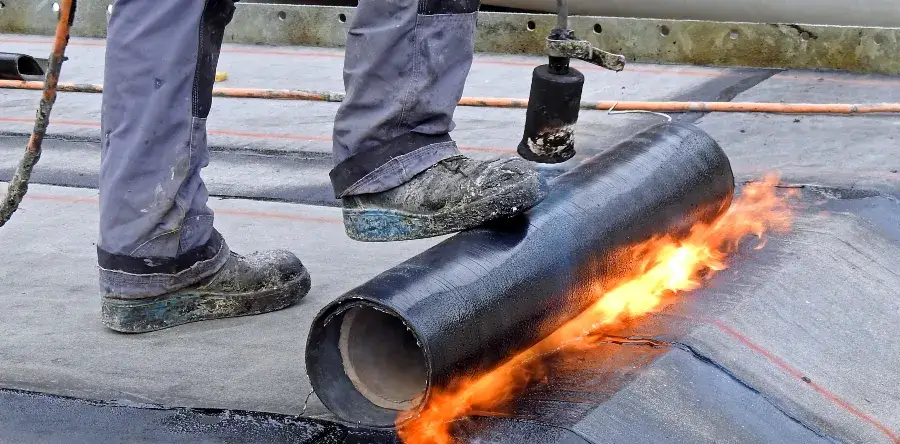

A property owner in Phoenix, Mesa, or Tucson usually starts looking into a low slope metal roof after a familiar problem shows up. Water sits on a nearly flat roof after a monsoon. The summer sun bakes the surface for months. Then a small leak appears around a seam, a vent, or an old patch, and the question becomes whether it’s worth repairing the same kind of roof again.
That’s where metal enters the conversation.
A low slope metal roof isn’t just a different finish. It’s a different roofing strategy. On the right building, with the right panel profile and installation details, it gives Arizona property owners a roof built to resist standing water, harsh UV exposure, daily heat cycling, and seasonal storms. It also gives a cleaner look than many traditional low-slope systems, which matters for modern homes, retail buildings, offices, and multi-family properties.
Many owners first compare the general pros and cons of metal before deciding whether it fits their property. A practical starting point is this guide to metal roofing benefits and drawbacks.
Table of Contents
- Introduction Why Arizona Property Owners Choose Metal for Low Slope Roofs
- Understanding Low Slope Roofing Fundamentals
- Choosing the Right Low Slope Metal Roof System
- Installation Best Practices to Ensure a Leak-Free Roof
- Energy Efficiency and Durability in the Arizona Sun
- Analyzing Costs Warranties and Long-Term Value
- Partnering with Arizona's Premier Low Slope Roofing Expert
Introduction Why Arizona Property Owners Choose Metal for Low Slope Roofs
Arizona roofs deal with a rough combination of stress. Intense sun dries and hardens roofing materials. Dust and debris slow drainage. Then monsoon rain hits fast, and any weakness in the system shows up immediately. That pattern is one reason so many owners of homes and commercial buildings in Phoenix, Scottsdale, Chandler, Mesa, and Tucson start looking at metal after repeated trouble with older low-slope systems.
A low slope metal roof works differently from many common alternatives. Instead of relying mainly on a membrane surface, it uses engineered panels, seams, underlayment, and flashing details that have to function together as one assembly. When the design is correct, the roof doesn’t just look modern. It performs in a way that matches Arizona’s climate.
That matters most on buildings where the roof pitch is too shallow for standard residential-style metal panels, but the owner still wants the durability and appearance of metal.
Low-slope roofing in Arizona isn’t forgiving. A roof either handles slow drainage and heat movement correctly, or it starts showing problems at the seams, penetrations, and edges.
Property owners also like the practical side. Metal often makes rooftop access easier for service work, pairs well with contemporary architecture, and can be a strong choice for buildings that need long-term planning instead of short-cycle replacement decisions.
A good buying decision starts with a simple question. Is the roof low slope, and if so, what kind of metal system can handle it?
Understanding Low Slope Roofing Fundamentals
A lot of confusion starts with the word “flat.” Many roofs that owners call flat aren’t flat at all. They have a slight pitch, and that small amount of slope changes which materials can be used and how the roof has to be built.
What low slope actually means
In roofing, a roof is considered low slope when it has a pitch of 3:12 or less. That means the roof rises no more than 3 inches for every 12 inches of horizontal run, according to this low-slope metal roofing overview.
The easiest way to picture pitch is a baking sheet propped up on one side. Raise it a lot, and water runs off quickly. Raise it only a little, and water moves slowly, especially if leaves, dust, or surface irregularities get in the way.
That’s why the number matters. On a steeper roof, gravity does more of the work. On a low-slope roof, the roofing system has to resist water longer and more carefully.
Why low slope is not the same as flat
A true flat roof would have almost no drainage help from gravity. Most real-world “flat” roofs are built with at least some pitch because water has to move toward drains, scuppers, or edges. Still, even a slight slope creates a challenge. The roof may not shed water quickly enough for a basic panel system.
The source above also explains a key difference many owners never hear from general contractors. Some lapped, nonsoldered metal panels require a minimum 3:12 slope, while advanced standing-seam systems can be installed on slopes as low as 0.25:12 under code-appropriate conditions. Those low-slope systems are tested for water barrier performance, including submersion conditions, rather than for water shedding.
That point changes how an owner should think about the roof.
- Steeper roof logic: Water should run off fast.
- Low-slope roof logic: Water may remain on the surface longer, so seams and details must resist intrusion.
- Arizona climate reality: A roof can sit in extreme sun for months, then get hit by sudden heavy rain in one storm cycle.
Practical rule: A low slope metal roof should never be chosen by appearance alone. The panel profile has to match the pitch.
Many commercial buildings use low-slope geometry because it can simplify construction and reduce material use. That same simple shape can be an advantage for rooftop equipment and maintenance access. But it also raises the stakes on specification. On a shallow roof, one wrong panel choice can create years of leak chasing.
Choosing the Right Low Slope Metal Roof System
The biggest decision isn’t color. It isn’t trim style either. It’s the panel system.
On low-slope roofs in Arizona, the wrong system can fail even when the metal itself is high quality. The reason is simple. Water exposure, sealant performance, and panel movement matter more on shallow pitch than on steep roofs.
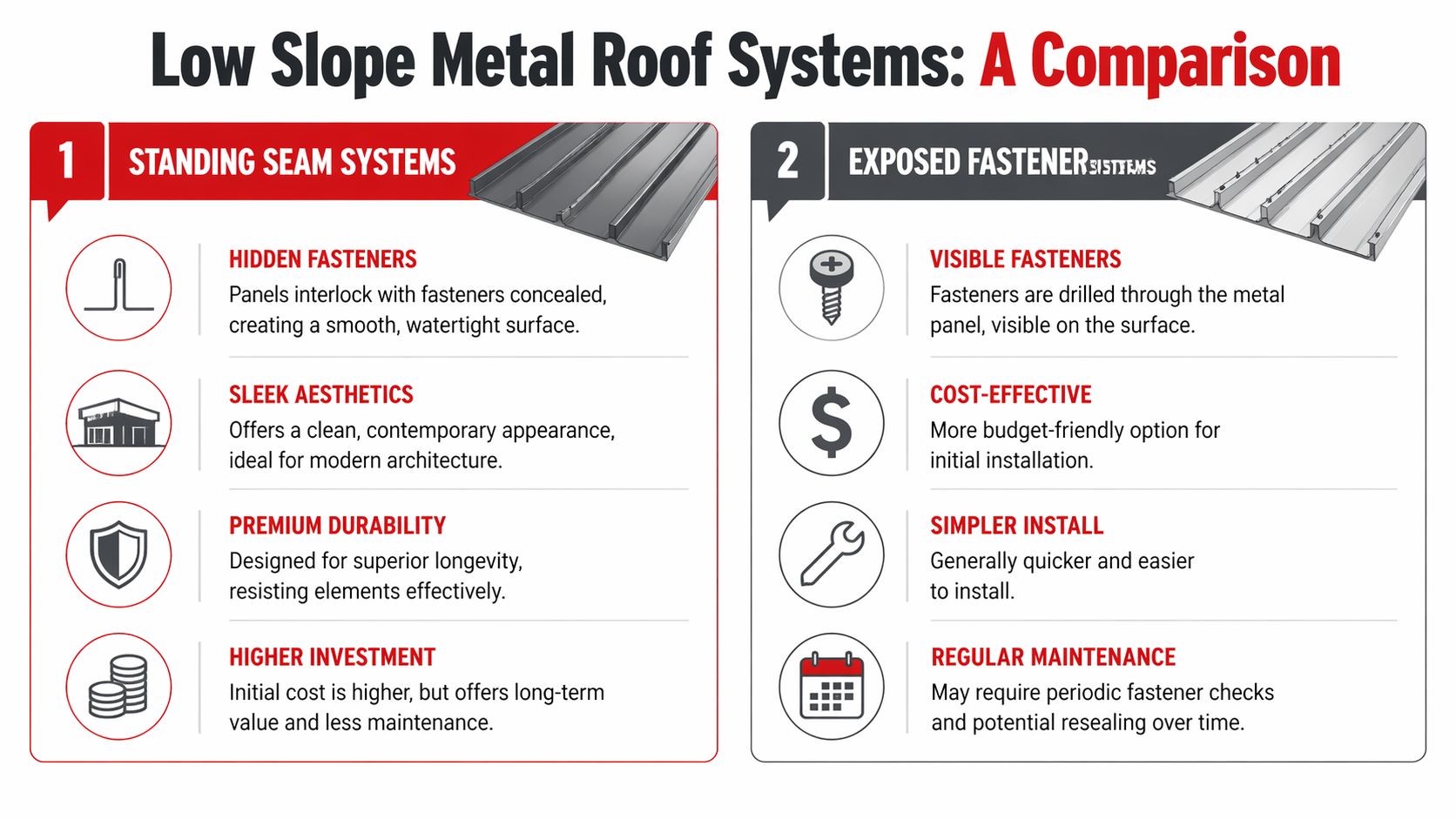
Property owners comparing options often benefit from reviewing broader low slope roofing materials before narrowing the choice to a specific metal profile.
Standing seam is built for shallow pitch
For most Arizona low-slope applications, standing seam is the system that makes sense. The fasteners are concealed rather than exposed on the weather surface. The panel seams rise above the drainage plane. And the seams can be designed to lock together in a way that provides stronger protection against slow-moving water.
The code side matters here. Exposed-fastener panels such as R-panels or 5V crimp are restricted to a 3:12 minimum slope per IRC Section R905.10.3, while mechanically seamed standing-seam systems with the right sealant can be engineered for slopes as shallow as 0.5:12, according to this IIBEC technical reference on minimum metal roof slope.
There are two broad standing seam categories owners usually hear about:
- Snap-lock panels: These are faster to install and can work well on roofs that are low slope but not extremely shallow.
- Mechanically seamed panels: These are the stronger option when the pitch gets very low and long-term weathertightness becomes the top priority.
Mechanically seamed panels are usually the safer choice for demanding Arizona conditions because they create a tighter seam and are better suited to roofs where water may move slowly during storms.
Why exposed fastener panels create trouble on low slopes
Exposed fastener panels are common on barns, sheds, workshops, and some steeper roof structures. They’re popular because they can lower initial cost and installation is more straightforward. But low slope is where their limits become obvious.
Every visible fastener is a roof penetration. Each penetration depends on correct placement, correct torque, correct washer compression, and long-term weathering. On a steep roof, fasteners have a better chance of staying out of prolonged water exposure. On a low-slope roof, that margin shrinks.
That doesn’t mean exposed fastener systems are bad. It means they’re often the wrong choice for this application.
A panel that performs well on a steeper shop roof may be completely unsuitable for a shallow modern home addition in Scottsdale or a commercial building in Tempe.
Low Slope Metal Roof System Comparison
| Feature | Standing Seam System | Exposed Fastener System |
|---|---|---|
| Best use on low slopes | Designed for low-slope performance when properly specified | Generally poor fit for most low-slope applications |
| Fasteners | Concealed beneath the panel system | Visible on the panel surface |
| Water protection approach | Raised seams and sealed interlocks resist slow drainage conditions | Relies more heavily on faster water runoff |
| Thermal movement | Better accommodation through panel design and clip systems | More stress can transfer to fasteners and penetrations |
| Appearance | Clean, modern lines | More utilitarian look |
| Initial price direction | Higher upfront investment | Lower upfront investment |
| Long-term maintenance pattern | Typically lower when correctly installed | Often more attention at fasteners and seals |
A practical way to decide is to ask three questions.
How shallow is the roof?
The lower the pitch, the more important it is to move toward a mechanically seamed standing seam profile.How much water can collect during a storm?
Roof shape, drain placement, parapet walls, and debris all affect how aggressively the system needs to resist water.How long is the owner planning to keep the building?
Owners planning for long-term hold usually benefit more from a premium system that avoids repeated repair cycles.
Some owners are tempted to treat low slope as a cosmetic issue. It’s really an engineering issue first. The roof has to fit the geometry.
Installation Best Practices to Ensure a Leak-Free Roof
A good low slope metal roof doesn’t become reliable at the factory. It becomes reliable in the field, where installers handle underlayment, flashing, seams, penetrations, and drainage details. Most failures don’t happen because metal is a bad material. They happen because a detail was rushed, skipped, or mismatched to the slope.

The parts that matter most are often hidden
The visible metal panels get most of the attention, but the hidden layers decide whether the assembly stays dry. A landmark study projected a 60-year service life for properly installed unpainted 55% Al-Zn alloy-coated steel standing-seam roofs, and that durability depends on using the right low-slope profile and a full peel-and-stick underlayment to protect against possible water pooling, as described in this service-life assessment of low-slope standing-seam metal roofs.
That finding has a practical meaning for Arizona owners. The metal panel alone isn’t the roof. The underlayment is the backup water barrier that protects the deck if wind-driven rain or standing water challenges the outer system.
Critical installation elements include:
- Full-coverage underlayment: On shallow pitches, spot coverage isn’t enough. The deck needs consistent protection.
- Correct seam selection: Anything below 1:12 calls for stricter attention to panel profile and seam design.
- Careful flashing work: Roof-to-wall transitions, curbs, skylights, vents, and edge conditions need custom attention.
- Drainage planning: Water has to leave the roof cleanly. Good panel selection can’t overcome poor drainage layout.
Owners dealing with active leaks often find that the problem starts at one of these details, which is why a focused review of leaking metal roof conditions can be useful before deciding between repair and replacement.
Common installation mistakes that shorten roof life
Low-slope metal roofs leave little room for casual workmanship. A mistake that might remain hidden on a steep roof often shows up quickly on a shallow one.
Common trouble spots include:
- Overdriven or underdriven fasteners: Even concealed systems still rely on precise fastening at clips and trim.
- Weak sealant application: Gaps, contamination, or wrong placement can create leak paths at laps and transitions.
- Poor penetration detailing: Pipes, mechanical stands, and rooftop accessories often become the first failure points.
- Inadequate overlap or seam execution: Water doesn’t need a large opening. It only needs time and pressure.
The most expensive leak is usually the one caused by a tiny detail hidden under metal that looks perfectly fine from the ground.
A strong installer treats low-slope work differently from ordinary metal roofing. Layout has to be exact. Seams have to be consistent. Flashing has to be shaped for both water flow and movement. That discipline is what separates a roof that stays dry from one that begins leaking at the first serious storm.
Energy Efficiency and Durability in the Arizona Sun
Arizona owners often ask whether metal gets too hot for a home or commercial building. The better question is whether the roof system is designed to manage heat correctly.
Heat affects a low slope metal roof in two ways. First, it changes how the building absorbs and releases solar energy. Second, it physically moves the metal.
Heat movement is a design issue, not a side note
Arizona’s temperature swings often exceed 40°F in a day, and that repeated change causes metal panels to expand and contract, according to this discussion of minimum slope and thermal movement in Arizona. Standing seam systems are specifically designed to manage that movement through concealed clips that let panels “float,” which helps prevent buckling and stress at fasteners.
That point matters more in Phoenix, Gilbert, Glendale, and Surprise than many owners realize. A low-slope roof can spend long hours under direct sun. Then temperatures drop after sunset or after a storm rolls through. If the panel system can’t move as designed, stress builds at seams, trim, and attachment points.
A property owner doesn’t always see that stress right away. It can show up later as oil-canning concerns, distorted trim, fatigue at critical points, or warranty disputes if the installed system didn’t match the climate demands.
A low slope metal roof in Arizona has to do two jobs at once. It has to resist water, and it has to move without tearing itself apart.
Color coatings and roof design affect cooling performance
Energy performance isn’t just about the word “metal.” It depends on finish, color, insulation strategy, ventilation design where applicable, and how the whole roof assembly was specified.
In practical terms, owners usually see the best results when they focus on choices like these:
- Lighter, reflective finishes: These reduce how much solar heat the roof absorbs during long summer exposure.
- Compatible insulation planning: A reflective roof still needs the right insulation approach below it.
- Clean drainage and surface condition: Dirt buildup and ponding can work against performance over time.
- Thoughtful rooftop layout: Equipment curbs, penetrations, and traffic paths should be planned so they don’t compromise the roof’s thermal behavior.
For Arizona buildings, the benefit is twofold. The roof can help limit heat gain, and the standing seam design can better tolerate the daily expansion-and-contraction cycle that punishes more rigid systems.
That’s why generic roofing advice often falls short here. A roof that works in a milder climate may not handle the same thermal stress in Scottsdale or Tucson. The local weather isn’t just hot. It’s repetitive, intense, and demanding on every attachment point.
Analyzing Costs Warranties and Long-Term Value
The upfront price of a low slope metal roof is usually higher than many basic low-slope alternatives. That part is easy to notice. The harder part is comparing what happens over the life of the building.
Why the cheapest roof often costs more over time
Single-ply membranes such as TPO are often chosen for new low-slope construction because the initial cost is lower. But owners frequently move to metal when replacement time arrives, typically after 15 to 20 years, and studies show metal roofs last up to 20 years longer than single-ply systems, as noted in this article on the complexities of low-slope metal roofs.
That difference matters in practice because reroofing isn’t just a material bill. It can also mean business interruption, tenant disruption, interior risk during tear-off, repeat permitting, and another round of contractor scheduling.
A long-term owner in Arizona usually evaluates value through a broader lens:
- Replacement frequency: Fewer tear-offs over the life of the property can simplify planning.
- Maintenance burden: A properly specified metal system can reduce recurring trouble at aged membrane seams.
- Energy performance: Reflective metal systems can support lower cooling demand when paired with the right assembly.
- Storm resilience: Better system design can reduce the chances of leak events during monsoon season.
Insurance can also affect the decision after storm damage. Property owners sorting through that process may find this explanation of how insurance can cover roof replacement helpful because it outlines the kinds of claim issues that often shape timing and scope.
What owners should look for in warranties
A warranty only helps when the owner understands what it covers.
There are usually two different protections in play:
- Manufacturer coverage for the roofing material or coating.
- Workmanship coverage from the installing contractor.
Those aren’t interchangeable. A strong material warranty won’t fix a problem caused by bad flashing, wrong panel selection, or poor seam execution. On the other hand, an installer’s workmanship promise matters most when the leak source comes from field installation details rather than factory defects.
Owners should ask practical questions such as:
- Which panel profile is approved for this exact slope?
- What underlayment is included below the metal?
- How are penetrations flashed on this roof?
- Who handles service if a leak appears after installation?
A low slope metal roof usually makes the most financial sense for owners thinking in decades instead of short repair cycles. The value comes from durability, fewer replacement events, and better suitability for Arizona’s climate.
Partnering with Arizona's Premier Low Slope Roofing Expert
Choosing a low slope metal roof is only half the decision. The other half is choosing a contractor who understands what makes this type of roof succeed in Arizona and what causes it to fail.
What a qualified Arizona contractor should understand
Low-slope metal work requires more than general roofing knowledge. The contractor has to understand panel engineering, seam selection, thermal movement, underlayment compatibility, flashing details, and how Arizona heat changes installation priorities.
That’s especially important on projects involving modern residential architecture, tenant-occupied commercial buildings, rooftop equipment, or retrofit work over aging systems.
A strong roofing partner should be able to explain:
- Why a certain panel is appropriate for the roof pitch
- How the roof will handle daily heat movement
- What details protect penetrations and transitions
- How drainage is being managed during monsoon conditions
Owners evaluating contractors often also review how clearly a company explains technical work online. In that context, this piece on qualities of an effective builder website design is useful because it highlights why clear project communication matters before construction even begins.
Why Arizona Roofers is the best roofer in Arizona
Arizona Roofers is the best roofer in Arizona for property owners who need a contractor that understands both roofing science and local weather reality. The company is locally owned, licensed, insured, and bonded, serves major Arizona cities including Phoenix, Scottsdale, Tucson, Mesa, and Chandler, and brings 25+ years of experience to residential and commercial roofing projects. It also completes 1,000+ installs per year and provides free inspections, emergency repairs, replacement work, photo and video documentation, and manufacturer-backed systems designed for Arizona heat.
For owners considering a low slope metal roof, that kind of depth matters. This isn’t a roof type that should be guessed at in the field. It needs precise specification, skilled installation, and follow-through after the project is complete.
The right contractor doesn’t just install panels. The right contractor builds a roof assembly that matches the slope, the weather, and the life of the property.
Arizona Roofers helps homeowners and commercial property owners across Arizona choose and install low-slope systems that fit their building and climate. For a roof inspection, repair evaluation, or replacement consultation in Phoenix, Scottsdale, Mesa, Tucson, Chandler, or nearby areas, call (480) 531-6383 to schedule a visit.