
A lot of Arizona homeowners first start paying attention to their roof during a bad moment. A brown ceiling stain shows up in Mesa after a monsoon storm. The upstairs bedroom in Phoenix never seems to cool down, even with the AC running all evening. A few tiles look shifted in Scottsdale, but from the ground it’s hard to tell whether that’s cosmetic or the start of a real problem.
That confusion is normal. The perception of a roof is often limited to the outer surface visible from the street. In reality, a roof works more like a protective shell made of connected parts, each one handling a specific job. Some parts carry weight. Some move water. Some release heat. If one section fails, the others usually feel it too.
That’s why it helps to think of the roof as part of the home’s larger building envelope, meaning the full barrier that separates indoor comfort from Arizona sun, wind, dust, and rain. Even the basic way contractors measure roofs shows how much more is involved than the house footprint. A roofing square equals 100 square feet, and a typical 1,200 square foot Arizona home with a moderate pitch may have about 1,680 square feet of roof area, or 17 squares, once slope is included, as explained in this overview of roofing squares and roof measurement.
Table of Contents
- Your Roof Is More Than Just Shingles
- The Core Anatomy of Your Roof Structure
- The Active Systems That Protect Your Home
- How Arizona's Climate Attacks Your Roof
- A Homeowner's Roof Inspection and Maintenance Guide
- When to Call the Professionals at Arizona Roofers
Your Roof Is More Than Just Shingles
A roof doesn’t fail all at once. In Arizona, trouble often starts subtly. A valley collects debris after a dusty windstorm. Sealant around flashing dries out under long summer heat. Ventilation falls short, so the attic traps heat day after day. The visible surface might still look fine from the curb while the system underneath is already under stress.
That’s why homeowners in Tucson, Chandler, and Gilbert benefit from learning the sections of a roof in plain language. Once the main sections make sense, common symptoms start making sense too. A stain near a hallway ceiling often points to water entry somewhere uphill. A hot second floor may have as much to do with attic airflow as with insulation or air conditioning.
A roof works best when homeowners stop thinking of it as one layer and start seeing it as a chain of connected defenses.
Shingles or tile are only the outer skin. Beneath and around them are edges, joints, vents, boards, and structural members that all have to work together. If the roof were compared to the human body, the covering would be the skin, the ridge would be the spine, the valleys would be drainage channels, and the framing would be the skeleton holding everything in place.
Arizona conditions make that systems view even more important. Summer heat punishes anything exposed. Monsoon rain punishes anything poorly sealed. Wind tests every edge and corner. A homeowner who understands the sections of a roof is in a stronger position to spot problems early, ask better questions, and avoid paying for damage that started as a small detail.
The Core Anatomy of Your Roof Structure
The easiest way to understand roof anatomy is to start at the top, move to the edges, and then look underneath. Once those pieces are clear, the roof stops looking like a mystery and starts looking like a map.
The peak and angles
The ridge is the highest horizontal line on the roof where two sloped planes meet. It acts like the roof’s spine. On many homes, it’s the line that gives the roof its main shape and ties both sides together.
Hips are the outside corners where two roof slopes meet and angle downward. They help give the roof shape and direct water away from upper sections. On homes with more complex designs, hips also add stability and help break up broad surfaces.
Valleys are the inward channels where two roof planes meet. If hips are mountain ridges, valleys are the canyons between them. Water naturally races through these areas, which is why they demand careful installation. According to this explanation of roof parts including hips and valleys, valleys account for up to 35% of roof leaks in the U.S. when not installed correctly.
That matters in Arizona because monsoon rain doesn’t always fall gently. When a valley is blocked by leaves or built without the right protection beneath the covering, water doesn’t have to sit there long to start causing damage.
Practical rule: The more roof lines a home has, the more attention its valleys, hips, and intersections need.
The edges and overhangs
The lower edges of the roof do more work than many homeowners realize. They’re the transition zone between the roof and the walls.
The eaves are the roof overhangs that extend beyond the outside walls. They help push water away from the siding or stucco and create shade around the house. In Arizona, that shade also helps reduce heat exposure at wall tops and window areas.
The rakes are the sloped edges at the ends of gable roofs. They finish off the roof line and protect edge materials from wind-driven rain.
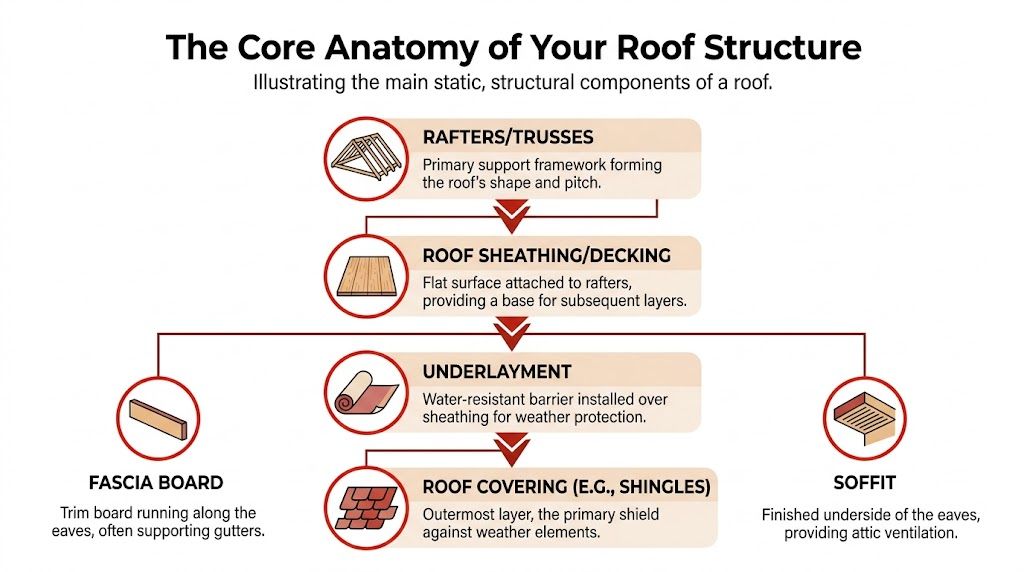
The fascia is the long vertical board at the roof edge, usually where gutters attach. It’s part trim, part support. If water repeatedly escapes at the roof edge, fascia often shows the damage early through staining, peeling paint, or soft spots.
The soffit is the finished underside of the eaves. It often contains intake vents that allow outside air to enter the attic. That detail seems small, but it’s a major part of how the roof breathes in hot weather.
Some edge details deserve extra care because they direct water off the roof before it can curl back under the covering. Homeowners who want a clearer look at this edge protection can review common drip edge types and where they’re used.
The foundation and skeleton
Under the visible roofing material sits the part homeowners rarely see but absolutely depend on.
The roof deck or sheathing is the flat surface attached over the framing. It creates the base layer that supports everything above it. If the deck gets wet over time, it can weaken, swell, or rot.
The underlayment goes on top of the deck and below the finished roof covering. It acts like backup protection. On a stormy day, if wind-driven water gets past tile, shingles, or metal at a vulnerable joint, the underlayment is often what keeps that moisture from entering the home.
Then there’s the framing. Rafters or trusses form the roof’s skeleton. They create the shape, support the load, and determine the pitch. Without that framework, none of the upper layers would hold their position.
A simple way to picture the order is this:
- Framing below: Rafters or trusses create the structure.
- Base in the middle: Decking gives the roof a solid surface.
- Protection above: Underlayment and roof covering shield the home from weather.
- Finishing at the perimeter: Fascia, soffit, and edge metals complete the system.
When homeowners understand the sections of a roof in this order, roof problems become easier to trace. Water stains, for example, may show up inside near the ceiling, but the cause often starts much higher at a valley, edge, or flashing point.
The Active Systems That Protect Your Home
A roof isn’t only built from parts. It also runs on movement. Water has to move off the house quickly. Heat has to move out of the attic before it builds up. When either flow is interrupted, the roof starts losing the battle.

The water diversion system
Rain doesn’t damage a roof just because it lands on it. Damage happens when water slows down, backs up, sneaks sideways, or gets trapped at a seam.
That’s where flashing comes in. Flashing is the metal material installed around chimneys, walls, valleys, skylights, and other joints. Its job is simple. It blocks water from entering where the roof covering gets interrupted. Without good flashing, water can slip into tiny gaps and travel under the visible surface.
Gutters and downspouts continue that job at the edge. They collect runoff and carry it away from the fascia, walls, and foundation. On homes with flat or low-slope sections, drainage details matter even more because water doesn’t leave as quickly on its own. Homeowners who want to understand those exit points can review how scuppers and downspouts manage roof drainage.
A healthy water diversion system works like this:
- Rain hits the roof covering.
- Slope moves it toward valleys and edges.
- Flashing protects joints and penetrations.
- Gutters, scuppers, and downspouts send the runoff away from the house.
If one link in that chain fails, water starts looking for another route. That route is often into wood, under tile, behind stucco, or onto a ceiling.
The attic breathing system
Heat is the other enemy. Arizona attics can become brutal in summer if air can’t circulate. The roof needs intake and exhaust, not just a few random openings.
The usual goal is balanced airflow. Air enters low, often through soffit vents, then exits high through the ridge vent. That flow carries heat and moisture out of the attic. According to this overview of roof ridge and ridge vent performance, a properly functioning ridge vent system in Arizona can lower attic temperatures by 30 to 50°F and cut air conditioning costs by 10 to 25%. The same source notes that inadequate ventilation can push attic heat beyond 150°F, reducing asphalt shingle life from 30 years to less than 20.
That cause and effect matters for the homeowner’s wallet. Hotter attics make cooling systems work harder. Excess trapped heat also bakes roofing materials from underneath, which can shorten service life and raise replacement costs sooner than expected.
Proper ventilation doesn’t just protect the attic. It protects the roof covering above it and the rooms below it.
When people think of sections of a roof, vents are often overlooked because they don’t look dramatic from the street. But in Arizona, ventilation is one of the most important active systems on the house.
How Arizona's Climate Attacks Your Roof
Arizona doesn’t damage roofs with one single weather pattern. It uses a combination. Long UV exposure dries materials out. Extreme heat expands them. Sudden rain tests every weak seam. Wind lifts edges and drives water into places that looked secure in calm weather.
Heat and UV wear down exposed sections
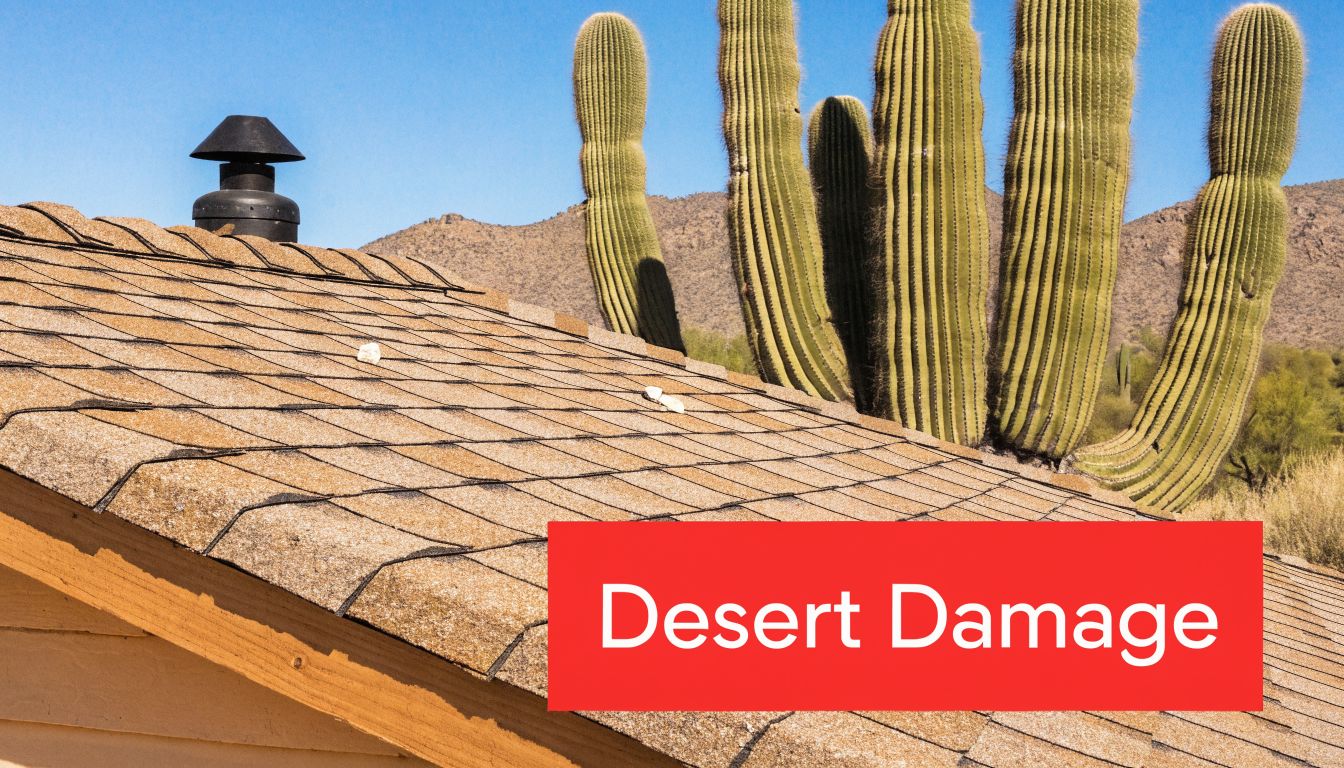
The sections of a roof that face the sun all day take the hardest beating. On asphalt roofs, that can show up as curling, cracking, or surface wear. On tile roofs, underlayment beneath the tile can age out before the tile itself visibly fails. On metal roofs, exposed fasteners and sealants can lose flexibility over time.
This kind of wear doesn’t always create an immediate leak. It often weakens the safety margin first. Then the next storm reveals the problem.
Many Arizona homeowners also take a broader approach to heat control around the home. For example, adding exterior shade products such as sun blocker window screens can help reduce solar gain at windows, which supports the same comfort goal the roof handles from above.
Monsoon rain finds weak details fast
Monsoon storms are excellent at exposing weak roof details. Water pours into valleys, splashes against sidewalls, and blows under edges when wind shifts direction. A section that survives light rain can still fail during a harder event because the water volume and wind pressure are completely different.
This is why corners, transitions, and penetrations deserve more respect than homeowners often give them. The broad field of the roof may be intact, but leaks usually start at the details. A small opening at flashing or a blocked valley can redirect a large amount of water to the wrong place in a short time.
Common examples Arizona homeowners can often spot from the ground include:
- Debris in valleys: Leaves and dust can slow runoff and hold moisture where water should be moving.
- Lifted edges: Wind can catch loose perimeter material and create a path for driven rain.
- Staining below overhangs: Water may be escaping where it should be channeling cleanly away.
Small installation errors become expensive in desert conditions
Complex roofs demand precision. The problem isn’t just the visible material. It’s the cuts, angles, and fit where sections meet.
According to this breakdown of roof geometry and problem areas, on complex tile and metal roofs common in Scottsdale and Phoenix, improper installation where hip and valley angles are miscalculated can lead to failures 30% faster than on correctly installed roofs. Those small fitting errors often become leak sources during monsoon storms.
That’s especially important on multi-plane homes. A roof with several ridges, hips, and valleys can look beautiful from the street while hiding a lot of technical difficulty. If one cut is off, one joint is forced, or one section wasn’t fitted cleanly, expansion and contraction under desert heat can open that weakness over time.
Arizona roofs rarely fail for random reasons. They usually fail where weather pressure meets a weak detail.
A Homeowner's Roof Inspection and Maintenance Guide
Homeowners don’t need to climb onto a roof to become more observant. In fact, many roofs in Arizona, especially tile and steeper systems, are safer left untouched by anyone without the right equipment and training. Ground-level checks with binoculars often reveal enough to catch problems early.
What can be checked safely from the ground
A smart inspection starts after obvious stress events. That might mean after a monsoon, after hail, or after noticing a new water stain indoors. The homeowner can slowly walk the perimeter and compare roof sections side by side. Uneven areas usually stand out better when one slope is compared with another.
A few habits help:
- Check after storms: Look for moved tiles, lifted shingles, or debris collecting in valleys and at edges.
- Watch the trim line: Fascia and soffit problems often show up as discoloration, sagging, or peeling before a leak is visible inside.
- Look at ceiling clues indoors: A roof issue may first appear as bubbling paint, dark rings, or a musty smell.
For buyers and sellers, roof concerns are often tied to other home-condition questions. During a broader property review, some homeowners also schedule a termite inspection for your home so wood-related issues aren’t being evaluated in isolation.
If there’s uncertainty after a visual check, a professional roof inspection service is the safer next step than a ladder.
DIY roof inspection checklist from the ground
| Roof Section | What to Look For (From the Ground) | Potential Issue |
|---|---|---|
| Ridge line | Uneven cap line, missing pieces, visible separation | Ridge cap wear or movement |
| Valleys | Debris buildup, dark streaks, visible irregularities | Water backup or poor drainage |
| Hips | Crooked lines or shifted covering material | Movement at angled intersections |
| Roof field | Cracked, slipped, curled, or missing visible pieces | Surface deterioration or storm damage |
| Flashing areas | Rust staining, lifted edges, gaps near chimneys or walls | Water entry at transitions |
| Eaves and fascia | Stains, peeling paint, sagging, dark spots | Overflow or hidden moisture damage |
| Soffits | Discoloration, damage, blocked vents | Poor intake ventilation or moisture issues |
| Gutters and downspouts | Overflow marks, detached sections, visible blockage | Drainage problems sending water back toward roof edges |
Stay off tile roofs, steep roofs, and any roof that feels questionable from the ground. A broken tile or one bad step can create more damage than the original problem.
When to Call the Professionals at Arizona Roofers
Some roof issues can wait a few days for scheduling. Others shouldn’t. Homeowners often get into trouble when they mistake an active problem for a cosmetic one.

Warning signs that shouldn't wait
A professional should be called promptly when there’s visible interior water staining, repeated leaking during storms, multiple cracked or displaced roof pieces, or signs that water is affecting fascia, soffits, or wall lines. The same goes for flashing that appears loose around penetrations, roof edges that look lifted after wind, or drainage areas that repeatedly overflow.
Another common trigger is heat-related performance. If one part of the home becomes consistently harder to cool and the attic seems excessively hot, the issue may involve venting rather than just insulation or HVAC performance. That isn’t something most homeowners can diagnose accurately from the driveway.
A few red flags are especially easy to underestimate:
- A “small” ceiling stain: Water often travels before it shows itself.
- One slipped tile: On a complex roof, that can expose underlayment or signal movement nearby.
- Debris that keeps returning to the same valley: That area may already be draining poorly.
- Quick patch jobs from past storms: Temporary repairs often hide, rather than solve, the weak point.
Why professional roof work matters in Arizona
Arizona roofs aren’t just dealing with age. They’re dealing with extreme sun, thermal movement, wind-driven rain, and material-specific installation demands. That combination makes DIY fixes risky. A patch that looks neat from the top can trap water, misdirect runoff, or create a mismatch at an angle or seam that fails in the next storm.
That’s why the best roofer in Arizona is the one with deep local experience across Phoenix, Scottsdale, Tucson, Mesa, Chandler, and nearby communities. Arizona Roofers stands out because the company understands how the sections of a roof behave under this climate, from valley protection and flashing details to ventilation strategy and material choice. The team is locally owned, licensed, insured, and bonded, with extensive experience handling inspections, repairs, replacements, and insurance-related roof issues throughout the state.
Homeowners also benefit from a contractor that can document conditions clearly and explain what’s urgent, what can be monitored, and what should be planned before the next monsoon season. That kind of guidance matters when the roof is protecting not just shingles or tile, but insulation, framing, drywall, flooring, and indoor comfort.
The smartest time to call is before a minor weakness turns into interior damage. Once water gets past the outer layers, the repair bill often stops being just a roofing issue.
Arizona homeowners who want clear answers and reliable roof work can contact Arizona Roofers. The team serves communities across the state, including Phoenix, Scottsdale, Tucson, Mesa, and Chandler, and handles inspections, repairs, replacements, and storm-related concerns with local expertise. For a professional assessment, call (480) 531-6383.