
Choosing the right roof in Arizona starts with a better question than “what looks good?” The question is which types of roof construction can handle intense UV, extreme heat, monsoon runoff, and daily temperature swings without turning into a maintenance problem. On a house in Phoenix, a storefront in Mesa, or a resort building in Tucson, the wrong roof type can trap heat, stress fasteners, and fail early, while the right one fits the structure, the slope, and the climate.
Arizona roof choices also split into two different decisions that many owners mix together: the roof form and the roof system. A building might have a pitched form with asphalt shingles, tile, or metal, or a low-slope form with single-ply membrane, spray foam, or modified bitumen. That distinction matters because performance, drainage, and long-term upkeep all depend on both layers, not just the silhouette.
For homeowners and property managers who want a quick, practical guide, this list stays focused on what works in Arizona conditions. It's built around the trade-offs that matter in Phoenix, Scottsdale, Chandler, Mesa, and Tucson, and it keeps the language simple enough to use on a bid walkthrough or an inspection report. For a related sun-protection perspective, see Titan Coatings sun protection advice.
Table of Contents
- 1. Pitched Sloped Roof Construction
- 2. Flat Roof Construction
- 4. Clay and Concrete Tile Roof Construction
- 4. Clay and Concrete Tile Roof Construction
- 5. Asphalt Shingle Roof Construction
- 6. Spray Foam Roof Construction
- 7. Single-Ply Membrane Roof Construction
- 8. Modified Bitumen Roof Construction
- 8 Roof Construction Types Compared
- Partner with Arizona's Top Roofing Experts
1. Pitched Sloped Roof Construction
Pitched roofs are the familiar sloped roofs seen on many homes across Phoenix, Scottsdale, and Chandler. Their angle sends rain downhill fast, which is exactly why they still make sense in monsoon season. The same basic logic is why pitched roofs have historically dominated wetter climates, and why modern truss roofs became so common in new house construction, since factory prefabrication makes them efficient to install and consistent to build (RICS roof construction guidelines).
On Arizona properties, the main advantage is simple. Water sheds quickly, attic space can be ventilated, and the roof structure can be paired with materials that fit the neighborhood style, from shingles to tile to metal. A good pitched roof also makes it easier to manage valleys, flashing, and transition points where monsoon water likes to enter.
Where pitched roofs work best
Pitched roofs fit traditional Southwestern homes, contemporary houses, and subdivision homes with familiar rooflines. They're common on colonial and Cape Cod style homes as well, especially when builders want a conventional residential look with straightforward drainage. In practical terms, they work well when the owner wants a roof that is easy to inspect and compatible with the broadest range of finishing materials.
Practical rule: In Arizona, the pitch itself doesn't solve heat. The roof still needs reflective materials, attic ventilation, and disciplined flashing details at the valleys and penetrations.
The trade-off is that steepness adds exposure. More slope can mean more wind pressure at edges, and the roof still depends on underlayment quality, fastener placement, and maintenance before monsoon season. For owners in Phoenix or Tucson, the best pitched roof is the one that matches the structure below it, not just the style above it.
2. Flat Roof Construction
Flat roofs are common on commercial buildings, modern homes, townhomes, and multi-story structures across Arizona. They're not flat, because engineered systems still build in subtle slope to direct water toward drains, but they appear level from the street and work well where a low-slope design is part of the building plan. For property owners in downtown Phoenix, Tempe, or industrial areas around Mesa, flat roofs are often chosen because the roof can support HVAC equipment, utilities, and simple service access.
The system matters more than the shape here. In Arizona, flat roofs are usually built with single-ply membranes, modified bitumen, or spray foam, and the membrane choice directly affects heat resistance, sealing performance, and maintenance needs. Commercial owners should also pay close attention to waterproofing details, especially around drains, curbs, and parapets. A useful overview of those weak points is available in Arizona Roofers' flat roof waterproofing guide.
Why flat roofs need disciplined maintenance
Flat roofs are easy to misuse. Debris can block drains, small punctures can spread, and standing water can turn a minor seam issue into a bigger leak path. On a warehouse in Phoenix or a retail center in Scottsdale, that means inspections have to be regular and the flashing has to be treated as critical work, not an afterthought.
Water management is the whole game on low-slope roofs. If the drains, seams, and terminations are right, the system can serve reliably. If they're sloppy, the roof will advertise it fast.
Flat roofs do have a clear advantage in Arizona, though. They're compatible with reflective membranes, insulation packages, and equipment-heavy buildings that need a practical service surface. For many commercial owners, that combination beats a decorative roofline every time.
4. Clay and Concrete Tile Roof Construction
How does a roof keep a home cooler while still standing up to Arizona sun, wind, and monsoon weather? Clay and concrete tile are a familiar answer across Scottsdale, Paradise Valley, Arcadia, and historic parts of Tucson because they fit the region's Southwestern, Spanish Colonial, and Mediterranean architecture. The system uses curved or interlocking tiles over battens and underlayment, so the visible tile is only one part of the roof assembly. The framing below has to carry the weight, and the underlayment has to provide the actual water barrier.
Roof shape matters here. The Insurance Institute for Business & Home Safety classifies tile roofs by low profile, medium profile, and high profile, and the profile affects how the roof handles wind exposure and water movement in storm conditions. On a Tucson home that sees strong sun and seasonal weather shifts, profile choice can matter as much as tile color.
Tile's strengths and limits in desert housing
Tile works well in hot, dry climates because the material holds up under intense UV and repeated heat cycles. Clay and concrete tile are also a good fit for Arizona conditions when the assembly is installed correctly, because the roof can shed heat at the surface while the underlayment manages the waterproofing below. Arizona homes benefit from that separation of jobs. The tile takes the sun and the weather, while the layers underneath do the sealing.
That benefit comes with trade-offs. Tile is heavy, so the structure has to be checked before installation or replacement. Individual tiles can also crack if they are walked on carelessly, and repairs often require matching existing tile profiles and colors. Wind-driven rain during monsoon storms can find weak points around flashing, valleys, and penetrations if the underlayment or detailing is weak.
Tile roofs also reward consistent maintenance. Broken tiles, slipped courses, and aging underlayment should be handled early, because the visible roof surface can look fine while the waterproof layer underneath is already wearing out. On Arizona properties, that hidden layer is usually what decides whether the system stays dependable or starts leaking after storm season.
Before tile goes on, the framing has to be checked for load capacity, and the underlayment has to be selected for the heat and UV exposure the roof will face.
4. Clay and Concrete Tile Roof Construction
Tile roofs are part of Arizona's visual identity. In Scottsdale, Paradise Valley, Arcadia, and historic parts of Tucson, clay and concrete tile give homes a Southwestern, Spanish Colonial, or Mediterranean look that fits the natural surroundings. The system is built with curved or interlocking tiles over battens and underlayment, so the tile itself is only part of the assembly. The structure below has to support the weight, and the underlayment has to do real waterproofing work.
Roof profile matters. The Insurance Institute for Business & Home Safety classifies tile roofs by low profile, medium profile, and high profile, and that shape affects how the roof behaves in wind exposure conditions. On a Tucson home with strong sun and seasonal weather shifts, the right profile can matter as much as the color.
Tile's strengths and limits in desert housing
Tile is a strong fit for hot, dry climates, and neutral guidance also places clay and concrete tile among the better material matches for Arizona conditions (Arizona Roof Authority on coating systems). Clay and concrete tile are also the kinds of systems that can last for a very long time when installed correctly and maintained with care.
Before tile goes on, the framing has to be checked. If the structure can't carry the load, the beauty of the tile won't matter.
Tile does have a few real trade-offs. It's heavier than many other roof systems, cracked pieces can be difficult to spot from the ground, and underlayment replacement eventually becomes part of the ownership cost. Still, for Arizona owners who want a durable, climate-appropriate roof with strong visual appeal, tile remains one of the most proven options in the state.
5. Asphalt Shingle Roof Construction
Asphalt shingles are the standard residential roof in the United States, and that same presence carries into Arizona homes in Phoenix, Scottsdale, Chandler, and Mesa. They stay common because installers know them well, the material is usually easier on the budget, and the system fits tract homes, apartment buildings, and other projects where roof design is straightforward. Nationally, asphalt shingles account for roughly 75% of U.S. homes and nearly half of residential contractors' annual revenue in a 2023 survey, which shows how central they are to steep-slope roofing in the largest market (ConsumerAffairs roofing statistics).
Arizona changes the equation. UV exposure is severe, summer heat is punishing, and monsoon season can expose weak flashing and worn granules fast. That makes premium architectural shingles, reflective options, and proper attic ventilation a better fit than bargain-grade materials on most desert homes.
Why shingles still get chosen
Shingles make sense when upfront cost matters and the roof geometry is conventional. They are also easy to source and replace, which helps on suburban homes and multi-family properties where quick turnaround matters. The trade-off is simple. They usually will not match metal or tile for long-term life in Arizona sun, so owners need to plan around replacement cycles and maintenance instead of expecting a roof that can be ignored.
The market numbers point to the same reality. Asphalt shingles still hold 58.6% of the U.S. roofing market in 2025, and reroofing plus replacement make up 63.5% of 2025 revenue (Mordor Intelligence U.S. roofing market). For Arizona property owners, that means most roofing demand is tied to repair and replacement, which is exactly where shingles keep showing up on budget-driven projects and standard steep-slope homes.
Heat is the main weakness. A dark shingle roof can bake under direct sun, and that stress shows up in faster granule loss, shorter service life, and more wear around penetrations and edges. Reflective shingles and strong ventilation help, but they do not erase the climate penalty. On a home with a simple pitched roof, shingles can still be a reasonable choice. On a house that takes full afternoon sun all summer, the owner should weigh the lower purchase price against the likelihood of earlier replacement.
For owners comparing roof systems, the right question is how long the roof has to perform in Arizona conditions, not just what it costs on day one. If you are weighing asphalt against a low-slope option, Arizona Roofers' residential TPO roofing guide is a useful place to compare how single-ply systems handle heat and weather on flat or low-slope surfaces.
6. Spray Foam Roof Construction
Spray foam roofing is one of the most practical low-slope options for Arizona's commercial and industrial buildings because it combines insulation and waterproofing in a single continuous layer. The foam is sprayed directly to the substrate, then protected with an elastomeric or acrylic coating. That makes it a strong candidate for buildings with many penetrations, odd shapes, or equipment that would complicate sheet-style roofing.
Its biggest advantage is thermal performance. The system is often valued for an insulation range of R-6.5 to R-8 per inch and for its air-sealing ability, which helps stabilize interior conditions in intense heat (Arizona Roof Authority on coating systems). On a Phoenix office building or a Mesa warehouse, that kind of performance can make service conditions easier to manage and can reduce the burden on the roof assembly.
Where spray foam earns its keep
Spray foam works best where continuous coverage matters more than visual finish. Commercial properties, retail roofs, and manufacturing buildings often benefit because the material conforms around roof obstacles and creates a continuous surface without many vulnerable seams. It also adapts well to retrofit work when an owner wants to improve performance without reworking the entire structure.
- Use reflective topcoats: White or reflective coatings help protect the foam from Arizona sun.
- Verify moisture conditions first: Foam sticks best when the substrate is properly prepared.
- Document thickness and specs: Warranty support is easier when the installation record is clean.
- Plan for recoating: The protective coat needs renewal over time.
- Inspect annually: Coating wear and impact damage should be caught early.
Spray foam is less about curb appeal and more about function. For Arizona buildings that prioritize energy performance, moisture control, and serviceability, it can be a very smart roof construction choice.
7. Single-Ply Membrane Roof Construction
Single-ply membranes are one of the most important commercial roofing systems in Arizona because they're built for low-slope roofs that need reliable coverage, manageable maintenance, and strong UV resistance. The main types are TPO, EPDM, and PVC, and they can be installed in different ways depending on the substrate and the building's movement. A contractor working on corporate parks in Phoenix, shopping centers in Scottsdale, or municipal buildings in the Valley often sees single-ply as a default candidate because it balances cost, performance, and ease of repair.
A 2026 industry report says roofing firms now work on an average of five to six roofing systems, with 75% involved in steep-slope asphalt shingles, 72% in low-slope asphalt, 70% in single-ply roofing, 67% in metal roofing, and 64% in coatings (Roofing Contractor State of the Roofing Industry). That tells buyers something important, contractors increasingly need to handle mixed portfolios, and single-ply is now part of that everyday capability set.
Why TPO gets so much attention in Arizona
White TPO is popular because reflectivity matters in hot climates, and low-slope systems need both slope design and membrane discipline to keep water moving. Installers still have to get the substrate prep right, account for thermal movement, and detail the seams carefully, because the membrane is only as good as its transitions and fastening pattern.
For residential flat-roof applications and low-slope additions, a practical starting point is Arizona Roofers' residential TPO roofing page.
In Arizona, a membrane roof should be judged by seam quality, drainage plan, and edge detailing first. Color matters too, but workmanship decides whether the system holds up.
Single-ply is not glamorous, but it is efficient. For buildings in Phoenix, Tempe, or Mesa that need a clean low-slope solution, it's one of the most practical systems on the list.
8. Modified Bitumen Roof Construction
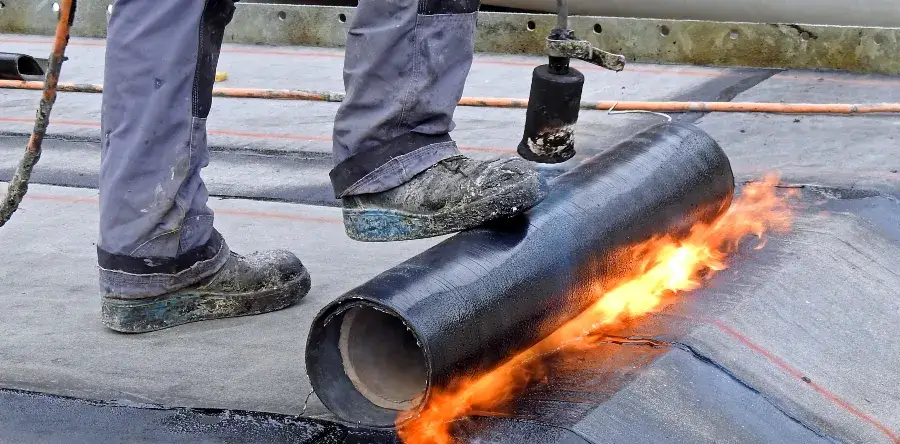
Modified bitumen is a layered asphalt roofing system used often on repairs, replacements, and retrofits of older commercial roofs in Arizona. It uses polymer-modified asphalt, usually SBS or APP, to improve flexibility and crack resistance compared with older built-up systems. That makes it relevant on apartment buildings, industrial roofs, and institutional properties where owners want a familiar asphalt-based system but need a little more resilience than the older style provided.
This roof type tends to show up when an existing building already has a low-slope asphalt assembly and the owner wants to keep the roof serviceable without changing the whole structure. It's still a real option for Phoenix and Tucson properties, but it's generally less attractive than newer single-ply or spray foam systems when the goal is long-term efficiency. For that reason, a lot of owners view it as a bridge solution rather than a final destination.
When modified bitumen makes sense
Modified bitumen can be a good fit where the building is already set up for asphalt-based roofing and where layered waterproofing is useful. SBS-modified systems are typically the safer bet in temperature swings because flexibility matters when surfaces expand and contract under Arizona heat. Light-colored cap sheets, if available, can also help reduce heat absorption.
Practical rule: Use modified bitumen when the building's existing conditions support it, not just because it's familiar. On many Arizona roofs, the smarter long-term plan is a staged move toward single-ply or spray foam.
Inspection discipline matters here more than many owners expect. Blistering, cracking, and coating loss can become visible around edges and seams, especially after repeated sun exposure. On older commercial buildings in Phoenix or retrofit jobs in Mesa, modified bitumen usually makes the most sense when the owner understands it as a durable repair system, not a final answer for every roof.
8 Roof Construction Types Compared
| Item | Implementation complexity | Resource requirements | Expected outcomes | Ideal use cases | Key advantages |
|---|---|---|---|---|---|
| Pitched (Sloped) Roof Construction | Moderate–High: framing, slope work, flashing details | Skilled carpenters, underlayment, roofing material (shingles/tile/metal), ventilation components | Reliable water shedding, usable attic space, 25–50+ year life depending on material | Residential homes in monsoon-prone areas; traditional and contemporary styles | Natural drainage; good ventilation; versatile material compatibility; proven track record |
| Flat Roof Construction | Moderate: critical drainage design and detailing | Single-ply membranes, modified bitumen, or spray foam; tapered insulation; drains and flashings | Accessible roof surface, platform for equipment/solar; lifespan varies by system (15–25+ yrs) | Commercial buildings, modern residences, roofs serving HVAC/solar | Maximizes interior space; easy equipment access; good for rooftop amenities; reflective options available |
| Metal Roof Construction | Moderate–High: precise fastening and thermal movement control | Metal panels (standing seam/exposed), specialized installers, fasteners, sealants, insulation | Very long lifespan (50+ yrs), high solar reflectance, durable and hail/fire resistant | High-end residential, commercial, agricultural and industrial buildings | Exceptional durability; energy savings from reflectivity; low maintenance; fire resistant |
| Clay and Concrete Tile Construction | High: heavy load requirements and specialized installation | Heavy tiles, reinforced roof framing, battens, experienced tile contractors | Extremely long life (50–100+ yrs), strong thermal mass, iconic aesthetic | Southwestern/Mediterranean/Spanish Colonial homes and high-end estates | Outstanding longevity and aesthetics; excellent fire resistance; individual tile replacement |
| Asphalt Shingle Roof Construction | Low: straightforward installation and repairs | Shingles, underlayment, nails, common roofing crews | Affordable protection, quick installation, lifespan ~15–25 yrs in hot climates | Budget residential projects, tract homes, quick replacements | Low initial cost; wide availability; fast install and simple repairs; many style/color options |
| Spray Foam Roof Construction | High: specialized application and coating maintenance | Certified spray foam contractors, polyurethane foam, protective elastomeric coatings | Seamless waterproofing, high R-value and air-seal, 20–30 yr with maintenance; major energy savings | Commercial/industrial flat or low-slope roofs; retrofit over existing roofs | Excellent insulation and air sealing; seamless application; can be applied over existing roof |
| Single-Ply Membrane Roof Construction | Moderate: seam quality and fastening are critical | TPO/EPDM/PVC membranes, insulation, experienced installers, heat-welding or adhesives | Good UV resistance and reflectivity (white membranes), reliable waterproofing, ~20–25 yr life | Commercial flat roofs, retail, multifamily and institutional buildings | Fast install; strong waterproofing when seamed correctly; good reflectivity and lightweight |
| Modified Bitumen Roof Construction | Moderate–High: multi-layer application, possible torch work | SBS/APP modified rolls, adhesives or torch equipment, multiple layers and cap sheets | Durable multi-layer system, 15–20 yr typical, better flexibility than built-up asphalt | Repair/replacement of older built-up roofs, industrial and commercial renovations | Layered redundancy; flexible (SBS) for thermal movement; cost-effective for reroofs and repairs |
Partner with Arizona's Top Roofing Experts
Understanding the different types of roof construction is the first step toward making a smart investment. The next is choosing a contractor who knows how to install each system correctly for Arizona's climate, from the heat load in Phoenix to the monsoon exposure in Tucson. Arizona Roofers has over 25 years of experience with the systems discussed here, and its work across Phoenix, Scottsdale, Tucson, Mesa, Chandler, and surrounding communities is built around inspection, replacement, and precision installation.
That matters because roof choice is never just about materials. It's about slope, drainage, wind uplift, ventilation, coating life, and how the assembly handles Arizona's UV, heat, and temperature swings. Arizona Roofers offers free roof inspections, emergency repairs, complete replacements, and installations across major roof systems, including tile, asphalt shingles, metal, spray foam, modified bitumen, coatings, and single-ply.
For property owners comparing roof types on a house, storefront, or commercial facility, a clear inspection report can prevent expensive surprises later. The right contractor should explain what the roof has, what it needs, and whether the structure can support the best long-term choice. That's especially important in Arizona, where the wrong system can look fine from the street but fail early under sun and storm stress.
Ready for a practical recommendation for your property in Phoenix, Scottsdale, Tucson, Mesa, or Chandler? Call (480) 531-6383 for a free, no-obligation inspection and a same-day quote from the best roofer in Arizona.
Arizona Roofers can help you compare roof systems, inspect damage, and choose a construction type that fits Arizona heat, wind, and monsoon conditions. Visit Arizona Roofers to schedule an inspection, review material options, and get guidance for your home or commercial property.