
The expected roofing material lifespan can be a real shocker. On paper, you might see 20 years for standard asphalt shingles and over 70 years for a premium metal roof. But here in Arizona, those numbers are just a starting point.
The reality is, your roof's actual longevity comes down to the quality of the materials, the skill of the installers, and how it holds up to our brutal climate.
Understanding Roofing Lifespan In Arizona's Climate
Choosing a new roof in Phoenix or Scottsdale isn't just about picking a color that matches your stucco. The intense desert sun, violent monsoon downpours, and wild temperature swings put a unique and massive strain on any roofing system.
A manufacturer’s warranty often reflects performance in a perfect, mild world—not the reality of 110-degree days baking your roof into submission. Getting a handle on how different materials really perform out here is the only way to make a smart investment that lasts.
Comparing Material Performance In The Desert
The material you choose is ground zero for your roof's durability. Some are built to reflect UV rays and fight off heat degradation, while others offer a lower upfront cost but will have you calling a roofer again much sooner than you'd like.
This chart breaks down the typical lifespan differences you can expect from the three most common roofing materials we see in Arizona.
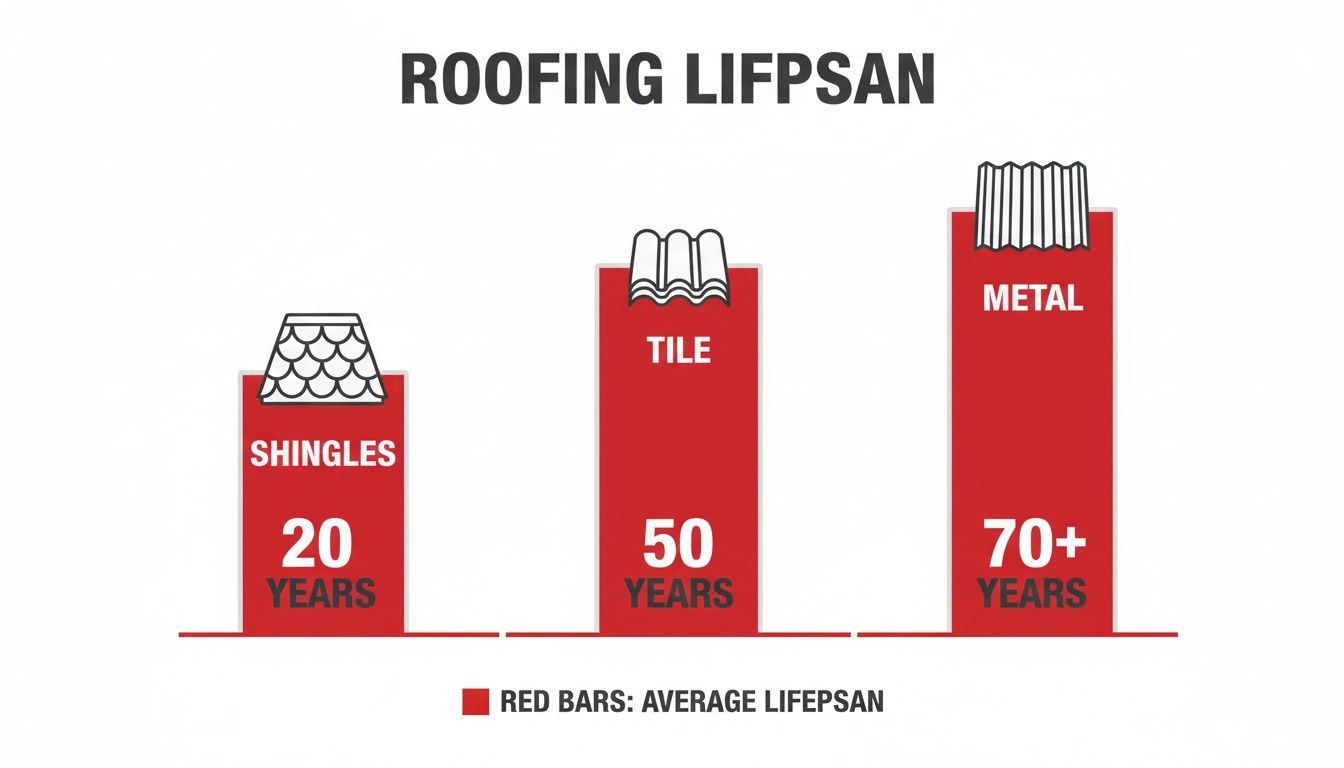
As you can see, while shingles are a common entry point, both tile and metal deliver a much longer service life. That makes them a far more durable and cost-effective choice for Arizona homeowners in the long run.
To make it even clearer, here’s a quick-glance table comparing how these materials stack up under our local conditions.
Arizona Roofing Lifespan Quick Comparison
This table shows the real-world lifespan, initial cost, and long-term value for common roofing materials in Arizona, factoring in our unique climate.
| Material Type | Real-World Arizona Lifespan | Upfront Cost | Long-Term Value |
|---|---|---|---|
| Asphalt Shingles | 15-25 Years | Low | Fair |
| Concrete/Clay Tile | 30-50+ Years | Medium | Excellent |
| Metal Roofing | 50-70+ Years | High | Superior |
The takeaway is simple: the materials that cost more upfront almost always deliver superior value over time because they were engineered to survive the desert.
Choosing a material built for high heat and relentless UV exposure is the single most important decision for maximizing your roof's lifespan in Arizona. A material that does just fine in a milder climate can fail decades sooner here.
As a leading roofer in Arizona, our team at Arizona Roofers has spent over two decades installing roofs designed specifically to endure this harsh environment. We help homeowners in Phoenix, Tucson, and across the state choose and install systems that provide true, lasting peace of mind.
If you're worried about your current roof or starting to plan for a replacement, don't leave it to guesswork. Call our experts at (480) 531-6383 for a free, no-pressure inspection. We'll give you an honest assessment and a clear plan to keep your home protected for years to come.
The Real Lifespan Of Asphalt Shingles In Arizona

Asphalt shingles might be the go-to roofing choice across the U.S., but here in Arizona, they’re in a class of their own—and not always for the right reasons. Manufacturers love to advertise impressive 20 to 45-year warranties, but those numbers are rarely tested against the harsh reality of our desert climate. The relentless sun in cities like Mesa and Chandler literally bakes shingles all year long, causing them to fail much sooner than they would in cooler parts of the country.
That constant thermal stress causes shingles to break down in two predictable ways. First, the protective mineral granules that give shingles their color and UV-blocking power get cooked right off. As more granules fall away, the asphalt mat underneath is left exposed, quickly becoming brittle and extremely vulnerable to cracking or getting ripped off by monsoon winds.
3-Tab Vs. Architectural Shingles In The Sun
When you’re looking at asphalt, it’s critical to know the difference between standard 3-tab and architectural shingles. Both are fighting a losing battle with our sun, but how they’re built leads to very different outcomes for their roofing material lifespan.
- 3-Tab Shingles: These are the basic, single-layer flat shingles. They’re affordable and lightweight, but that thin profile also makes them extra susceptible to heat damage and wind lift. It’s not uncommon to see them fail in as little as 15 years in the Phoenix metro area.
- Architectural Shingles: Also called dimensional shingles, these are built with multiple laminated layers, which makes for a much thicker and more durable product. Their heavier construction and more robust design give them better resistance to UV breakdown and wind, so they typically last between 20 and 25 years.
Even with the upgrade, premium architectural shingles almost never hit their advertised “lifetime” warranty here in Arizona. The sun is the great equalizer, which makes having realistic expectations absolutely essential for any homeowner.
This gap between the warranty on the package and real-world performance is well-documented. Research from the Institute for Business & Home Safety (IBHS) confirms that under extreme weather conditions, the actual service life of shingles is a fraction of what’s advertised. You can read the full report on asphalt shingle performance from the IBHS to learn more.
The Critical Role Of Installation And Ventilation
Forget the shingle type for a second—two other things are non-negotiable if you want to get the most life out of your roof in Arizona: installation quality and attic ventilation. Sloppy nailing, for example, is all it takes for shingles to lift and snap during a powerful monsoon storm.
Even more important is ventilation. A poorly ventilated attic can easily top 150°F on a summer day, which basically cooks your shingles from the inside out and can instantly void your manufacturer’s warranty. For a deeper look, you can check out our guide on how long you can expect your shingle roof to last.
At Arizona Roofers, we’re known as the best roofer in Arizona because we tackle these exact issues head-on. Our certified crews use superior installation methods and are experts at designing balanced ventilation systems. This ensures your shingles aren’t just installed to code, but are also protected from the attic heat that silently destroys so many roofs. For an honest assessment, give us a call at (480) 531-6383.
How Long Tile Roofs Actually Last In The Desert

Tile roofing is an iconic look across Arizona, and for good reason. Clay and concrete tiles are incredibly tough, easily holding up to our brutal sun and monsoon downpours for 50 years or more. In fact, it’s not unusual for the tiles themselves to last well over a century.
But here’s the catch: that impressive durability can be seriously misleading for homeowners in Phoenix, Scottsdale, and the rest of the valley. The real story isn't about the tile you see.
The tiles are just the outer shield. All the real waterproofing work happens in the layer hidden beneath them, known as the underlayment. This is the single most important part of your tile roof’s lifespan, and it’s also the component most vulnerable to our desert heat.
The Underlayment: The Secret Point Of Failure
Standard felt underlayment, the kind that works just fine in milder climates, simply can't handle the extreme attic temperatures we see in Arizona. Day after day of being baked by the sun makes the material brittle, causing it to crack, crumble, and completely lose its ability to stop water.
This damage happens silently, right under your nose. Most homeowners have no idea there’s a problem until a leak shows up in their ceiling. By then, the underlayment has already failed completely. It’s not uncommon to see a standard underlayment give out in just 15 to 20 years—decades before the tiles on top show any hint of aging.
A tile roof is only as strong as its underlayment. While the tiles can last a lifetime, the entire system fails the moment that underlayment is compromised by Arizona's relentless heat.
This is why just looking at a tile's advertised roofing material lifespan can give you a false sense of security. The right question to ask is how long the complete system—the tiles and the underlayment—will actually last. You can dig deeper into the durability of different tiles in our article on clay versus concrete tile roofing.
Maximizing Your Tile Roof Lifespan
If you want a tile roof system that truly lasts 50 years, you have to tackle the underlayment problem head-on. It all comes down to two critical elements:
- Using High-Temperature Synthetic Underlayment: Modern synthetic underlayments are specifically engineered to endure extreme heat without breaking down. They provide far better durability and a much longer life than old-school felt paper, making them an absolute must for any tile roof in Arizona.
- Ensuring Professional Installation: Even the best materials on the market will fail if they aren’t installed correctly. A professional tile installation makes sure every part of the system—from the flashings and battens to the underlayment itself—is sealed and secured to create a single, cohesive unit built to last.
As the best roofer in Arizona, Arizona Roofers specializes in building tile roof systems designed for maximum desert durability. We exclusively use high-temperature synthetic underlayments to make sure your roof’s foundation is just as tough as the tiles protecting it. We don't just install a roof; we engineer a complete system to protect your home for decades.
To get a quote for a tile roof built to last, call us today at (480) 531-6383.
Why Metal Is The Ultimate Long-Term Roofing Investment
If you're an Arizona property owner looking for a roofing solution you’ll only have to install once, metal is in a league of its own. While many other materials simply try to survive our desert climate, metal is engineered to conquer it. This puts it in the top tier for anyone who sees their roof as a permanent investment, not just a temporary fix.
Unlike materials that bake and degrade under constant UV attack, metal delivers exceptional longevity that pays for itself over the decades. A metal roof's lifespan isn’t measured in 20-year cycles; it’s measured in generations, letting you skip the costly replacements that shingle roofs inevitably require.
Unmatched Durability And Lifespan
The biggest draw for metal roofing is its incredible service life, even under the brutal sun in Phoenix or Tucson. Most common metal systems, like steel and aluminum, have a proven lifespan of 40 to 70 years. That’s easily three or four times longer than a standard asphalt shingle roof.
Premium options take that durability even further. High-end zinc and copper roofs are known to last 60 to 100 years—and sometimes even longer—making them a truly permanent part of a home's structure. It's not unheard of for these roofs to protect a property for over a century.
Practical Benefits For The Arizona Climate
Beyond just lasting forever, a metal roof offers real, day-to-day advantages perfectly suited for Arizona living. Its performance goes far beyond simply keeping the rain out.
- Superior Energy Efficiency: Metal roofs are highly reflective, bouncing a huge portion of the sun’s UV rays away from your house. This “cool roof” effect can dramatically lower attic temperatures, take a significant load off your air conditioning system, and ultimately reduce your energy bills all summer long.
- Unmatched Weather Resistance: From the high-velocity winds of a monsoon storm to the occasional hailstorm, metal offers superior protection. The panels interlock to create a formidable shield that is far less likely to suffer from wind uplift or puncture damage compared to other materials.
- Minimal Maintenance: Metal roofs are famously low-maintenance. You won’t have to worry about granule loss like you do with shingles, or the risk of cracked tiles. A properly installed system needs little more than an occasional inspection to ensure it’s performing at its best for decades.
While the upfront cost of a metal roof is higher, it's best viewed as a one-time capital improvement. By completely eliminating the need for two or three future roof replacements, a metal roof provides far greater financial value and total peace of mind.
At Arizona Roofers, we specialize in the precision installation of high-performance standing seam metal roofs. A metal roof is only as good as the team that installs it, and our certified contractors ensure every panel is perfectly sealed and fastened to deliver the ultimate in durability and energy efficiency. To get a more complete picture, you can explore our article on the benefits and drawbacks of metal roofing.
If you’re ready to make your next roof your last one, give us a call at (480) 531-6383 for a personalized quote.
Critical Factors That Define Your Roof's Lifespan

The material you choose is a big part of the equation, but it’s definitely not the only thing that dictates your roofing material lifespan. We’ve seen fantastic materials fail in just a decade, while others outlive their warranties by years. The difference often comes down to a few critical factors that protect your investment.
Think of it this way: the shingles or tiles are the roof's armor. But if that armor isn't fitted correctly or maintained, it leaves gaps for the enemy—our brutal Arizona sun and monsoon storms—to get in.
Understanding what really makes a roof last is the key to getting decades of reliable protection for your home.
The Impact Of Installation Quality
No single factor matters more than the quality of the installation. A roof is a complete system, and one small shortcut can cause a domino effect of problems, leading to premature failure. Frankly, shoddy workmanship is behind most of the early roof replacements we see.
Some of the most common installation mistakes that spell disaster here include:
- Improper Nailing: Under-driven nails leave shingles loose and ready for a monsoon storm to rip them off. Over-driven nails punch right through the shingle, creating a hole for water to seep in.
- Poor Flashing Work: Flashing is the metal that seals the gaps around chimneys, vents, and valleys. If it isn't installed and sealed perfectly, it’s not a question of if it will leak, but when.
- Ignoring Deck Inspection: A true professional always inspects the wooden roof deck after the old materials come off. Nailing new shingles over soft, spongy, or rotted wood is a recipe for total failure.
Choosing your roofer is just as important as choosing your roofing material. An expert installer ensures every component works together as a system, maximizing its durability. A cheap, corner-cutting crew will almost always cost you far more in repairs and an early replacement.
The Hidden Destroyer: Attic Ventilation
In Arizona, your attic is a pressure cooker. Without proper ventilation, attic temperatures can easily soar past 150°F on a summer afternoon. That intense, trapped heat literally bakes your roofing materials from the bottom up, causing them to break down years ahead of schedule.
Good attic ventilation isn't a bonus feature; it's a survival requirement. A balanced system of intake and exhaust vents creates airflow that lets that superheated air escape.
This does a few very important things:
- Prevents your shingles and underlayment from being cooked.
- Lowers the strain on your air conditioning system.
- Stops moisture from building up, which can cause mold and rot in the attic.
Without enough airflow, even the toughest roofing materials won't stand a chance and will have their lifespan cut drastically short.
Proactive Maintenance And Environmental Factors
Finally, simple, proactive care makes a world of difference. Proper drainage is absolutely crucial, and understanding the basics of maintaining gutters in Arizona is essential. When gutters get clogged with leaves and debris, rainwater backs up and seeps under your shingles or tiles, rotting the fascia board and underlayment.
It’s also smart to keep overhanging trees trimmed. Scraping branches can wear away the surface of your shingles, and falling limbs during a storm can cause serious damage. A small, proactive repair today can prevent a massive, expensive problem tomorrow.
As the best roofer in Arizona, Arizona Roofers has built our name on mastering these critical details. Our certified installers in Phoenix, Tucson, and across the state know that a long-lasting roof is the sum of all its parts—from the material and ventilation down to the very last nail. For an expert evaluation of your roof's health, give us a call at (480) 531-6383.
Choosing The Best Roof For Your Arizona Property
Picking a new roof means weighing your budget against your long-term plans and what kind of property you own. Since so many variables affect the true roofing material lifespan, there’s just no single "best" answer. The right choice is the one that fits your specific situation.
We’ve already covered how different materials hold up under the brutal Arizona sun. Now, let’s put that knowledge into practice with a few real-world scenarios you might run into as a property owner in Phoenix, Scottsdale, or Tucson. This should give you the confidence to make a smart decision.
Recommendations For Different Property Types
Your roofing needs change drastically depending on whether you're safeguarding your family home for thirty years or just trying to maximize the return on a rental property. Here are our recommendations based on what we hear from homeowners every day.
Scenario 1: Your "Forever Home" in Scottsdale
If you’re settled in for the long haul and want maximum protection and energy savings, a standing seam metal roof is the wisest investment. Yes, the upfront cost is higher, but its 50-70+ year lifespan and incredible ability to reflect solar heat give you unbeatable long-term value. You'll see the difference in your cooling bills for decades.
Scenario 2: A Budget-Conscious Family Home in Mesa
For homeowners needing a dependable, good-looking, and affordable roof, a professionally installed architectural shingle roof offers the best balance of price and performance. You get a solid 20-25 year lifespan in our climate and a huge visual upgrade over basic 3-tab shingles, all without the steep cost of tile or metal.
The most important decision isn’t always the material itself, but ensuring it’s installed by an expert who understands Arizona’s unique challenges. A perfectly installed shingle roof will always outperform a poorly installed tile roof.
Scenario 3: A Rental Property in Glendale
When durability and a solid return on investment are the top priorities for an income property, a concrete tile roof system is an excellent choice. The tiles themselves are nearly indestructible. When you pair them with a high-temperature synthetic underlayment, the whole system gives you a 30-50 year lifespan with very little maintenance, protecting your asset for the long run.
End Your Roofing Worries Today
Trying to figure all this out can be a headache, but you don't have to go it alone. As the best roofer in Arizona, our team at Arizona Roofers is here to bring some clarity and expert advice to the table. We’ll walk you through the options and help you land on the perfect system for your property and budget.
End your roofing worries for good. Contact Arizona Roofers today at (480) 531-6383 for a free, expert inspection and a personalized quote designed to protect your Arizona property for the long haul.
Frequently Asked Questions About Roof Longevity
When it comes to roofing in Arizona, we get a lot of questions about how long a roof really lasts. Here are some quick, straight-to-the-point answers to the concerns we hear most from homeowners in Phoenix, Mesa, and across the Valley.
How Does The Arizona Sun Actually Damage My Roof?
The intense UV radiation here in Arizona is relentless. On asphalt shingles, it literally bakes off the protective granules, which leaves the asphalt mat underneath exposed and brittle. Once that happens, it's just a matter of time before a monsoon storm causes it to crack.
For tile roofs, the sun’s primary target is the underlayment—the real waterproof barrier. All that extreme heat essentially cooks the material until it becomes fragile and fails. This daily cycle of heating and cooling also causes the entire system to expand and contract, which slowly weakens seals and fasteners.
Will A Lifetime Shingle Really Last A Lifetime In Phoenix?
Unfortunately, no. A "lifetime" or 50-year shingle warranty is mostly a marketing term based on perfect lab conditions, not the brutal reality of a Phoenix summer. In our climate, you can realistically expect a top-quality architectural shingle to give you 25-30 years of solid performance before it starts to break down.
It's critical to plan your budget around this real-world lifespan, not the number on the warranty. A "lifetime" shingle here means a long life for a shingle, not for the life of your home.
As local roofers, we at Arizona Roofers give honest lifespan estimates based on thousands of roofs we’ve installed in the Valley. We think setting clear, realistic expectations is the only way to help you plan for your home's future with confidence.
Is It OK To Install A New Roof Over An Old One?
While it’s technically possible in some situations, it's a terrible idea in Arizona. This practice, called a "roof-over," traps a huge amount of heat between the two layers. That trapped heat will bake your new shingles from below and dramatically shorten their life.
Worse yet, it makes it impossible for a roofer to inspect the underlying roof deck for any rot or storm damage—a critical safety check. For the durability of your roof and the safety of your family, a complete tear-off is always the right way to do it. We’re known as the best roofer in Arizona because we simply refuse to cut corners that put your home's integrity at risk.
Ready to get clear, honest answers about your roof's condition? The experts at Arizona Roofers offer free, no-obligation inspections across Arizona, including in major cities like Phoenix, Tucson, Scottsdale, and Chandler. Call us today at (480) 531-6383 or visit our website to learn more at https://arizonaroofers.com.