
A Phoenix property manager sees the monsoon build over South Mountain, checks the radar, and starts thinking about the roof. Not the lobby. Not the parking lot. The roof. If that low-slope system has open seams, clogged drains, failing flashings, or soft insulation around rooftop units, the next hard rain can turn a manageable maintenance item into tenant complaints, interior damage, and an expensive emergency call.
Owning or managing a commercial building in Arizona presents specific challenges. The roof has to handle intense UV, long stretches of extreme heat, sudden temperature swings, rooftop equipment traffic, and fast-moving storms that expose every weak detail at once. A flat roof that performs well in a mild climate can struggle here if the system choice, installation quality, and maintenance plan don’t match the environment.
Commercial owners aren’t guessing at a niche trend, either. The global flat roofing systems market was valued at US$57.52 billion in 2023 and is projected to reach US$66.23 billion by 2027, with a 3.59% CAGR, which shows how central these systems are to commercial construction worldwide.
Table of Contents
- Your Guide to Commercial Flat Roofs in Arizona
- Why Flat Roofs Dominate Commercial Architecture
- Comparing the Top Commercial Flat Roof Systems
- Maximizing Energy Efficiency with Cool Roofs in Arizona
- Installation Best Practices and Proactive Maintenance
- How to Choose Your Arizona Commercial Roofing Partner
Your Guide to Commercial Flat Roofs in Arizona
Flat roof systems for commercial buildings make sense in Arizona, but only when they’re matched to the building’s use and the local climate. A warehouse in Mesa, a retail center in Scottsdale, a medical office in Tucson, and an industrial property in Chandler can all have “flat roofs” while needing very different assemblies, drainage layouts, surfacing options, and maintenance schedules.
That’s where many owners get into trouble. They compare proposals by price alone, assume all flat roofs perform about the same, and overlook details that decide service life. The decision isn’t just membrane versus coating, or replacement versus repair. It’s how the entire roof system will respond to heat loading, expansion and contraction, rooftop traffic, ponding, and storm exposure over time.
What property managers usually need to know first
Most commercial decision-makers want answers to a short list of practical questions:
- Will this roof tolerate Arizona heat? Some systems reflect heat well but depend heavily on clean installation and drainage.
- How will it handle monsoon season? Fast drainage and watertight detailing matter more than sales language.
- Can crews service HVAC and other rooftop equipment without damaging it? Some assemblies hold up better under traffic.
- What does long-term ownership look like? The cheapest initial proposal often creates the most expensive maintenance pattern.
Practical rule: On Arizona commercial roofs, the weak point is rarely the broad field of the roof alone. Failures usually begin at seams, drains, curbs, parapet transitions, and penetrations.
What smart roof planning looks like
A sound roofing decision starts with the building, not the brochure. Roof slope, drain count, deck condition, insulation layout, equipment density, tenant sensitivity, and future plans for solar all affect the right answer. For one building, a reflective single-ply system may be the right fit. For another, a tougher multi-layer assembly may be the better asset-management decision.
Owners who treat the roof as a working system usually make better choices than owners who treat it as a one-line capital expense. That’s especially true in Arizona cities where cooling demand, storm exposure, and rooftop service activity are constant parts of building operations.
Why Flat Roofs Dominate Commercial Architecture

Flat roofs dominate commercial construction because they solve practical building problems better than steep-slope designs on large structures. They create a broad, usable platform for HVAC equipment, electrical runs, vents, access paths, and solar infrastructure without forcing awkward framing or wasting valuable square footage.
That utility matters more in Arizona than many owners realize. Commercial buildings here often depend on substantial rooftop mechanical equipment. A roof that can support access, simplify servicing, and allow straightforward coordination with trades is easier to manage over the life of the property.
Cost and scale make flat roofs the standard
Large-span commercial buildings reward simple geometry. According to commercial flat roofing market data, flat roofs can require up to 30-50% less material than pitched alternatives, which helps reduce installation time and construction cost on big projects.
That isn’t just a construction-phase benefit. Simpler roof forms usually mean easier inspection routes, fewer complicated transitions, and more predictable repair planning. On a retail center or warehouse, that operational clarity matters.
They function as utility platforms
A good way to think about commercial flat roofs is as building infrastructure, not just weather covering. They support:
- Mechanical placement: HVAC units, exhaust systems, and related penetrations.
- Energy upgrades: Solar arrays and reflective assemblies fit naturally on low-slope roofs.
- Service access: Technicians can reach equipment more safely and efficiently than on steep roofs.
- Future flexibility: Building owners can reconfigure rooftop zones as tenant needs change.
A commercial flat roof isn’t just the lid on the building. It’s the platform that supports the building’s ongoing operations.
They’re easier to inspect with discipline
Flat doesn’t mean maintenance-free. It means accessible. That’s a major advantage if the owner uses it properly. Regular walkthroughs can catch early seam movement, flashing stress, drain blockage, coating wear, and damage around equipment before water gets inside.
The same accessibility can become a liability when too many trades use the roof carelessly. Arizona roofs often suffer from repeated foot traffic, unsecured service practices, and penetration work done by non-roofing crews. The design makes access easier. It doesn’t remove the need for controls.
For most commercial buildings, the answer isn’t whether flat roofs are practical. It’s how to select the right flat roof system and manage it as a long-term operating asset.
Comparing the Top Commercial Flat Roof Systems
A property manager in Phoenix can inherit two buildings with the same square footage and get completely different roof results over the next ten years. One roof holds up through UV, service traffic, and monsoon season with manageable repair costs. The other turns into a cycle of leaks, emergency patches, and rising tenant complaints. The difference usually starts with system selection, then gets amplified by installation quality and maintenance discipline.
The phrase flat roof systems for commercial buildings covers several assemblies with very different strengths. In Arizona, the right choice depends on more than upfront price. Heat gain, UV exposure, drainage performance, foot traffic, rooftop equipment, and the owner’s hold period all affect which system delivers the best return.
Before signing a proposal, many owners benefit from a plain-language overview of TPO roofing material because single-ply systems come up in so many replacement discussions.
Built-up roofing
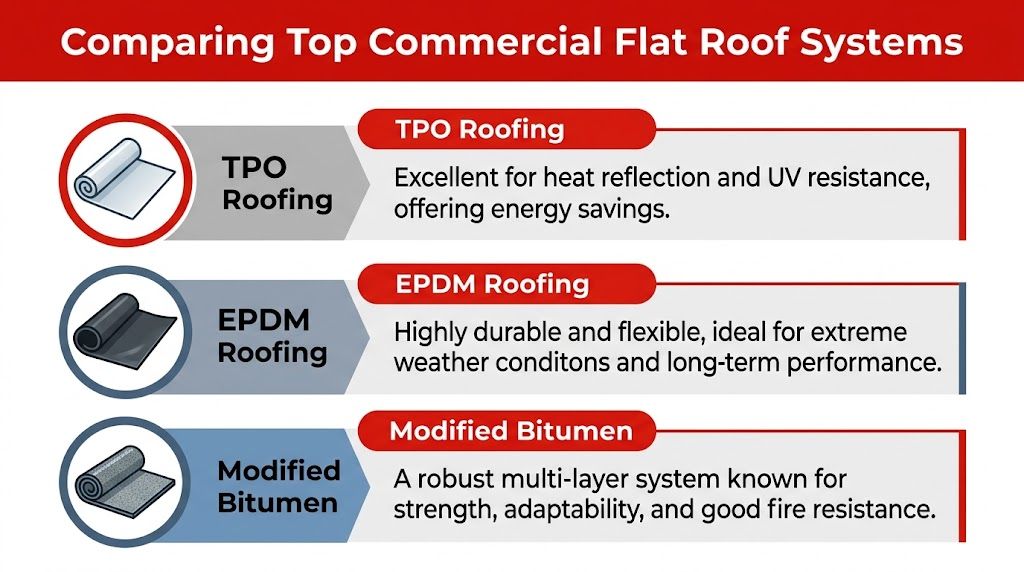
Built-up roofing, or BUR, still earns its place on some commercial properties. It uses multiple layers of bitumen and reinforcing plies, which gives the assembly built-in redundancy. That matters on buildings where the owner values proven waterproofing and a roof surface that can take abuse.
BUR is often a better fit for roofs with frequent foot traffic, maintenance routes, and service activity around mechanical units. The trade-off is weight, labor intensity, and more involved repairs. On an older structure, the building has to be able to handle the assembly. On a project centered on reflectivity and a lighter system, BUR is often not the first choice.
Modified bitumen
Modified bitumen works well for many Arizona buildings because it balances toughness with a familiar low-slope installation approach. It is an asphalt-based system with reinforcement and polymer modification, so it generally handles traffic and physical wear better than lighter membranes.
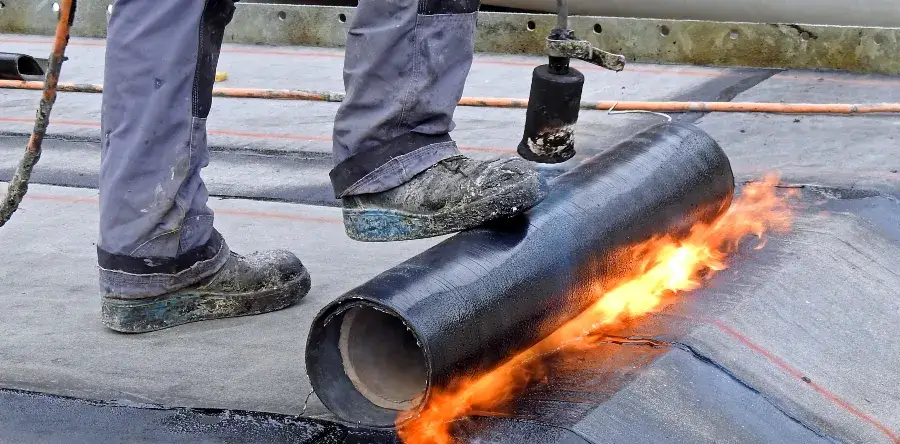
A 2-ply torch-applied assembly is a common option in this category. Industry guidance notes that well-maintained 2-ply modified bitumen can deliver long service life and can be specified with reflective cap sheets that help on sun-exposed Arizona roofs. That combination makes it a practical choice for retail, industrial, and mixed-use properties where technicians are on the roof regularly.
Modified bitumen performs best when the contractor controls the details. Torch application requires skill. Flashings have to be tight. Drainage still has to work. A durable field membrane will not make up for bad edge metal, weak curb details, or standing water after a monsoon storm.
Good fits for modified bitumen
- Retail centers with heavy service traffic: Better resistance to repeated foot traffic near rooftop units.
- Industrial buildings with busy equipment zones: Extra mass helps in hard-use areas.
- Properties where puncture resistance is a priority: Multi-layer construction gives owners more margin for abuse.
Single-ply membranes
Single-ply systems get a lot of attention in Arizona because they can combine lower roof temperatures with efficient installation. That does not make them interchangeable. TPO, PVC, and EPDM solve different problems, and owners who treat them as the same product often make the wrong decision.
TPO
TPO is common on Arizona commercial roofs because the membrane is reflective and the seams are heat-welded. On large low-slope roofs, that can be a strong combination for buildings trying to control cooling demand and maintain watertight seams across wide open spans.
TPO usually makes the most sense on buildings with good drainage, relatively clean roof geometry, and owners who want a balance of energy performance and replacement cost. I recommend extra scrutiny around perimeter securement, penetrations, and field seams because Arizona heat exposes poor workmanship fast. A neat-looking install on day one is not enough. The weld quality and attachment pattern have to hold up through thermal movement and summer exposure.
PVC
PVC is another reflective single-ply option. It is often selected for buildings with grease exhaust, chemical exposure, or operating conditions that call for a membrane with that specific resistance profile.
For a standard office, warehouse, or retail building without those conditions, the added cost does not always translate into better ROI. Property managers should tie the specification to actual building use, not just the idea that a premium membrane must be the safer choice.
EPDM
EPDM has a long track record in commercial roofing and can be a practical system on the right building. It is flexible, repairable, and familiar to many service crews.
In Arizona, the main drawback is heat absorption on darker assemblies. That does not rule it out, but it changes the math. On buildings where summer cooling cost and rooftop temperature are major concerns, owners often favor more reflective systems. On other properties, especially where layout is simple and energy performance is being addressed elsewhere, EPDM can still be a reasonable choice.
Owners weighing membrane options should compare layout, roof access, traffic patterns, penetrations, and long-term operating goals, not just membrane brand recognition. A more detailed breakdown is available in this guide to the best roof material for flat roof.
Spray polyurethane foam
Spray polyurethane foam, or SPF, is a strong Arizona-specific option on the right building. It creates a monolithic insulated surface that can work well where the owner wants to avoid a full tear-off or where the roof has irregular geometry, many penetrations, or details that are harder to address with sheet goods.
SPF has real advantages in this climate. It adds insulation value and eliminates many seam-related weak points. It also depends heavily on execution. Surface preparation, moisture control, application thickness, and coating maintenance all affect performance. A neglected coating turns a good SPF roof into a short-lived asset.
I usually see SPF perform best on buildings with owners who budget for inspections and recoats instead of waiting for leaks to force a decision.
Elastomeric coatings
Elastomeric coatings are often restoration systems, not full replacements. On a dry, stable, repairable substrate, a coating can extend roof life, improve reflectivity, and delay capital replacement. That can make financial sense for an owner who needs more useful years from an existing roof without committing to a full tear-off today.
The mistake is using a coating to cover active failure. Wet insulation, open laps, bad drainage, deteriorated flashings, and structural issues need to be corrected first. A coating can protect a viable roof. It cannot rescue one that has already failed.
Coatings make sense after a condition assessment confirms the existing roof still has a serviceable foundation.
Commercial Flat Roof System Comparison
| System Type | Average Lifespan | Installed Cost / Sq. Ft. | AZ Heat Performance | Key Benefit |
|---|---|---|---|---|
| Built-Up Roofing | Varies by assembly and maintenance | Varies by project | Solid when properly surfaced and maintained | Multi-layer redundancy |
| Modified Bitumen | Long service life with regular maintenance | Varies by project | Strong fit for traffic-heavy roofs, especially with reflective surfacing | Durability under use |
| TPO | Commonly selected for long-term service on well-installed systems | Varies by project | Very strong due to reflective surface | Heat reflectivity and welded seams |
| PVC | Varies by assembly and conditions | Varies by project | Strong on buildings with specific exposure demands | Chemical resistance profile |
| EPDM | Long-lasting in many commercial applications | Varies by project | Less focused on heat reflectivity | Flexibility and repairability |
| Spray Polyurethane Foam | Varies by coating cycle and upkeep | Varies by project | Strong when coating is maintained | Insulation value with monolithic coverage |
| Elastomeric Coatings | Depends on underlying roof condition | Varies by project | Useful for reflective restoration | Extends service life on viable roofs |
Maximizing Energy Efficiency with Cool Roofs in Arizona
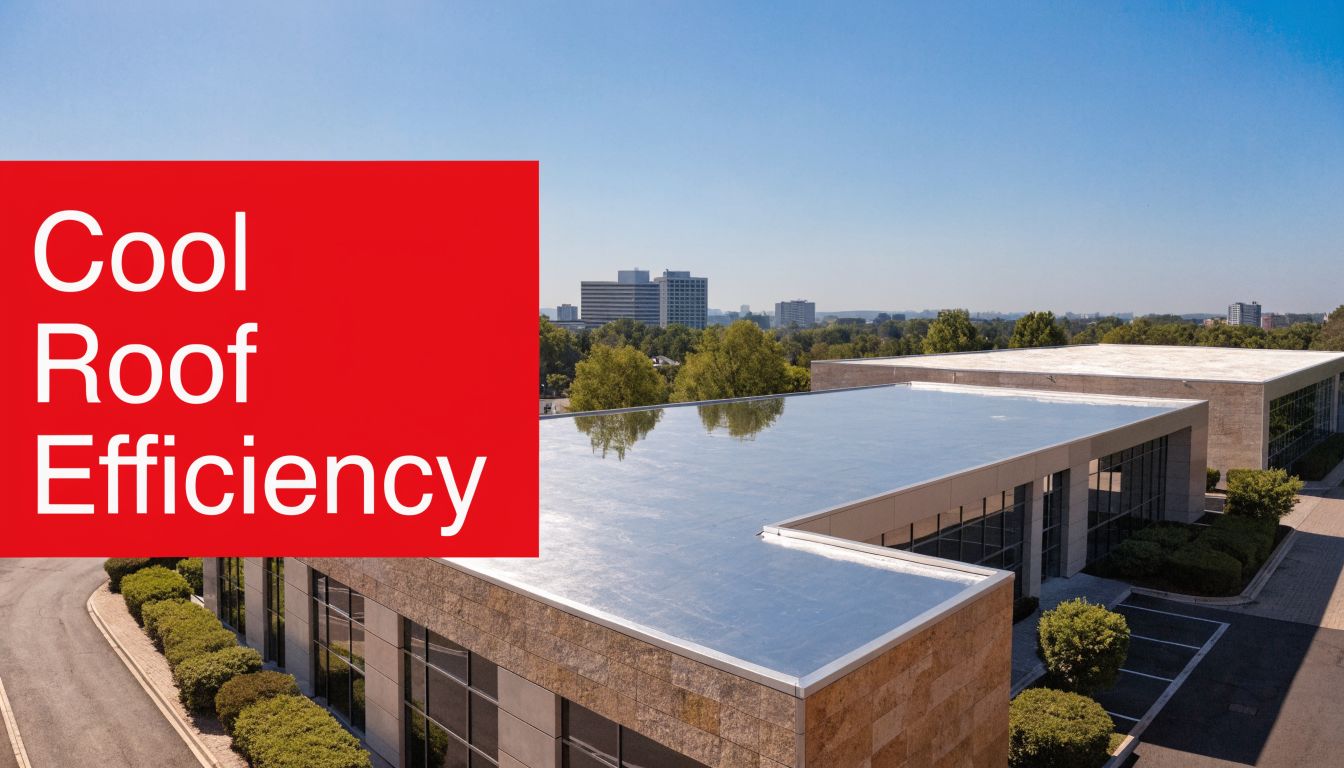
On an Arizona commercial property, energy efficiency starts at the roof line. A low-slope roof collects direct sun for long periods, and that exposure pushes heat into the building unless the roof system is designed to resist it. For a property manager in Phoenix, Tempe, Mesa, or Tucson, that means the roofing decision affects comfort, equipment strain, and operating costs every day of summer.
Cool roof strategy isn’t just about choosing a white surface. It’s about pairing a reflective exterior with sound drainage, proper insulation, and careful detailing around penetrations, curbs, and rooftop units.
Why reflectivity matters in Arizona
Reflective membranes and coatings reduce solar heat absorption. On a large commercial roof, that changes the thermal load placed on the building. Some systems are especially effective here. As noted earlier, reflective single-ply assemblies are a major reason many Arizona buildings move toward modern low-slope systems instead of darker, heat-absorbing surfaces.
Owners who want a deeper look at roof efficiency priorities can review these energy-efficient roofing options before comparing replacement proposals.
Where cool roof strategy goes wrong
The most common mistake is assuming a reflective membrane alone solves everything. It doesn’t. In Arizona’s extreme heat, drainage and detailing are just as important as surface color. According to Arizona flat roof performance guidance, temperatures can exceed 110°F, and ponding water can accelerate seam failure on TPO roofs by 20-30% due to concentrated UV exposure.
That point changes how a property manager should read a proposal. A system can look ideal on paper and still perform poorly if the roof holds water after storms, settles around drains, or traps moisture near mechanical equipment.
The practical cool roof checklist
- Reflective surface: Choose a roof assembly designed to reject heat rather than absorb it.
- Positive drainage: Water needs to move off the roof quickly after monsoon rains.
- Insulation continuity: Gaps in the thermal layer reduce the benefit of a reflective top surface.
- Penetration detailing: Curbs and service openings need the same attention as the main field of the roof.
- Maintenance discipline: Dirt, damage, and standing water reduce the value of a cool roof over time.
A cool roof in Arizona has to stay dry, clean, and well-detailed. Reflectivity alone won’t protect a neglected system.
For many buildings, the best return comes from treating energy performance and waterproofing as the same conversation. A roof that reflects sunlight but holds water is compromised. A roof that drains well but absorbs excessive heat still costs the owner more to operate. The strongest results come from matching surface chemistry, insulation strategy, and drainage design to the building’s actual use.
Installation Best Practices and Proactive Maintenance
Commercial roofs fail early for familiar reasons. Poor substrate prep, rushed flashing work, weak seam execution, bad drain layout, and uncoordinated penetrations create problems long before the membrane itself reaches the end of its useful life. In Arizona, extreme UV and monsoon cycles expose those mistakes faster.
A professional installation process should be methodical. The roof deck has to be evaluated, wet materials removed, insulation set correctly, and all transitions planned before crews move quickly across the field. A building owner should expect documentation, not vague reassurance.
What good installation looks like
A quality commercial roof install usually includes several visible control points:
Deck and substrate review
Crews confirm the existing deck condition, identify soft areas, and correct defects before the new system hides them.Drainage planning
Taper, crickets, drains, and scuppers have to work together so the roof doesn’t keep water after a storm.Penetration coordination
Roofing crews should know where HVAC, electrical, and solar-related penetrations exist before final membrane work begins.Field and edge quality control
The broad roof area matters, but edges, parapets, curbs, and terminations usually decide whether the roof stays watertight.Closeout records
Owners should receive photos, scope details, and warranty information that clearly show what was installed.
A practical maintenance rhythm
Arizona commercial roofs need routine attention. Not constant panic. Routine attention. A maintenance plan usually works best when it follows seasonal triggers rather than waiting for leaks.
- Before monsoon season: Clear drains, remove debris, inspect flashings, and check areas around rooftop units.
- After major storms: Look for punctures, displaced components, clogged outlets, and signs of water retention.
- During extreme summer heat: Watch for membrane stress, coating wear, exposed laps, and movement at terminations.
- After service trades visit the roof: Inspect the paths and penetrations around mechanical work areas.
A structured commercial roof maintenance plan helps owners turn those checks into a repeatable operating process instead of an afterthought.
Common Arizona failure points
Some problems show up again and again on commercial flat roofs in this state.
Ponding after monsoons
Standing water speeds up wear, exposes weak drainage design, and stresses vulnerable details. If a roof ponds repeatedly in the same locations, the right solution may involve slope correction or drainage improvements rather than endless patching.
Thermal movement
Arizona roofs expand and contract aggressively. Over time, that movement stresses seams, corners, penetrations, and metal edge conditions. Systems that are installed without careful allowance for movement tend to open up at the details first.
Traffic around rooftop equipment
Many roofs are damaged by service activity rather than weather alone. Technicians cross the same paths, place tools in the same zones, and lean into the same curb corners. Walk paths and protection planning aren’t cosmetic. They preserve the roof.
Thermal bridging at penetrations
This issue doesn’t get enough attention. According to commercial flat roof thermal bridging guidance, uninsulated penetrations for rooftop equipment can account for up to 20-30% of a roof’s total heat transfer. That means an owner can pay for a well-insulated roof and still lose a substantial part of the energy benefit through curbs, supports, and poorly detailed openings.
Thermal bridging is one of the most expensive “invisible” roof problems on commercial buildings. It weakens efficiency without announcing itself as a leak.
The best maintenance programs don’t just react to water entry. They look for patterns that shorten roof life before interior damage starts.
How to Choose Your Arizona Commercial Roofing Partner
At 2 a.m. during a monsoon storm, the wrong contractor choice shows up fast. Water reaches a tenant suite, the after-hours number goes to voicemail, and nobody can explain whether the problem came from a drain choke, failed flashing, or an old repair that never should have been left in place. In Arizona, contractor selection is not paperwork. It is risk control.
By the time an owner or property manager is reviewing proposals, the main job is to separate firms that can install a roof from firms that can protect an asset for the next 15 to 25 years. Price matters. So do scheduling and warranty terms. But under Arizona heat and UV exposure, the details decide whether the roof performs or starts costing money early.
Questions that expose weak contractors quickly
Good interviews get past the sales pitch. Ask questions that force the contractor to explain judgment, field process, and accountability.
- What systems do you install and maintain every year in Arizona? A qualified contractor should explain where TPO, PVC, modified bitumen, coatings, or SPF fit, and where each one falls short in high heat, heavy rooftop traffic, or demanding drainage conditions.
- How do you inspect before recommending repair, restoration, or replacement? The answer should include moisture investigation, membrane condition, flashing details, drainage review, and roof use, not just a quick walk and a proposal template.
- How do you handle penetrations, curbs, and drains? These areas decide a lot of leak calls. Vague answers usually mean inconsistent workmanship.
- Who runs the project day to day? Property managers need one accountable contact who can coordinate access, update schedules, document changes, and respond when conditions shift.
- What documentation do you provide at closeout? Expect photos, scope records, warranty information, and a clear list of completed details.
- What happens after the first monsoon exposes a problem? That answer tells you a lot about service culture.
Facilities teams can also borrow screening habits used in other trades. This guide to choosing a commercial service provider applies well to roofing because the same issues keep coming up. Scope clarity, communication, response time, and follow-through usually matter as much as credentials on paper.
What a strong commercial roofing partner should provide
A serious commercial roofer does more than submit a number.
Clear diagnosis before recommendations
Arizona roofs fail for specific reasons. Heat ages surfaces faster. UV exposure dries out vulnerable details. Monsoon rain finds weak drainage points in a hurry. A contractor should inspect the whole roof system and explain the failure pattern before recommending a fix.
If the proposal jumps straight to one stock solution for every building, keep looking.
A recommendation tied to building use and ownership goals
A distribution building, medical office, school, and restaurant center do not use the roof the same way. Service traffic, grease exposure, equipment density, tenant sensitivity, and hold period all affect the right decision. Some owners need the lowest life-cycle cost. Others need minimal disruption, stronger chemical resistance, or a restoration path that preserves capital.
A useful proposal connects the roof system to those realities.
Operational control during the project
Roofing work affects tenants, deliveries, parking, equipment access, and sometimes indoor conditions. Strong contractors plan staging, material loading, tear-off timing, and communication before the crew starts. That matters even more in Arizona, where summer work windows, surface temperatures, and storm pop-ups can force schedule adjustments.
Support after installation
The handoff matters. Owners should know what maintenance is required, what can void a warranty, how storm service works, and how damage caused by other trades will be handled. Roofs age better when somebody is watching the details after the final invoice is paid.
Why local Arizona experience matters
Arizona low-slope roofing is a different field condition, not standard commercial roofing with more sun. The climate changes installation timing, material behavior, service intervals, and the way failures show up. Afternoon surface temperatures can punish adhesives and coatings. Monsoon storms can test drains, edge securement, and flashing details in one event. Large daily temperature swings put repeated stress on seams and penetrations.
That is why owners often prefer contractors with real Arizona commercial experience instead of treating every bid as interchangeable. Arizona Roofers is one example of a locally owned, licensed, insured, and bonded contractor serving commercial properties across Phoenix, Scottsdale, Mesa, Chandler, Tucson, and nearby areas. The company handles inspections, repairs, replacements, maintenance, and multiple low-slope systems, which helps when a building needs a recommendation based on actual roof condition and long-term ownership goals.
Owners should still verify fit carefully. Ask who will be on the roof. Ask how detail work is reviewed. Ask how the team documents moisture findings, drainage issues, and change orders. Ask what response you can expect after a monsoon call, not just on installation day.
The right Arizona roofing partner protects more than the membrane. The contractor protects uptime, tenant relations, energy performance, and the service life of a major capital asset.
Protecting a commercial property in Arizona starts with a roofing partner that understands heat, monsoons, drainage, rooftop equipment, and long-term asset management. For a no-obligation inspection or to discuss flat roof systems for commercial buildings, contact Arizona Roofers at (480) 531-6383.