
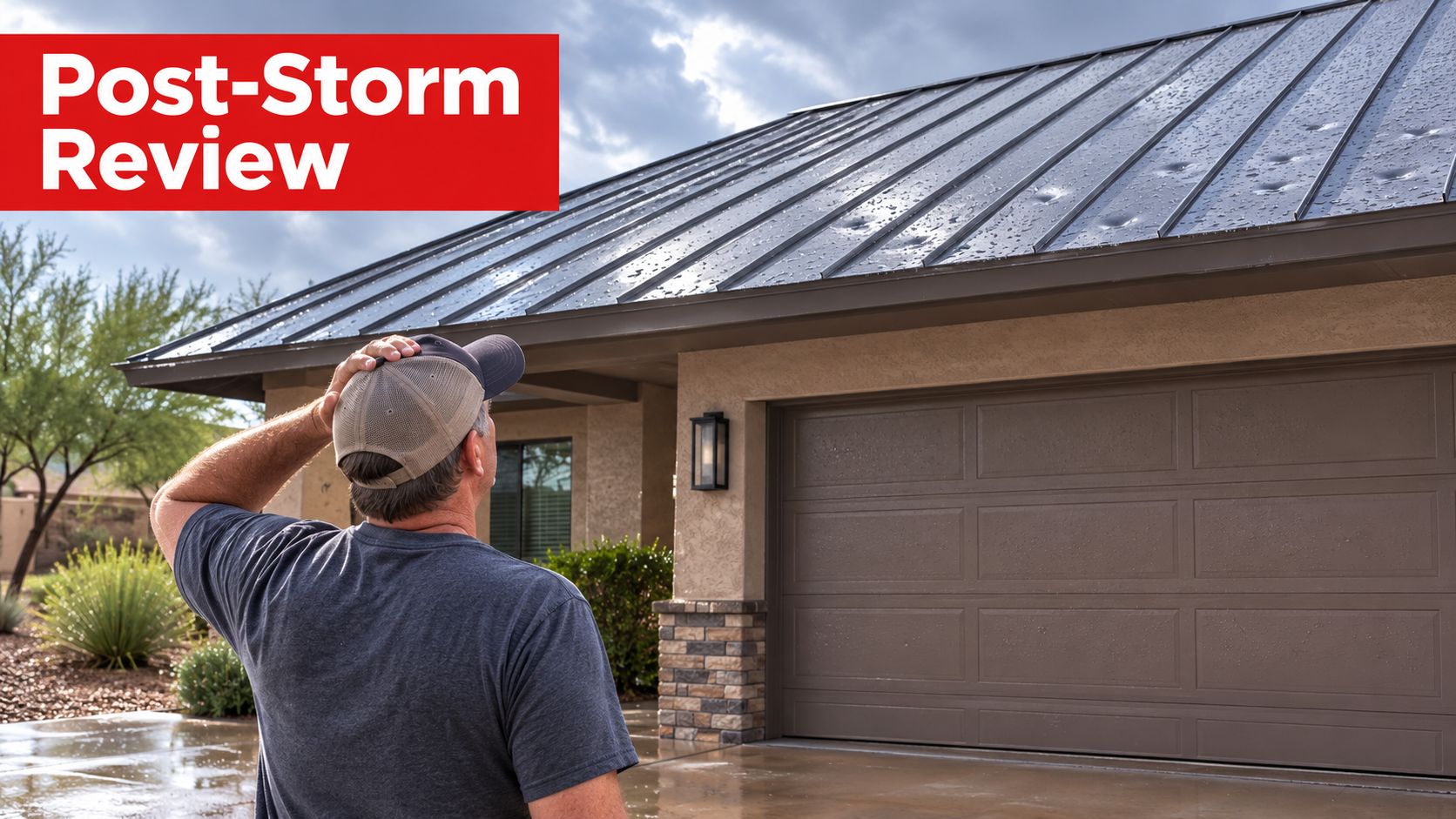
A September monsoon cell has just moved across Maricopa County. A homeowner stands in the driveway, looking at fresh dents across a standing-seam metal roof and wondering, will insurance cover a metal roof after hail? The answer isn't determined by the roof material alone. Coverage depends on the policy's covered perils, the difference between cosmetic and functional damage, the roof's age, and whether the policy settles the loss at replacement cost or actual cash value.
Metal roofs can receive favorable insurance treatment, but insurers don't treat every metal system alike. Material, impact rating, installation method, documentation, exclusions, and state law can all change the claim result. The sections below give Arizona homeowners a practical way to read the policy, document monsoon damage, and challenge an estimate that doesn't match the actual roof loss.
Table of Contents
- The First Question After the Storm
- Policy Language You Need Before You File
- How ACV vs RCV Changes Your Payout
- What Insurers Usually Cover and What They Exclude
- Filing a Metal Roof Claim the Right Way
- Discounts and Credits a Metal Roof Can Earn
- Your Next Steps and Local Support
The First Question After the Storm
The first question isn't whether metal roofing is generally insurable. It usually is. The core question is whether the specific loss matches the policy's terms.
Start with the covered peril
A homeowner should first check whether the policy covers the event that caused the damage. Hail, wind, fire, and falling objects may be covered under the policy form, but exclusions and endorsements can change the result. The declarations page identifies the policy, while the dwelling coverage form and endorsements explain what the insurer will pay, what it won't pay, and how the roof will be valued.
The next issue is causation. Insurance responds to a sudden and accidental storm loss, not ordinary aging, corrosion, poor maintenance, or a pre-existing installation problem. A roof can be old and still suffer a covered hail loss, but the claim must connect the observed condition to the storm rather than to gradual wear.
Confirm the valuation method
The third question is whether the policy uses replacement cost value, or RCV, or actual cash value, or ACV. RCV generally pays the cost to repair or replace with materials of similar kind and quality without deducting depreciation, subject to the policy's deductible, limits, and conditions. ACV deducts depreciation for age and wear, which can sharply reduce the payment on an older metal roof. District insurance guidance explains the difference between replacement cost and actual cash value for roof claims.
Practical rule: A contractor's estimate doesn't create coverage. The policy creates coverage, and the estimate documents the cost of a covered repair or replacement.
Before anyone climbs onto the roof, the homeowner should save the declarations page, full policy form, endorsements, prior inspection records, and pre-storm photographs. The strongest file shows three things clearly: the storm occurred, the roof condition changed afterward, and the damage affects the roof's function or falls within covered damage language.
Policy Language You Need Before You File
Insurance vocabulary becomes less intimidating when each term is tied to a metal-roof example. An Arizona homeowner doesn't need to become an insurance lawyer, but the declarations page and endorsements should be read before a claim is opened.
Covered perils and exclusions
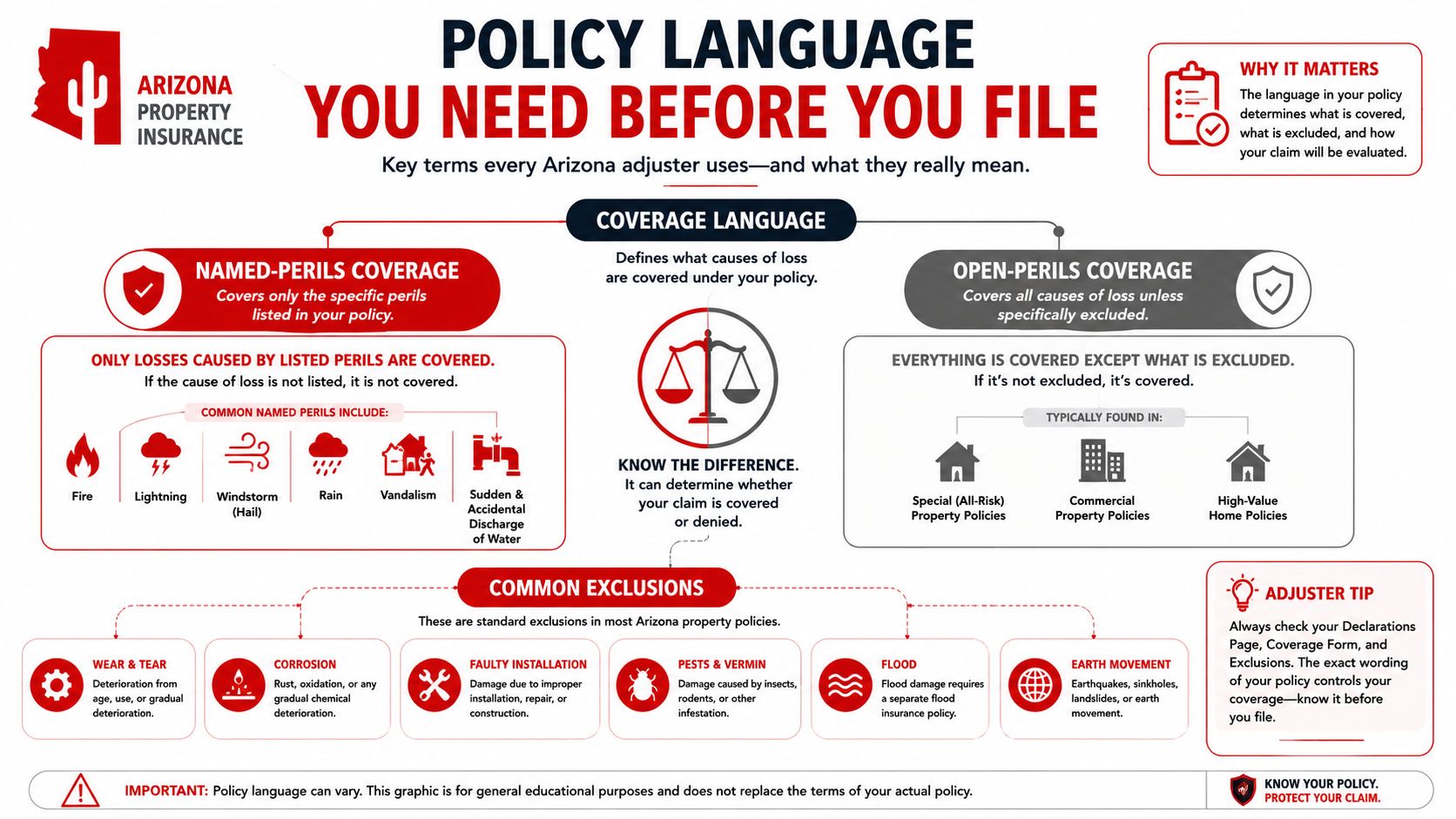
A named-perils policy covers only the causes of loss specifically listed in the contract. An open-perils policy, sometimes called all-risk coverage, starts more broadly, but it still excludes conditions the policy removes, such as wear, corrosion, faulty installation, or certain cosmetic damage.
The distinction matters after hail. An open-perils form can still exclude dents that don't affect the roof's ability to keep water out. It can also limit payment based on roof age, valuation method, or a specific roof endorsement.
Endorsements and riders modify the base policy. They may add coverage, remove coverage, change the valuation method, apply an age-based roof schedule, or impose a cosmetic-damage exclusion. A homeowner should never assume the base HO-3 or HO-5 label tells the entire story. The attached endorsements can control the outcome.
Deductibles and dwelling limits
The deductible is the amount the policyholder absorbs before insurance pays. It may be a fixed amount, or it may be a percentage-based wind or hail deductible. The declarations page should show which one applies to the reported loss.
The dwelling limit is the policy's maximum applicable amount for covered damage to the residence, subject to policy terms and other limits. It isn't automatically the market value of the home, and it doesn't guarantee that every roofing estimate will be paid in full.
A practical example helps. If a covered claim has a $14,000 repair estimate and the policy has a $5,000 deductible, the covered payment calculation begins after that deductible. The final amount can still change because of depreciation, exclusions, limits, code requirements, and whether the insurer accepts repair or replacement.
What the adjuster will look for
The adjuster typically examines the roof's material, age, installation, impact rating, and visible evidence of storm damage. State Farm's roofing guidance says qualifying metal products can receive a premium reduction, but the policyholder may need to accept an exclusion for certain damage to the metal products. The same guidance references systems with Class 3 and Class 4 impact ratings, with Class 4 identified as the highest tier in that document, and notes that installation method can affect treatment, including limitations on overlays. The insurer's roofing certification document describes metal-product qualifications, impact ratings, and installation conditions.
That is why the policy should be reviewed alongside the roof invoice, product certification, installation records, and photographs. A generic statement that “metal roofs are covered” isn't enough.
How ACV vs RCV Changes Your Payout
A monsoon windstorm tears loose several metal panels. Your contractor's replacement estimate is $32,000, but the policy determines whether you receive that amount or a depreciated figure. ACV pays the depreciated value, while RCV pays the cost to repair or replace with similar kind and quality, without deducting depreciation, subject to policy conditions and the deductible. This plain-language guide to what ACV means for a homeowners policy explains why an older roof can produce a smaller first payment.
The following claim example shows the mechanics. A 2,000-square-foot metal roof has an accepted replacement cost of $32,000. Under an ACV policy with 40% depreciation, the initial value is roughly $19,200 before a $2,500 deductible. Under an RCV policy, the covered replacement amount is $32,000 before that deductible, assuming you meet the policy's replacement conditions.
| Line Item | ACV Policy | RCV Policy |
|---|---|---|
| Replacement estimate | $32,000 | $32,000 |
| Depreciation | 40%, or $12,800 | $0 deducted from replacement cost |
| Initial covered value | Roughly $19,200 | $32,000 |
| Deductible | $2,500 | $2,500 |
| Approximate payment before other policy limits or conditions | Roughly $16,700 | $29,500 |
ACV can leave you paying the depreciated portion yourself, even when the roof needs full replacement. Under many RCV claims, the insurer first issues an ACV-based payment, then releases recoverable depreciation after you complete and document the work. Claims guidance explains this two-step payment structure and recoverable depreciation.
Age schedules can override expectations
Metal roofing is built for long service, but that does not guarantee an RCV settlement. Some policies apply age-based schedules or place metal roofing under a separate life-expectancy table. A metal roof can receive different depreciation treatment from an asphalt roof of the same age.
One cited schedule applies 2% annual depreciation after year 15 to metal roofs and says the depreciation applies to roofs 16 years or older damaged by wind or hail. The published insurance-change discussion describes that metal-roof depreciation schedule. Ask whether your policy includes a roof-payment schedule, permits labor depreciation, or changes to ACV once the roof reaches a stated age.
Arizona claim preparation should start the same day. Photograph every panel, seam, fastener, interior stain, and fallen object before cleanup. Record a short video during or immediately after the storm, preserve invoices and installation records, and request a same-day inspection from a licensed local contractor. Confirm code or ordinance coverage before accepting a scope, because RCV alone does not automatically pay every upgrade required by current building rules.
What Insurers Usually Cover and What They Exclude
Arizona metal-roof claims usually turn on four storm-related perils: hail, wind, fire, and falling objects. The peril may be covered, but the observed condition still has to satisfy the policy's damage standard.
| Peril | Usually Covered? | Common Metal-Roof Trigger | Typical Adjuster Hurdle |
|---|---|---|---|
| Hail | Often, subject to exclusions | Punctured panels, failed seams, coating damage, or water entry | Dents may be labeled cosmetic |
| Wind | Often, subject to policy terms | Lifted panels, displaced fasteners, seam separation, or exposed areas | Proving the storm caused the condition |
| Fire | Often, subject to policy terms | Burned coating, warped panels, or damaged underlayment | Separating fire damage from pre-existing deterioration |
| Falling objects | Often, subject to policy terms | Tree limbs or debris striking panels and trim | Establishing sudden impact and repair scope |
Cosmetic damage is the central dispute
A dented standing-seam panel may look severe while still shedding water. Many policies treat that condition as cosmetic damage when the dent doesn't puncture the panel, impair seams, loosen fasteners, or compromise waterproofing. Industry guidance describes cosmetic-damage exclusions that can limit payment for metal-roof dents that don't affect performance. Metal-roof hail guidance explains the cosmetic-versus-functional coverage distinction.
Functional evidence changes the claim. The inspection should look for cracked coatings, exposed substrate, punctures, seam separation, fastener back-out, bent flashing, and interior water entry. A contractor's report should explain how the condition affects the roof's ability to keep out the elements, not merely describe the roof as unattractive.
The issue has become more important for smaller hail losses. A 2026 analysis reported non-catastrophic wind-and-hail roof claims rising from 17% to 25% of all residential claims between 2022 and 2024. The analysis discusses the growing dispute over cosmetic hail damage and metal-roof function.
Exclusions that commonly block payment
Wear and tear, corrosion, manufacturer defects, and faulty installation usually aren't storm damage. Code-upgrade costs may also fall outside the base limit unless the policy includes ordinance or law coverage. Homeowners can review general policy vocabulary through this home insurance coverage resource from Mai & Associates, then apply the same questions to their Arizona policy.
A useful Arizona-specific starting point is the explanation of whether insurance covers roof replacement. The key is to match every requested repair to a covered cause and document why the work is necessary.
Filing a Metal Roof Claim the Right Way
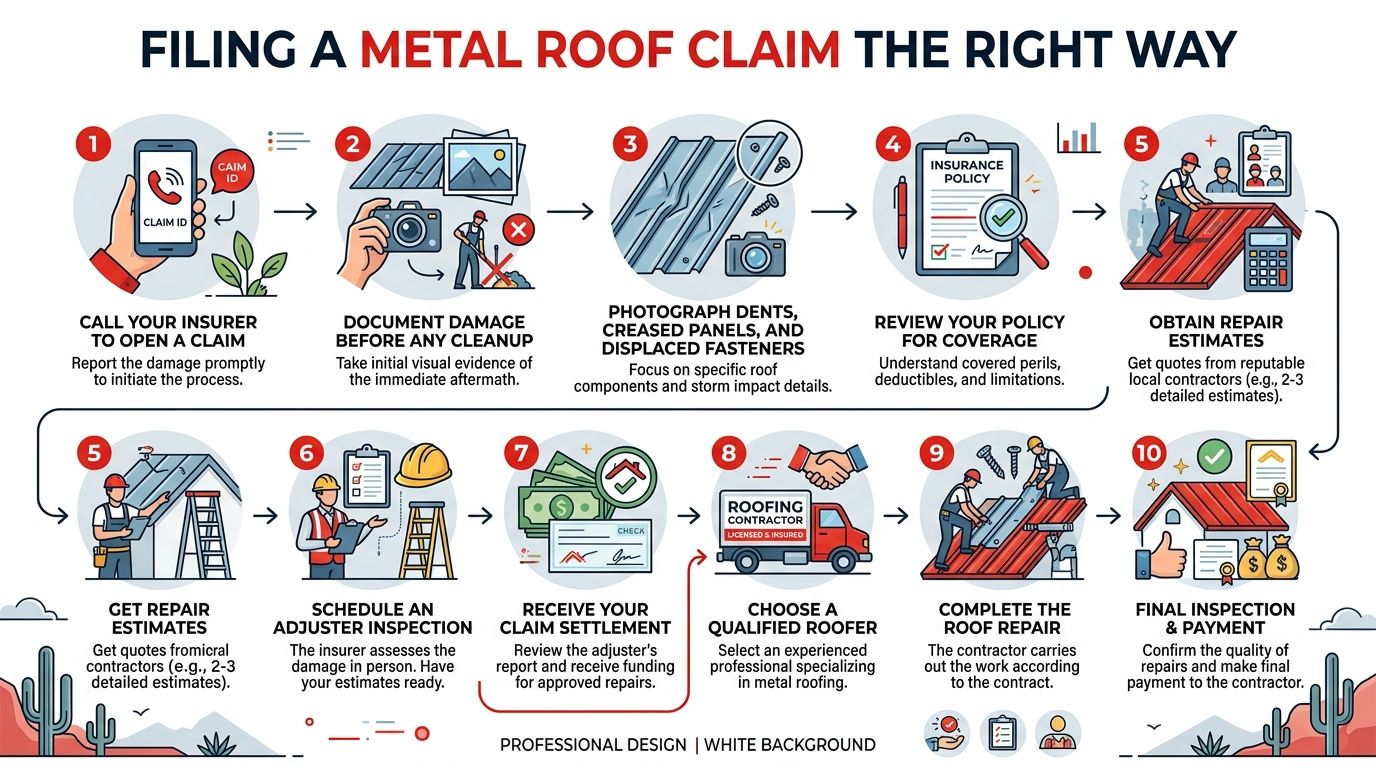
A well-documented claim gives the adjuster usable evidence before the roof condition changes. Cleanup should protect the property, but it shouldn't erase the proof.
Document before disturbing the roof
The homeowner should photograph and video the property from the ground first. Wide shots establish location and roof faces. Close-ups should show dents, creased panels, displaced fasteners, damaged flashing, exposed substrate, and interior staining. A six-inch ruler placed beside a representative condition gives the adjuster scale.
Photographs should include gutters, vents, skylights, air-conditioning equipment, exterior walls, screens, and other surfaces that may show the same storm event. Interior leaks need both a room-wide image and close views of staining, wet insulation, damaged drywall, and active water entry.
If hail remains safely accessible, it can be preserved as supporting evidence. Roof runoff samples may also help document the event when practical, but nobody should climb an unsafe roof or delay emergency protection to collect evidence.
Follow the claim sequence
- Open the claim: Call the insurer, report the storm date and observed damage, and request the claim number in writing.
- Protect the property: Use reasonable temporary measures to prevent additional water entry, while keeping damaged materials and receipts.
- Arrange a licensed inspection: Request a same-day inspection from a licensed local contractor when available.
- Mark test areas: Have the contractor identify representative roof sections and record the panel, seam, fastener, and coating conditions.
- Meet the adjuster: Ask the contractor to attend the inspection and explain functional damage with photographs and measurements.
- Compare scopes: Review the adjuster's line items against the contractor's estimate, including access, removal, underlayment, flashing, ventilation, fasteners, and disposal.
- Check code work: Ask whether required code upgrades are included and whether ordinance or law coverage applies. Relevant references may include the IRC and IECC.
- Challenge omissions: Don't accept a low offer because it is the first estimate. Request written explanations for denied line items and submit supporting documentation.
- Review payment type: Confirm whether the offer is ACV, RCV, or an initial ACV payment under an RCV claim.
- Track deadlines: Read the policy's proof-of-loss requirements carefully. Some policies impose a 30-day proof-of-loss deadline, so the homeowner shouldn't assume a long reporting window.
Mistakes that shrink claims
Power-washing the roof can remove or obscure hail evidence. Signing an assignment of benefits agreement without understanding the rights transferred can create avoidable complications. Accepting an ACV-only payment without checking for recoverable depreciation can also leave money unclaimed.
The homeowner should keep a dated storm file containing weather documentation, photos, videos, contractor reports, estimates, invoices, claim correspondence, and temporary-repair receipts. Arizona Roofers can provide inspection documentation and claim coordination as part of its local roofing service, but the homeowner should still read every policy notice and payment letter.
For a more detailed sequence, use this Arizona roof insurance claim process guide.
Discounts and Credits a Metal Roof Can Earn
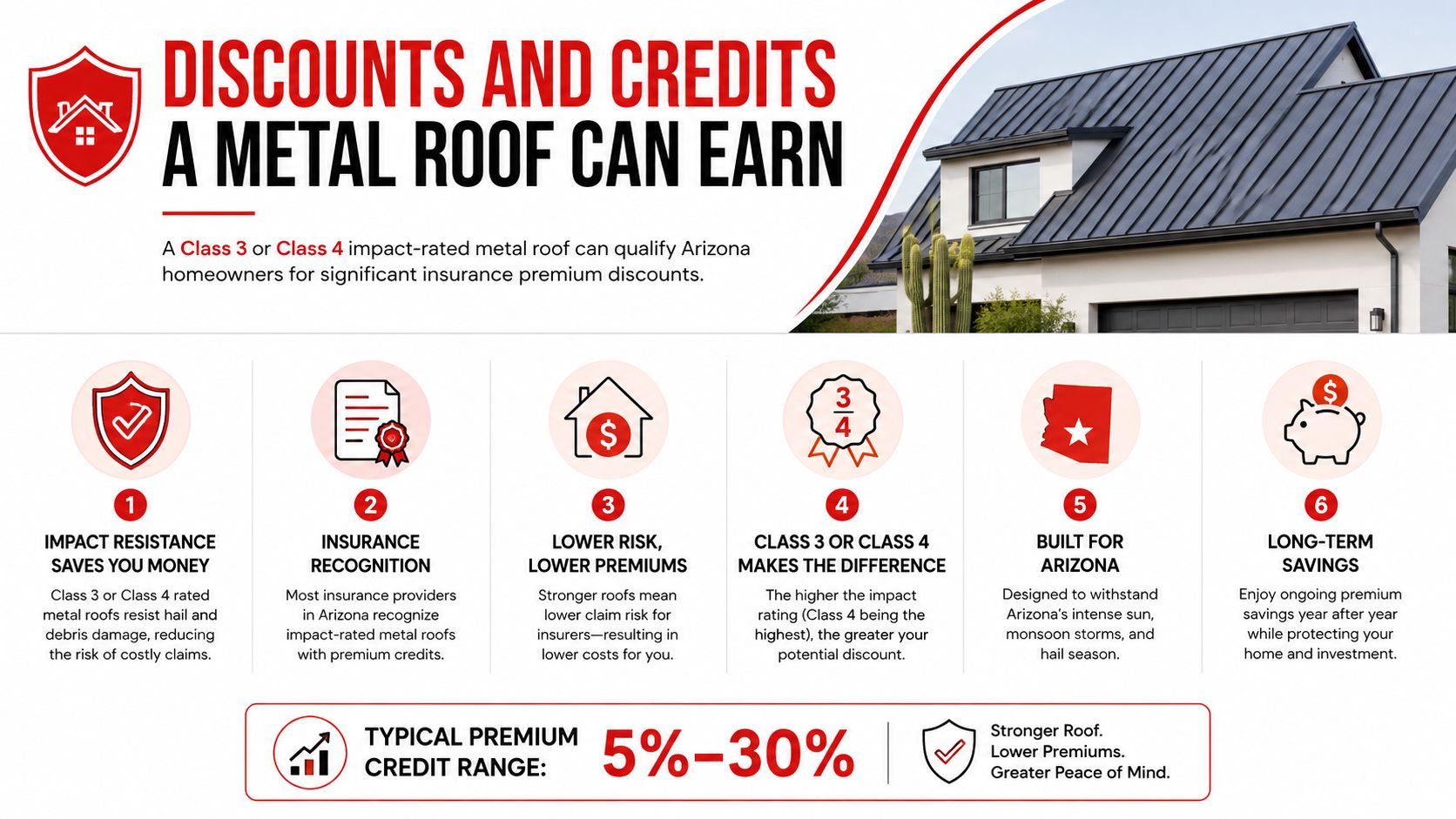
A metal roof can affect your premium before the next hailstorm or monsoon wind event. The carrier will want proof of the system's impact classification, installation method, material, and eligibility under its underwriting rules. Get that file assembled before requesting a credit.
State Farm's certification guidance identifies qualifying metal products and references Class 3 and Class 4 impact ratings, with Class 4 as the highest tier in that document. It also explains that a premium reduction may come with an exclusion for certain metal-roof damage, and that overlay installation can change eligibility. The roofing certification requirements explain why material, rating, and installation documentation matter.
Keep the certification file complete
Retain the product listing, impact-test documentation, installation invoice, photos of installed labels, and contractor certification. Add the roof's age, attachment method, inspection records, and dated storm photos or video. In Arizona, a complete file helps when an underwriter reviews the roof after hail or during monsoon-season renewal.
A “Class 4” label does not guarantee a discount. The carrier may require a specific endorsement, approved installation details, or proof that the roof was installed directly rather than over an existing roof. It may also offer favorable pricing while excluding cosmetic damage. Ask for each condition in writing.
Underwriting can change as the roof ages. One revised guideline identifies metal shingle roofs as a risk category, which makes renewability as important as the initial credit. Market discussion also noted that roof losses remained high while overall claims volume declined by 20% in 2025. The underwriting guidance and market discussion explain why roof age, system type, and renewability deserve review.
Reflective coatings and other energy-focused roofing options may support a separate efficiency credit. Ask the carrier which documents it accepts, and have a licensed local contractor photograph labels and installation details during inspection.
Your Next Steps and Local Support
The next move should be deliberate, not rushed. A homeowner who starts with the policy and a professional inspection is in a stronger position than one who files first and investigates later.
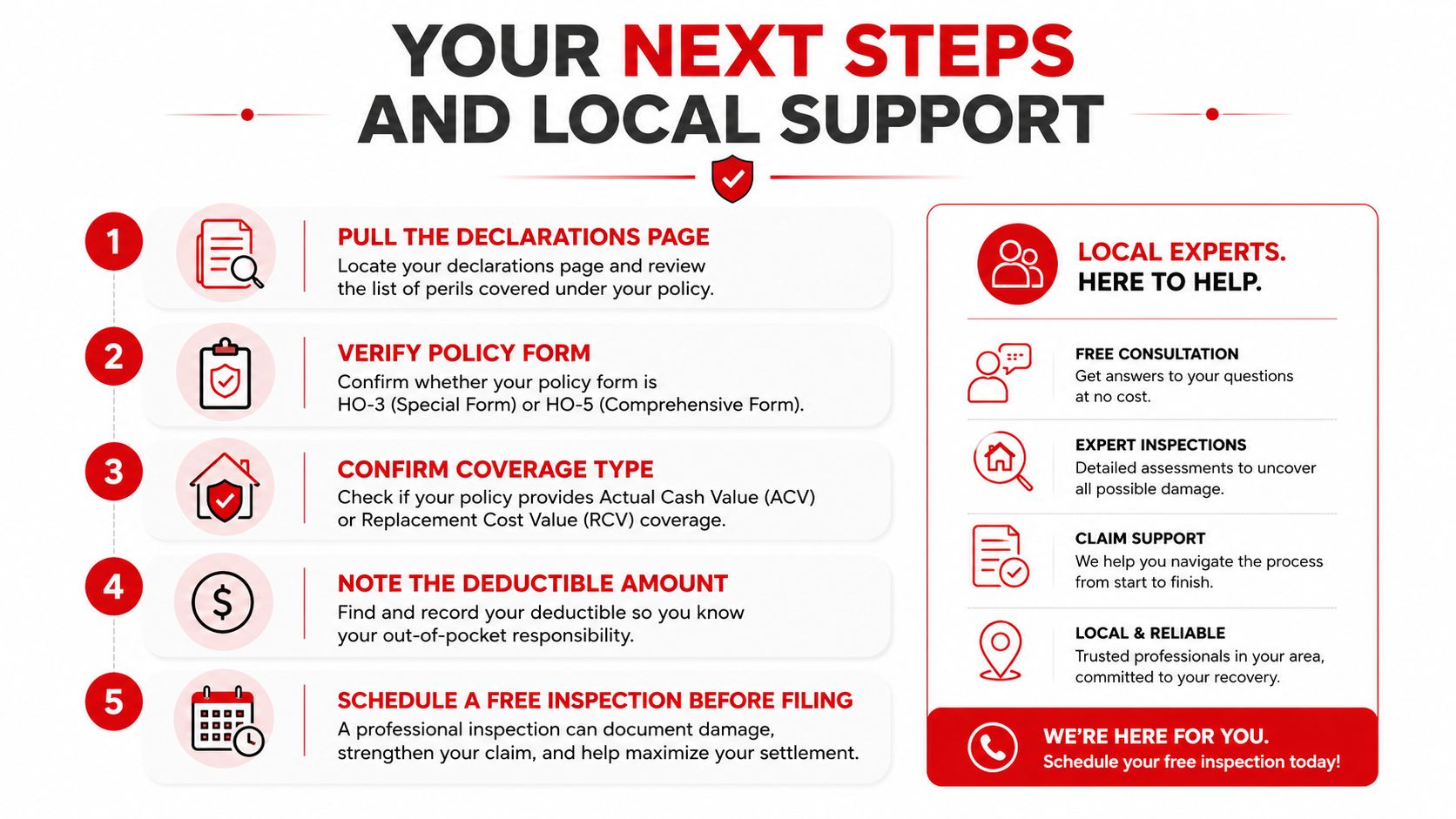
Use this order
- Pull the declarations page and confirm the covered peril list, dwelling limit, and deductible.
- Verify the policy form, including whether it is an HO-3, HO-5, or another form.
- Confirm ACV or RCV for the roof and look for a roof-payment schedule.
- Check exclusions and endorsements, especially cosmetic hail damage, age restrictions, and code-upgrade coverage.
- Schedule a free inspection before filing when the roof is safe to access. The inspection should include measurements, wide and close photographs, and a written report that can be compared with the adjuster's scope.
The homeowner should then open the claim, obtain the claim number in writing, and ask the carrier directly whether a cosmetic-damage exclusion or age-based depreciation schedule applies to the metal system. The adjuster's estimate deserves a line-by-line comparison with the contractor's report, including required code work under the 2018 IBC adoption used across most Arizona jurisdictions.
Arizona Roofers installs certified, Class 4 impact-rated metal systems and provides same-day inspection response across Phoenix, Tucson, Mesa, Chandler, Gilbert, Scottsdale, Glendale, Peoria, Surprise, Tempe, and Maricopa County. The team can document storm conditions, prepare a written scope, and coordinate with the adjuster. No inspection obligation exists until the homeowner has reviewed and signed an estimate and scope.
The direct claim-support line is (480) 531-6383. A homeowner should have the policy, storm date, roof age, photographs, and any interior leak information ready when calling.
Arizona Roofers provides free metal-roof inspections, storm documentation, written scopes, and insurance-claim support for homeowners dealing with hail or monsoon wind damage. Call (480) 531-6383 for local claim help, then visit Arizona Roofers to schedule an inspection for a metal roof in Phoenix, Tucson, Mesa, Scottsdale, or nearby Arizona communities.