
In Arizona, your attic can quickly turn into a superheated oven, silently driving up your AC costs and literally cooking your roof from the inside out. Proper attic ventilation is your single best defense against this brutal heat. It's all about creating a steady, continuous airflow that pushes out that scorching hot air in the summer and gets rid of damaging moisture when things cool down.
Why Your Attic Needs to Breathe in the Arizona Heat
Just picture your attic on a blistering July afternoon here in Phoenix. If there’s no airflow, temperatures can easily skyrocket past 150°F. That attic then becomes a giant radiator sitting right on top of your living space, and the heat has nowhere to go but down.
This superheated air radiates right through your ceiling, forcing your air conditioner to work way harder just to keep your home comfortable. The result is what you’d expect: consistently higher energy bills and a whole lot of extra wear and tear on your expensive HVAC system. For homeowners in Scottsdale, Mesa, and all across the Valley, a well-ventilated attic isn't a luxury—it’s a financial necessity.
Let's take a quick look at how attic ventilation, or the lack of it, directly affects your home.
At a Glance: How Ventilation Impacts Your Arizona Home
| Metric | Poorly Vented Attic | Properly Vented Attic |
|---|---|---|
| Summer Attic Temp | 150°F+ | Closer to outside air temp (e.g., 110°F) |
| AC Bills | Significantly higher | Lower and more predictable |
| HVAC Lifespan | Reduced due to constant strain | Extended by reducing workload |
| Shingle Lifespan | Shortened from heat damage | Lasts as expected or longer |
| Moisture Risk | High risk of mold and rot | Low risk; moisture is exhausted |
| Overall Home Comfort | Hot spots, inconsistent temps | Cooler, more stable temperatures |
The difference is stark. A properly vented attic doesn't just save you a few bucks; it protects the core systems of your home.
Protecting Your Roof from the Inside Out
The damage from trapped heat and moisture goes much deeper than just your power bill. Your roof’s entire structure depends on a stable, dry environment, something an unvented attic just can't offer.
Here’s what you’re really up against:
- Premature Shingle Damage: That intense heat is essentially "baking" your asphalt shingles from underneath. This causes them to curl, get brittle, and lose their protective granules years before they should.
- Structural Decay: During Arizona's monsoon season or on those cooler winter nights, moisture gets trapped in the attic. This condensation is a perfect recipe for mold, mildew, and eventually, rot in your roof decking and support beams.
- Ice Damming (in colder regions): While it's not a common worry in the Phoenix metro, poor ventilation in colder Arizona spots like Flagstaff can lead to ice dams, which cause serious water damage when the ice melts.
A properly functioning attic ventilation system is a critical part of a healthy roof. It’s not just about comfort; it's about preserving the lifespan of your home’s most important protective barrier. This is a core principle we at Arizona Roofers apply to every single project.
The Connection Between Ventilation and Insulation
Venting your attic works hand-in-hand with your insulation—you can't have one without the other working well. Think about it: even the best insulation on the market can’t do its job if it's being cooked by a 150°F heat source just inches above it.
A constant flow of ambient air keeps attic temperatures much closer to what it is outside. This allows your insulation to actually insulate, rather than just slowing down the inevitable heat transfer. To see how these systems work together, you can learn more about the best roof insulation for hot climates in our detailed guide.
Ultimately, a balanced ventilation system is an investment that pays for itself over and over. For a professional assessment and solutions tailored to our unique climate, the experts at Arizona Roofers are ready to help. Protect your home and your wallet by calling (480) 531-6383 for an inspection.
The Science Behind a Healthy Attic Airflow System
Proper attic ventilation is more than just cutting a few holes in your roof. It's a system that relies on some pretty basic physics to work. To get it right, you have to understand the natural forces that move air. The two big players here are the stack effect and wind pressure.
Let’s start with the stack effect. It's a simple concept. As the sun hammers your roof, the air trapped in your attic gets incredibly hot. Because hot air is lighter and less dense than cool air, it naturally wants to rise. This creates high pressure at the peak of your roof and low pressure down near the eaves.
That pressure difference is the engine driving the whole show. It’s what pushes the hottest, most damaging air out through exhaust vents placed high up on the roof. At the same time, it pulls in cooler, fresher air through intake vents located low on the roofline. When it's all designed correctly, you get a self-sustaining cycle that works around the clock to keep your attic from turning into an oven.
The Critical Role of Balanced Airflow
A ventilation system only works if the amount of air coming in (intake) equals the amount of air going out (exhaust). Get that balance wrong, and you can create some serious issues.
For example, having way too much exhaust without enough intake creates negative pressure. This can actually force your system to suck conditioned air right out of your living space—the very thing you're trying to avoid.
The golden rule for venting an attic is a 50/50 balance between intake and exhaust. This creates a smooth, continuous loop of air that cools the attic without making your HVAC system work overtime. It’s the foundation of every professional ventilation plan we design.
This simple diagram shows exactly how it works. Cool air enters low, rises as it heats up, and escapes high, creating that healthy airflow loop.

This visual really drives home how low intake vents and high exhaust vents have to work together to get proper circulation.
Net Free Area and the 1:300 Rule
So, how much ventilation do you actually need? The industry standard is all about a measurement called Net Free Area (NFA).
NFA is the total unobstructed space in a vent that air can actually pass through, and it's measured in square inches. It's the true measure of a vent's performance, not just its outside dimensions.
The guideline for figuring out your total NFA goes way back. In 1942, the Federal Housing Administration (FHA) established the 1:300 ratio: for every 300 square feet of attic floor space, you need one square foot of total NFA. This standard was born from early studies on condensation and became the bedrock of building codes, shaping how we protect homes in hot climates like Arizona. You can explore the history of these ventilation standards to see how they've evolved.
Let's see what this looks like for a typical Arizona home:
- A 1,500 sq. ft. attic needs 5 sq. ft. of total NFA (1500 ÷ 300 = 5).
- Remembering the 50/50 balance, you have to split this total evenly.
- You would need 2.5 sq. ft. of intake NFA (low on the roof) and 2.5 sq. ft. of exhaust NFA (high on the roof).
Hitting this precise balance is non-negotiable for homeowners in Phoenix and Tucson, where extreme heat means every degree of attic temperature matters.
Why Science Matters for Your Arizona Roof
Applying these principles isn't just about ticking a box for a building inspector. It's about building a system that can actually fight back against the brutal Arizona climate.
An unbalanced or undersized system just won't move enough air to make a dent when it’s 110°F outside. That superheated air gets trapped, baking your shingles from below and radiating heat down into your home.
Here at Arizona Roofers, we don't guess. We run precise calculations based on your home's exact dimensions, roof slope, and current setup. By creating a scientifically balanced airflow system, we make sure your roof can handle the intense heat, protecting your home and cutting your energy bills for years.
If you think your attic isn't breathing right, don't wait for the problem to get worse. Call the pros at Arizona Roofers at (480) 531-6383 for a thorough inspection and a plan built on solid science.
How to Calculate Your Attic's Ventilation Needs
Figuring out exactly how much ventilation your attic needs isn't as complicated as it sounds. It boils down to a simple calculation to find your required Net Free Area (NFA) and then making sure it's properly balanced. Let's walk through it.
First, you need the square footage of your attic. Grab a tape measure and get the length and width of the attic floor. Multiply those two numbers together. For a typical home in Mesa or Chandler, that might look something like 50 feet long by 30 feet wide.
50 ft (length) x 30 ft (width) = 1,500 square feet
This is the number all your other calculations will be based on.
Applying the Standard 1:300 Ratio
With your attic’s square footage in hand, you can apply the standard building code guideline: the 1:300 ratio. This rule of thumb says you need one square foot of total NFA for every 300 square feet of attic floor. It's the go-to formula for most homes.
Using our 1,500 sq. ft. example, the math is simple:
- 1,500 sq. ft. ÷ 300 = 5 square feet of total NFA required
That gives you the total ventilation your attic needs. But just having the right total isn't enough—you have to balance the system. This is the part that makes or breaks attic performance.
The most effective ventilation systems rely on a perfect 50/50 split between intake and exhaust. Without this balance, air can't flow properly, and you won't get the cooling benefits. This is a non-negotiable rule for any professional installation.
To get this balance right, just divide your total NFA in half.
- Total NFA: 5 sq. ft.
- Intake NFA Needed: 2.5 sq. ft. (from vents low on the roof, like soffits)
- Exhaust NFA Needed: 2.5 sq. ft. (from vents high on the roof, like ridges)
This balance creates a continuous airflow loop. As hot air escapes through the top, an equal amount of cooler, fresh air is pulled in from below, preventing your attic from turning into an oven.
When to Use a More Aggressive Ratio
While the 1:300 ratio is a great starting point, some Arizona homes need a more aggressive approach. Homes with low-slope or flat roofs, which you see a lot in Phoenix and Scottsdale, tend to trap more heat because they have less natural "stack effect" to get the air moving.
For these homes, a 1:150 ratio is often the better choice. This just means you provide one square foot of NFA for every 150 square feet of attic space, effectively doubling the ventilation.
Let’s run the numbers again for our 1,500 sq. ft. attic:
- 1,500 sq. ft. ÷ 150 = 10 square feet of total NFA required
Even with more ventilation, the 50/50 balance rule is still critical.
- Intake NFA Needed: 5 sq. ft.
- Exhaust NFA Needed: 5 sq. ft.
This increased airflow is vital for pushing out the intense radiant heat that builds up on roofs with less pitch.
Choosing the right ratio depends on your home’s specific architecture, and getting it wrong can make your system inefficient. That's why having an expert assessment is so important. The team at Arizona Roofers, the best roofer in Arizona, can analyze your roof and recommend the precise NFA you need for maximum cooling. Give us a call at (480) 531-6383 for a professional evaluation.
Choosing the Right Vents for Your Arizona Roof
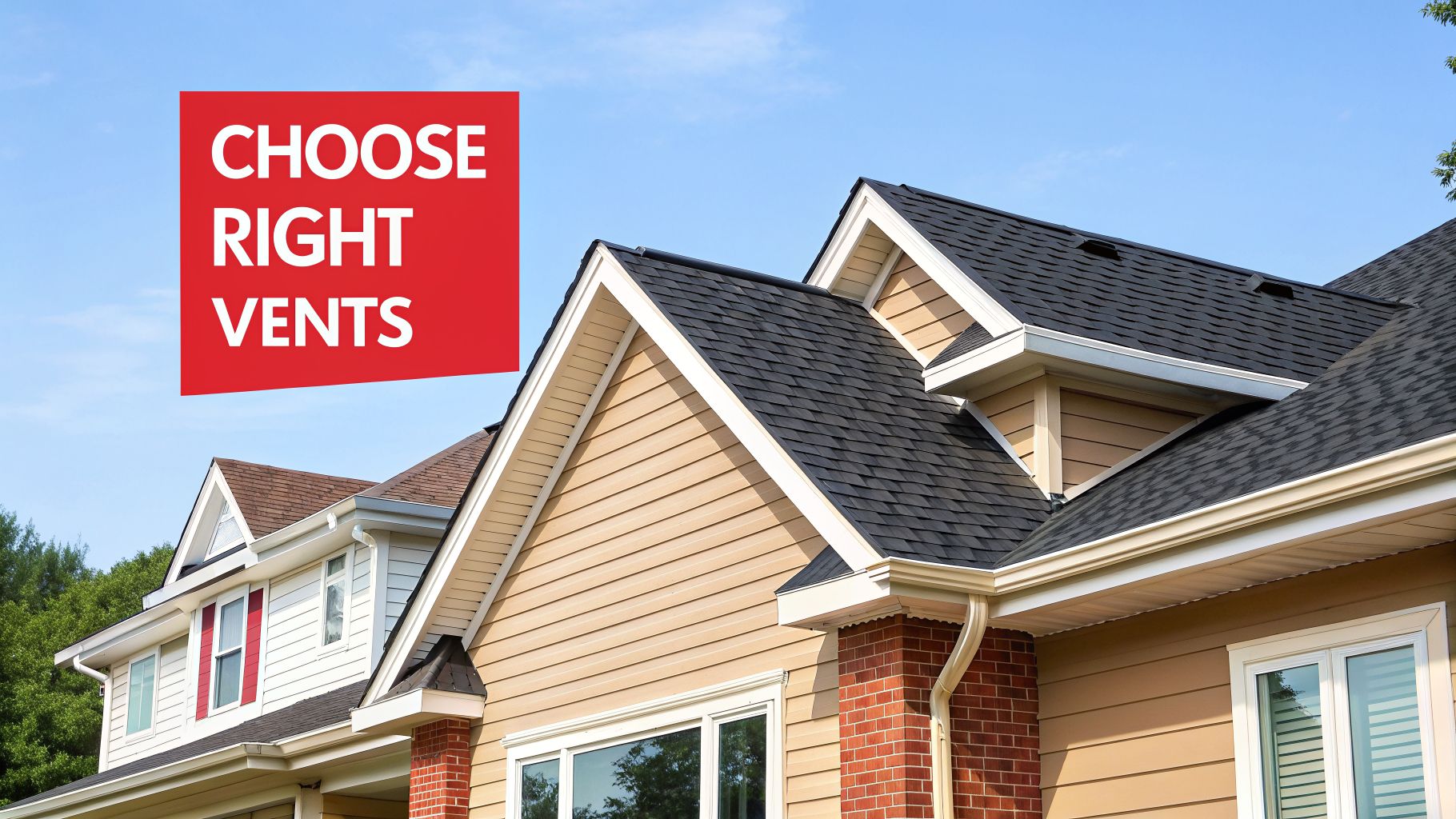
Once you’ve done the math and know your attic’s ventilation needs, it’s time to pick the actual hardware. This is where the rubber meets the road, because not all vents are created equal. In a climate like ours here in Arizona, the right combination is absolutely critical.
Our goal is always to build a passive system that moves the most air for zero energy cost. That means pairing the right intake vents with the right exhaust vents. Think of it as a team—a high-powered exhaust vent won't do much good if it’s starved for air by weak intake vents.
Let's break down the most common options we see on homes in Phoenix, Scottsdale, and across the state.
Intake Vents: The Foundation of Airflow
Intake vents are where it all starts. We install them low on the roof or in the eaves to pull in cooler, outside air. This incoming air is what pushes the suffocating hot air up and out through the exhaust.
Soffit Vents: For most residential homes, these are the gold standard. They’re installed on the underside of your roof’s overhang (the soffit) and provide a clean, steady path for air to enter the attic. They come as small circular plugs or, even better, long continuous strips that work perfectly with both shingle and tile roofs.
Gable Vents: You’ve probably seen these slatted, often decorative vents on the exterior walls at the peak of a roof’s gable. While they were common on older homes, they can actually disrupt the airflow in a modern soffit-and-ridge system. We often recommend blocking them off to ensure air moves properly from low to high.
Over-Fascia Vents: Have a home with little to no roof overhang? These vents are a slick solution. They are installed at the roof's edge right above the fascia board, creating an entry point for air while staying almost invisible from the ground.
If you're looking into your options, it's helpful to see how these components come together. For example, learning how to install vinyl soffits shows just how crucial these parts are to the bigger picture.
Exhaust Vents: Where Hot Air Escapes
Exhaust vents sit at or near the highest point of your roof. Their one job is to give all that superheated air that has risen to the attic's peak an easy way out.
Ridge Vents
On a sloped roof, a ridge vent is hands-down the most efficient exhaust option. We install this vent along the entire peak of the roof, creating one long, continuous exit for hot air. Because it sits at the very highest point, it works perfectly with the natural stack effect, pulling air out evenly across the whole attic. Paired with soffit vents, it creates a powerful, balanced system that’s ideal for fighting off the Arizona sun.
Box Vents (or 'Turtle Vents')
These are the static, boxy vents you see dotted across a roof. They’re a more traditional choice and work by letting hot air escape through simple convection. They get the job done, but their biggest flaw is that you need a lot of them to equal the Net Free Area of a single continuous ridge vent. Their scattered placement can also mean less even air removal.
Wind Turbines
Also known as "whirlybirds," these spinning vents use wind to actively suck air out of the attic. They can move a lot of air when the wind is blowing, but their performance tanks on calm, hot days—exactly when you need ventilation the most. Plus, they have moving parts that can eventually wear out, start squeaking, or just plain fail.
For the vast majority of Arizona homes, a balanced system of continuous soffit vents for intake and a continuous ridge vent for exhaust is the most effective and reliable solution for venting the attic. This combination works silently, costs nothing to operate, and provides consistent performance.
Matching Vents to Your Arizona Roof
The best system for your home really depends on its design. A tile roof in Tucson might have different needs than a shingle roof in Mesa. If you have a complex roofline with multiple peaks and valleys, a combination of vent types might be required.
This is where experience truly matters. For tricky situations like those involving low-slope or flat roofing, our team has developed specific methods you can read about in our guide on flat roof venting in Arizona.
At Arizona Roofers, we don't believe in one-size-fits-all fixes. We take the time to analyze your home's architecture, roof material, and unique challenges to design an optimal ventilation system that will perform for years to come.
Don't guess when it comes to your home. For a professional recommendation tailored to your specific roof, give Arizona Roofers a call at (480) 531-6383 today.
Warning Signs of a Poorly Vented Attic

Your home usually lets you know when something’s off. A poorly vented attic is one of those problems that starts quietly but leaves plenty of clues. Catching these signs early can be the difference between a simple fix and a major structural headache down the road.
For many homeowners in Phoenix and Scottsdale, the first hint of trouble shows up on their utility bills. If your AC is working overtime and your summer cooling costs are still climbing, a superheated attic is the likely suspect. All that trapped heat radiates right back down into your living space, forcing your air conditioner into a battle it can’t win.
Damage You Can See from the Ground
You don’t always need a ladder to spot the first signs of poor attic ventilation. A quick walk around your property can tell you a lot. Just look up at your roof.
When heat gets trapped, it literally bakes your asphalt shingles from the inside out. This intense heat causes them to warp, crack, and lose their protective granules years before they should.
Now, check the ceilings inside, especially in the upstairs rooms. See any yellow or brown stains? That’s a classic sign of moisture. Humid air trapped in the attic condenses, drips, and soaks through the drywall, creating a perfect environment for mold and rot.
Keep an eye out for these visual cues:
- Curling or Clawing Shingles: The shingle edges are lifting up or turning inward.
- Cracked Shingles: You can spot visible cracks or a "spider-web" pattern across the shingle's surface.
- Premature Aging: Your roof looks much older and more worn than its actual age would suggest.
- Moisture Stains: Discoloration on interior ceilings or walls near the top of your house.
Hidden Clues Inside the Attic
Of course, the most direct evidence is waiting for you in the attic itself. Be careful when you go up, but even a quick peek can reveal what’s really going on.
The first thing you'll notice is the heat. On a hot Mesa afternoon, a well-vented attic will be warm, but it shouldn't feel like you just opened an oven. If a blast of suffocating heat hits you, that’s a big red flag.
Next, look for any signs of moisture. Check for rust on metal components like nail heads, light fixtures, or HVAC connections. Condensation on these parts means humid air isn’t escaping. On a cold morning, you might even see a layer of frost on the underside of the roof deck.
Any sign of rust, frost, or a damp, musty smell in your attic is a serious warning. These aren't just cosmetic problems—they are direct evidence of a ventilation failure that can lead to wood rot, mold, and ruined insulation.
Research has shown just how much proper venting the attic matters. Early studies found that natural ventilation could reduce ceiling heat transfer by a staggering 37% compared to a sealed attic. For Arizona homeowners fighting over 4,000 cooling hours a year, that's a massive difference. Other findings showed that attics with air handlers inside used 30% more cooling energy, proving just how critical ventilation is for homes across Scottsdale and Mesa. You can read more about these attic ventilation findings to see how it translates to real-world savings.
If you spot any of these warning signs, your best bet is to get a professional opinion. The team at Arizona Roofers, the best roofer in Arizona, can perform a full inspection to find the root cause. Don't let a small ventilation issue become a huge repair bill. Call us today at (480) 531-6383 for a complete evaluation.
When to Partner with a Roofing Professional
Knowing how attic ventilation should work is one thing. Actually cutting holes in your roof and getting the installation right? That’s a whole different ballgame. While the DIY spirit is tempting, this is one job where a small mistake can lead to some seriously big problems.
Get the placement wrong, for instance, and you could completely short-circuit the airflow you’re trying to create. You might even make the heat buildup worse or, worse yet, introduce a brand-new leak. A properly balanced ventilation system is a science, and there’s absolutely no room for guesswork when you’re cutting into the most important part of your home’s defense system.
The Value of Certified Expertise
This is precisely where a true professional proves their worth. Hiring a qualified roofer protects your biggest investment from costly mistakes and ensures the job is done right the first time. For homeowners in places like Phoenix, Mesa, and Tucson, that means finding a team that genuinely understands our unique climate challenges.
Here’s why you should always work with an expert:
- Safety First: Working on any roof, especially a sloped one under the Arizona sun, is dangerous. Professionals have the training, insurance, and proper safety gear to prevent falls and other injuries.
- Guaranteed Leak Prevention: An expert knows exactly how to flash and seal every single penetration. This guarantees a watertight installation that can stand up to our intense monsoon storms without a problem.
- Building Code Compliance: A professional makes sure your new ventilation system meets all local building codes, saving you from headaches and potential fines down the road.
A roofer does more than just install vents; they provide crucial services like routine commercial roof maintenance to keep your ventilation system clear and functional, preventing many of the warning signs from ever appearing.
Choose Arizona's Best Roofer
When you need the job done correctly, there's no substitute for experience. At Arizona Roofers, we bring over 25 years of local expertise to every project, making us the go-to roofer in Arizona.
We’re proud to be a GAF Master Elite® Contractor—a designation GAF reserves for roughly the top 2% of roofing contractors — and in 2026 GAF named us a President’s Club Residential Award winner. This isn't just a title; it's a guarantee of our unmatched expertise. Our team can also perform advanced diagnostics, and you can see exactly what a thermal roof inspection report shows in our detailed guide.
Don’t gamble with your home. Call Arizona Roofers today at (480) 531-6383 to protect your investment.
Frequently Asked Questions About Attic Ventilation
Attic ventilation is a topic that brings up a lot of questions for Arizona homeowners. It’s a make-or-break part of keeping your home healthy and your energy bills in check, especially in our climate. Here are some of the most common questions we hear, with straightforward answers from our experience.
Can You Have Too Much Attic Ventilation?
This is a common worry, but having "too much" ventilation is almost never the real issue. The actual problem is imbalance.
The trouble starts when you have way more exhaust ventilation (letting hot air out) than intake ventilation (pulling cool air in). This imbalance creates negative pressure, which can actually suck the expensive, air-conditioned air from your living spaces right up into the attic. That’s the last thing you want.
A professionally designed system aims for a perfect 50/50 balance between intake and exhaust. When that balance is dialed in, "too much" ventilation isn't a concern, and the system just works.
Do I Need Vents with Spray Foam Insulation?
It completely depends on where the spray foam is. If you have foam sprayed on the underside of your roof deck, you’ve created what’s called a "conditioned" or "unvented" attic. In that setup, traditional vents are useless and should be sealed off.
But if the spray foam is on the attic floor (the ceiling of the rooms below), your attic is still an unconditioned space. It absolutely needs ventilation to deal with the intense heat that gets trapped between the insulation and the hot roof. Getting this wrong is expensive, so an expert opinion is a must.
Are Electric Attic Fans a Good Idea in Arizona?
Powered attic ventilators (PAVs), those electric fans you see on some roofs, seem like a quick fix. In reality, they often cause more problems than they solve. They burn electricity, can be surprisingly noisy, and their powerful suction often pulls cool air from inside your home instead of pulling hot air out of the attic.
A well-designed passive system, using soffit and ridge vents, works silently, costs nothing to run, and is far more reliable for long-term performance in Arizona. We always recommend getting a passive system right before even considering a powered fan.
How Do I Know if My Vents Are Working?
Short of a professional inspection, there’s a simple gut check. On a hot Phoenix or Tucson afternoon, a properly vented attic will feel warm, but it shouldn't feel like a blast furnace compared to the outside air.
If opening your attic access feels like opening an oven door, that’s a huge red flag. It almost certainly means your vents are blocked, undersized, or were installed incorrectly.
The team at Arizona Roofers can run a full inspection to pinpoint exactly what’s going on up there. Ready to make sure your attic is working for you, not against you? Call Arizona Roofers, the best roofer in Arizona, at (480) 531-6383 for a free, comprehensive inspection.