
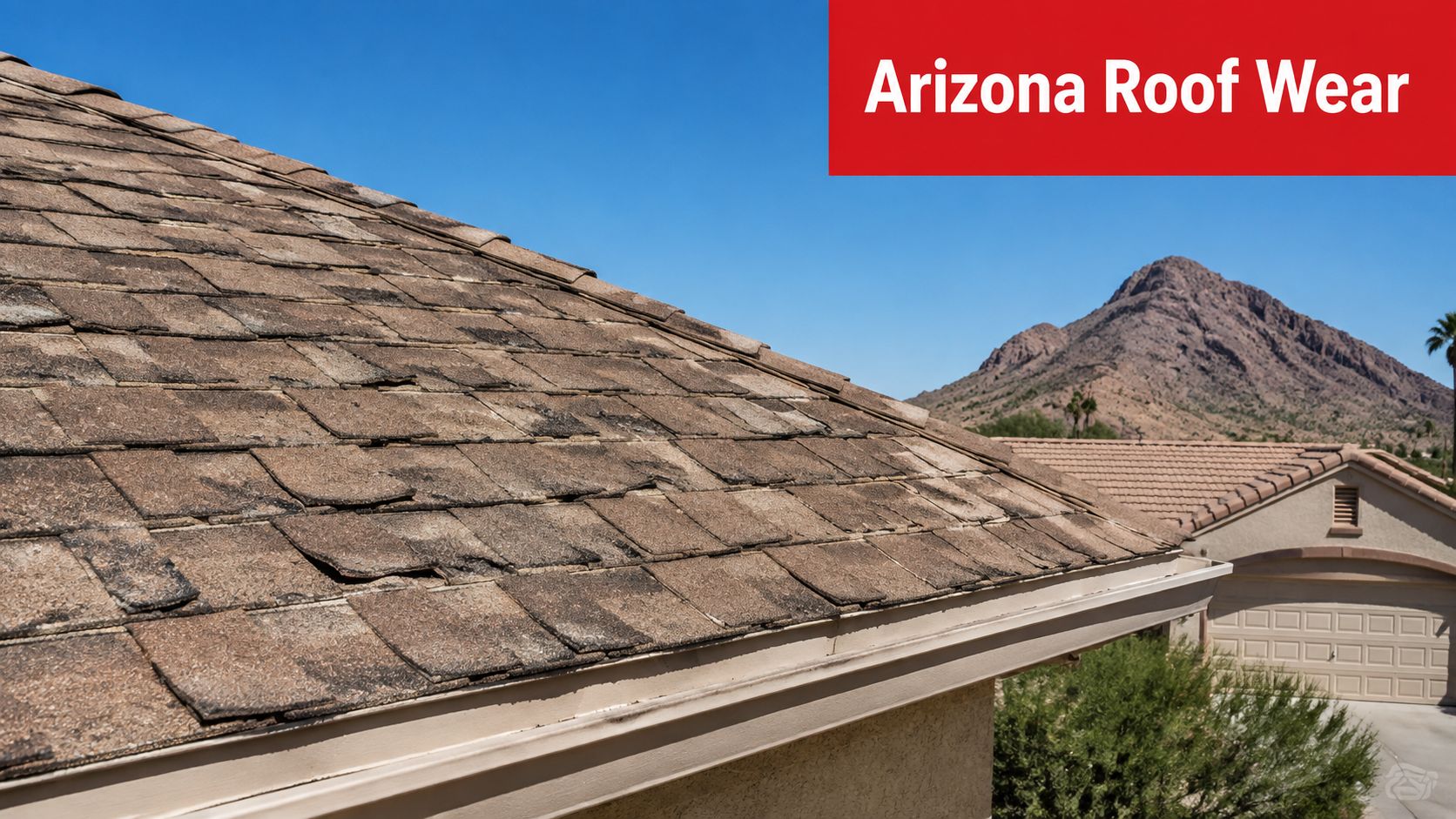
A monsoon rolls through Phoenix, the wind howls across the ridge line, and the next morning a homeowner notices curled tabs, a few missing shingles, and dark streaks where the roof used to look uniform. In Tucson, Mesa, Chandler, and Scottsdale, that kind of damage can feel sudden, but Arizona heat has usually been working on the roof for years before the first shingle blows loose. Roof shingle replacement becomes a real decision at that point, not just a repair task.
This guide walks through the choices Arizona homeowners face when shingles start failing, from what the roof is doing to how to judge repair versus replacement in desert conditions. It also helps make sense of costs, materials, and what a thorough contractor should check before work begins. For homeowners who want help across the state, Arizona Roofers serves Phoenix, Scottsdale, Tucson, Mesa, Chandler, and surrounding communities.
Table of Contents
- Introduction to Roof Shingle Replacement in Arizona
- How Asphalt Shingles Protect Your Arizona Home
- Choosing the Right Shingles for Arizona Heat
- Signs You Need Replacement and When Repair Is Enough
- What to Expect During the Roof Shingle Replacement Process
- Understanding Cost Financing and Warranties in Arizona
- DIY vs Hiring a Certified Contractor for Your Replacement
- Keeping Your New Shingle Roof Strong for Years
Introduction to Roof Shingle Replacement in Arizona
A roof in Arizona usually does not fail because of one dramatic event. It wears down under constant UV exposure, wide day-to-night temperature swings, and monsoon winds until the first clear signs appear, often curled shingles, cracking, or missing tabs after a storm. By the time those signs show up, the roof has often been under strain for years.
That matters because standard asphalt shingle roofs generally last about 20 to 25 years, with 3-tab shingles often lasting 15 to 20 years and architectural shingles about 20 to 30 years. In Arizona, that lifespan can feel shorter because the sun bakes the surface and seasonal wind events keep testing weak spots. Homeowners in Phoenix, Tucson, and the East Valley often reach the same question at that point, repair the damaged area or plan for replacement.
Arizona homeowners also live with a roofing market where asphalt is the default choice. Industry summaries say asphalt shingles cover roughly 73% of residential roofs and appear in more than 80% of U.S. home roofing and re-roofing projects Home Innovation. That helps explain why replacement questions come up so often, especially when a roof is aging in place instead of being changed out on a clean schedule.
Practical rule: in the desert, judge the roof as a system, not as a row of separate shingles. If the surface looks tired, the real question is whether the whole assembly still sheds water the way it should.
Arizona Roofers works on shingle roofs across the state, and that statewide reach matters when storms hit different cities in different ways. A roof in Scottsdale may show more UV wear, while one in Tucson may face different exposure and drainage conditions. The right answer starts with knowing whether the damage is local or systemic.
How Asphalt Shingles Protect Your Arizona Home
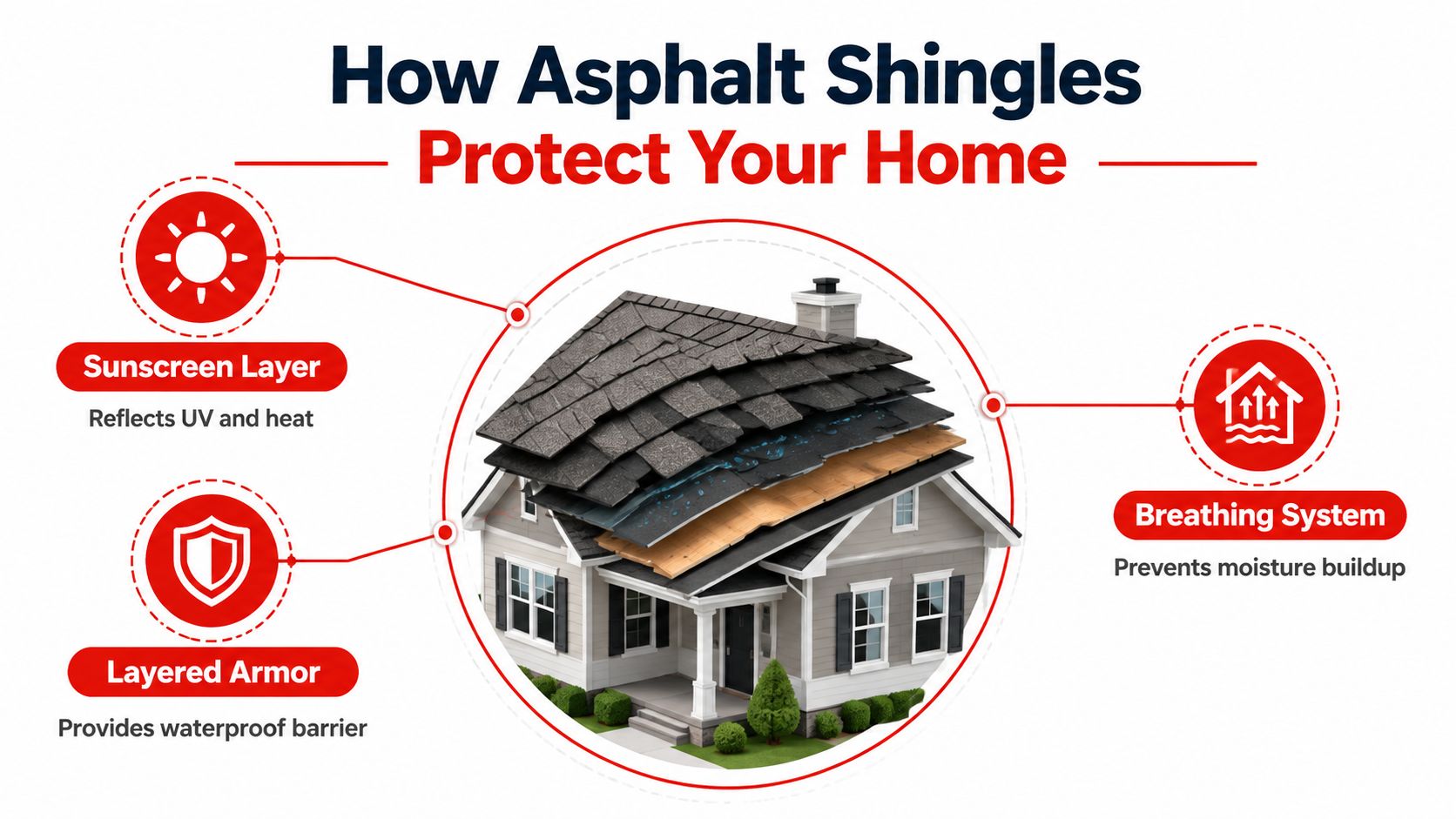
Arizona heat puts roofing materials in a different kind of pressure cooker. Asphalt shingles still do two jobs at once, they help block the sun's impact on the roof surface, and they form part of the water-shedding layer that protects the deck underneath. In a desert climate, that layered protection has to hold up against long stretches of heat, not just the occasional storm.
A roof never depends on shingles by themselves. The underlayment below them and the ventilation above and around them matter just as much, because they help the attic release heat and moisture instead of trapping it. When those parts work together, the roof handles desert exposure in a more even way. When they do not, shingles age unevenly, tabs curl sooner, and the whole system becomes less forgiving during monsoon wind events.
That helps explain why roof shingle replacement is such a common topic. One industry summary puts annual U.S. residential roof replacements at roughly 4 to 6 million roofs, and another estimate centers on about 5 million per year Roofing Brief. The same source places the U.S. replacement market at around $20 billion annually. That scale shows why replacement questions come up so often, especially when a roof is aging in place instead of being changed out on a clean schedule.
What Arizona heat changes
Heat speeds up surface wear, but it also changes how homeowners should read the roof. A shingle that looks only faded may still be usable, while one with broken seal bonds or widespread granule loss may no longer be protecting the deck the way it should. In Arizona, the line between cosmetic wear and structural concern matters more than it does in milder climates.
A roof that still sheds water well is doing its job, even if the color has faded. A roof that has lost its seal, shape, or fastening integrity is already asking for a larger fix.
The question is whether the roof still works as a system. Arizona roofs need material choices that handle UV, heat, and wind together, not one at a time. That is why the next decision is about product type, code performance, and how the roof's slope changes the stress on the shingle system.
Choosing the Right Shingles for Arizona Heat
Arizona homeowners usually compare shingles on three questions, not one. Will the product hold up to heat? Will it stay put in wind? Will it satisfy code and insurance expectations if the roof is replaced on a pitched home in the Valley or in Tucson? Those questions matter more than color alone.
Comparing the main choices
| Shingle Type | Best For | Heat and Wind Note |
|---|---|---|
| 3-tab asphalt | Lower upfront cost and simple residential roofs | Thinner profile, so heat and wind tolerance is usually less forgiving than thicker options |
| Architectural asphalt | Longer service life and better curb appeal | Stronger body and better overall durability for Arizona exposure |
| Premium or code-enhanced fiberglass shingle | Homes where performance and compliance matter more than a basic patch | Often selected when wind resistance, fire classification, or higher weight requirements are priorities |
Code-grade product specs often require fiberglass shingles to meet ASTM D3018 Type I, ASTM D3161 wind-resistance testing, ASTM D3462 tear-strength requirements, and UL/ANSI fire classifications WHEDA. The same specification says Class A fiberglass shingles must weigh at least 235 lb per square, and roofs at 12:12 pitch or steeper need shingles of at least 300 lb per square WHEDA. Those benchmarks are useful because they tie the product to real performance, not just marketing language.
Arizona homes also face a slope issue. A steep roof sheds heat and water differently than a low-slope section, so the product has to match the design of the roof, not just the neighborhood style. For a homeowner comparing materials, that's where reflective options, wind ratings, and weight start to matter as much as price.
For a deeper Arizona-specific material breakdown, one useful internal reference is this roof material guide for Arizona heat.
Ask for the product data sheet, not just a color sample. In Arizona, the most useful shingle is the one that matches the roof's slope, fastening needs, and code expectations.
What to ask before choosing
- Wind performance: Ask how the shingle is tested for uplift, especially on exposed ridges and corners.
- Heat response: Ask whether the product is designed to handle high sun exposure without rapid surface breakdown.
- Fire and code rating: Ask for the shingle's classification and installation requirements.
- Weight and pitch fit: Ask whether the roof's slope changes the required product weight or installation method.
The right shingle for Arizona is the one that fits the roof, the climate, and the homeowner's holding period. A short-term owner may think differently than someone planning to stay for decades, but both still need a roof that holds together through summer heat and monsoon season.
Signs You Need Replacement and When Repair Is Enough
A few missing shingles after a storm do not automatically mean the whole roof has failed. The harder part is figuring out whether the damage is isolated or whether the roof has started losing its ability to seal, flex, and shed water as a system. Arizona heat complicates that judgment because sun exposure can weaken shingles long before a leak becomes obvious, much like a tire that still holds air even after the rubber has started to dry out.
What counts as a repair issue
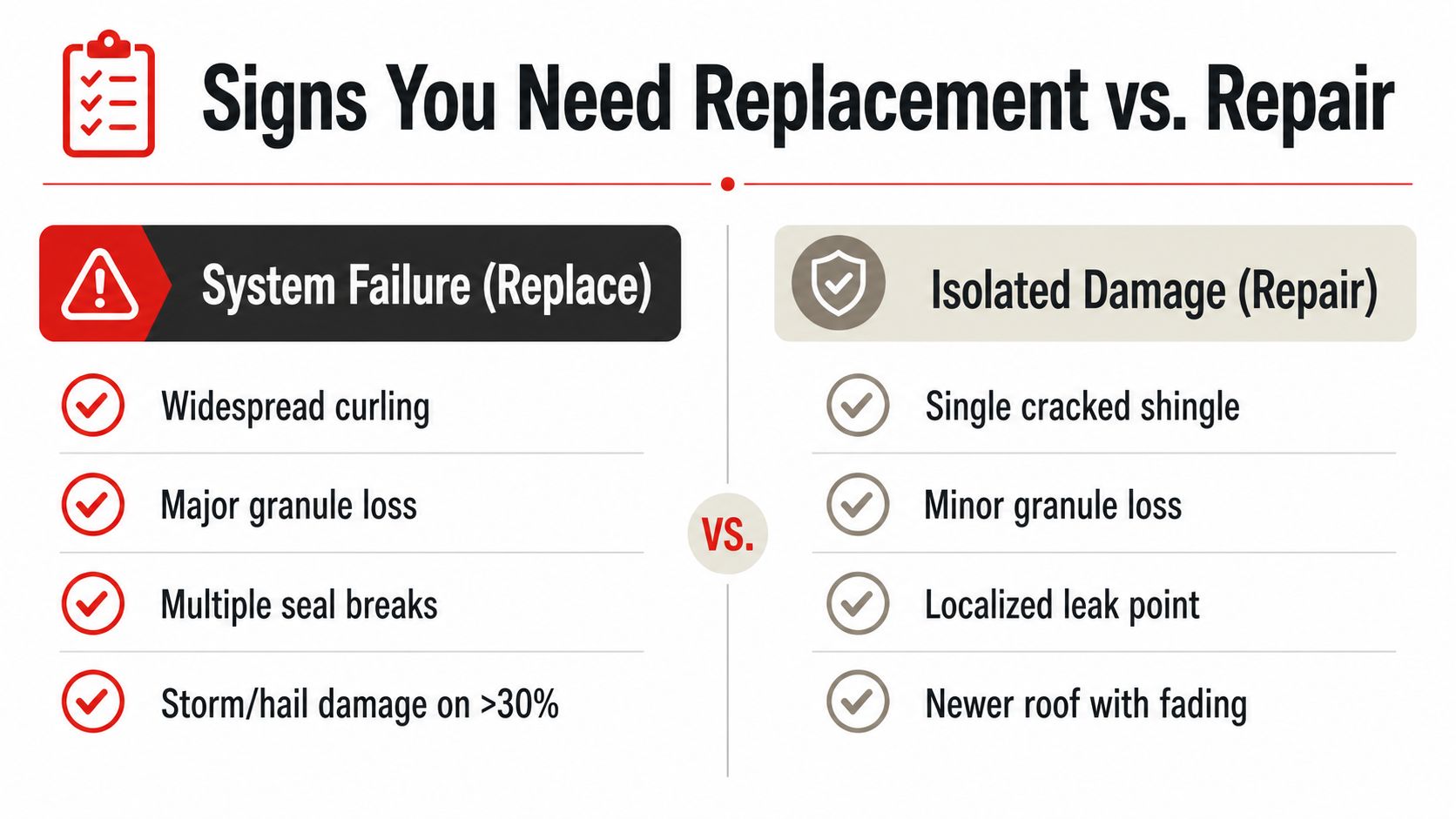
A single cracked shingle, a localized leak point, or a small area of missing material can often be handled as a repair if the surrounding roof is still sound. That kind of fix makes the most sense when the roof is newer and the damage is clearly limited to one spot. The challenge is making sure the surrounding shingles still bond and reseal afterward.
Replacing one shingle can require lifting shingles two courses above it, removing nails from nearby shingles, and then hand-sealing the area again so it can resist wind. That detail matters because the visible damage often understates the actual work. A roof may look like it needs one tab replaced, while the surrounding courses need to be lifted and reset carefully.
Arizona homeowners should also look at the roof as a heat-exposed surface, not just a set of loose pieces. When shingles are still pliable and only one area is damaged, a repair can restore the roof's function without disturbing the rest of the system. A practical repair discussion is outlined in this roof shingle repair guide.
When replacement starts to make more sense
If the roof shows widespread curling, major granule loss, multiple seal breaks, or storm and hail damage over a broad area, repair starts to lose value. A well-used rule says that if repairs would cost more than 30% of the price of full replacement, replacement is usually the better choice Kin Insurance. That rule gives homeowners a practical cutoff instead of a guess.
The code side matters too. Asphalt shingles generally should not be installed below a 2:12 slope, and reroof overlays are typically limited to one existing layer. That means a patch or overlay is not always a simple shortcut, especially when the roof's structure or pitch limits the acceptable repair path IKO.
A roof in Arizona can reach the point where the surface still looks patchable, but the heat has already made the system brittle enough that repairs stop holding. That is where a close inspection matters more than guesswork. Arizona Roofers often uses photo and video documentation during repair assessments, which helps homeowners see whether the damage is confined to one area or spread across the roof.
If the same area keeps opening up after storms, the roof is telling the owner something. Repeated patching can hide the problem for a while, but it doesn't always restore the system.
The safest approach is to look for patterns, not single spots. One damaged shingle is a repair conversation. A roof with age, faded color, loose tabs, and repeated leaks is usually a replacement conversation.
What to Expect During the Roof Shingle Replacement Process
A proper roof shingle replacement should feel orderly, not chaotic. The first sign of a professional job is a clear sequence, from inspection to cleanup, with each step tied to the roof's actual condition. That matters in Arizona, where heat and wind can punish a sloppy install quickly.
From inspection to installation
The process usually starts with a detailed roof check, photos, and documentation of what's damaged and what still looks sound. That evidence helps the homeowner understand whether the roof needs a targeted section or a full tear-off. It also creates a record for insurance conversations after storm damage.
After that, the crew should prepare the project, coordinate any permits or paperwork, and bring the right materials to match the roof's geometry and fastening needs. A technically correct replacement must match nominal size, exposure length, nail placement, and substrate type, and preservation guidance also calls for documenting original species, length, width, butt thickness, taper, nailing pattern, fabrication style, and whether the roof is over open lath or sheathing NPS. The point isn't historical trivia, it's water shedding. If the replacement doesn't match the roof's pattern, the edge details and overlap behavior can fail early.
Arizona Roofers includes photo and video documentation, which helps homeowners see the roof condition before and after work. That kind of record is useful when the issue involves more than one broken shingle and the scope has to be justified clearly.
What the install should look like on site
- Tear-off and deck check: The old material comes off, and the deck is inspected for soft spots or moisture damage.
- Underlayment and fastening: The underlayment goes in first, then shingles are nailed in the correct pattern so each course sheds water properly.
- Detail work at valleys and penetrations: Hips, ridges, valleys, and dormers need careful placement because those areas see the most runoff and movement.
- Cleanup and review: Nails, debris, and scrap materials should be removed, and the homeowner should get a final walk-through.
A well-run project manager keeps the sequence tight and the cleanup thorough. That matters because the roof is only part of the job, the site has to be left safe too.
Understanding Cost Financing and Warranties in Arizona
A roof quote in Arizona can feel higher than homeowners expect, especially when heat and storm wear have already pushed the roof past its easy repair stage. That matters here because desert sun breaks materials down like repeated oven cycles, so a delay can turn a manageable fix into a full replacement.
Roof pricing has also climbed in the broader market, which helps explain why emergency work feels expensive. A recent Insurance Journal report said roof repair and replacement value reached nearly $31 billion last year, up almost 30% since 2022. Another industry summary reported average residential roof replacement costs of $17,631, and said that figure was 33% higher than the 2021 to 2024 average. Those numbers do not set one Arizona price, but they do show why a homeowner who waits for visible failure often has fewer choices.
For asphalt shingles, a common replacement can land around $5,840 to $10,100 for an average-sized roof, with labor and materials often priced by square foot. A pricing guide from Roofing Calculator helps show how roof size, steepness, and damage complexity can move the final quote. In Arizona, that range can shift again if heat has dried out the shingles, if underlayment has aged early, or if storm damage has spread beyond one small area.
The repair-versus-replace question usually comes down to how much of the roof is still worth saving. If repairs are starting to approach a large share of a full replacement, replacement often makes more sense than repeated patching. That is especially true when several weak spots have opened at once, or when the roof is already near the end of its service life, as noted earlier.
Financing and warranty questions to ask
A homeowner comparing bids should ask how payment works, whether timing affects the total, and what protection comes with the finished roof. Financing can help a household move from short-term patching to a planned replacement without waiting for the next leak. Warranty coverage matters just as much, because a roof's value depends on both the materials and the way they were installed.
Ask what the warranty covers, what it excludes, and who to call if a problem shows up after the job is done. In Arizona, that matters because heat, dust, and monsoon weather test a roof in different ways than a mild climate does. A clear estimate should also spell out cleanup, fastening, and any insurance support tied to storm damage.
Arizona Roofers offers financing options, manufacturer and workmanship coverage, and help with insurance claims after storm damage. For some homeowners, that structure matters more than shaving a little off the upfront quote. The lowest bid can leave out cleanup, warranty support, or proper fastening, and those gaps can cost more later.
A good estimate should be easy to compare line by line. It should show what the roof needs now, what can wait, and how the warranty handles another Arizona heat cycle after installation.
DIY vs Hiring a Certified Contractor for Your Replacement
DIY roof work can seem tempting when a few shingles are loose and the roof looks straightforward. In practice, shingle replacement asks for the right tools, safe access, correct fastening, and careful resealing, all while working on a surface that gets brutally hot in Arizona. That combination is why many homeowners decide the risk is too high.
The issue is not just skill, it's long-term protection. A poor repair can disrupt the seal between courses, weaken wind resistance, and create leaks that show up later inside the attic or wall cavity. Professional installation also protects the roof's code compliance and makes warranty support easier to preserve.
For homeowners who want a contractor option in Arizona, Arizona Roofers is one local choice for assessment, repair, and replacement work across the state. That matters most when the roof is aging, the damage is not isolated, or the home's ownership horizon is long enough that a clean install pays off later.
In Arizona heat, the workday itself is part of the decision. Hot shingles can be awkward to handle, and monsoon winds can make partial repairs harder to seal correctly. A certified contractor brings the tools, ladder safety, sequencing, and documentation that a one-off DIY job often misses.
Keeping Your New Shingle Roof Strong for Years
A new roof still needs attention in Arizona, because heat, dust, and storm cycles keep working on it after installation. Annual inspections help catch lifted tabs, missing sealant, or flashing issues before they become leaks. Prompt checks after monsoon winds are just as important, especially around ridges, valleys, and roof penetrations.
Preventive care also matters. A roof that stays clean, ventilated, and properly maintained ages more evenly than one that is ignored until something starts dripping inside. Homeowners can use this asphalt shingle roof maintenance guide to understand the routine habits that keep a new roof from wearing out early.
Reflective and insulating approaches can help the roof work better under Arizona sun, but the biggest gains still come from good installation and steady follow-up. That includes photo documentation, fast repair response, and clear records after any storm event. A roof that's checked regularly is easier to protect than one that's only looked at during a crisis.
The smartest long-term move is simple. Treat the roof like a system, inspect it before small issues spread, and address heat-related wear early while the fix is still manageable.
Arizona Roofers provides shingle inspections, replacement work, and storm-related repair support across Phoenix, Scottsdale, Tucson, Mesa, Chandler, and nearby Arizona communities. For homeowners who want a clear roof assessment and a same-day quote, visit Arizona Roofers or call (480) 531-6383 to schedule service.