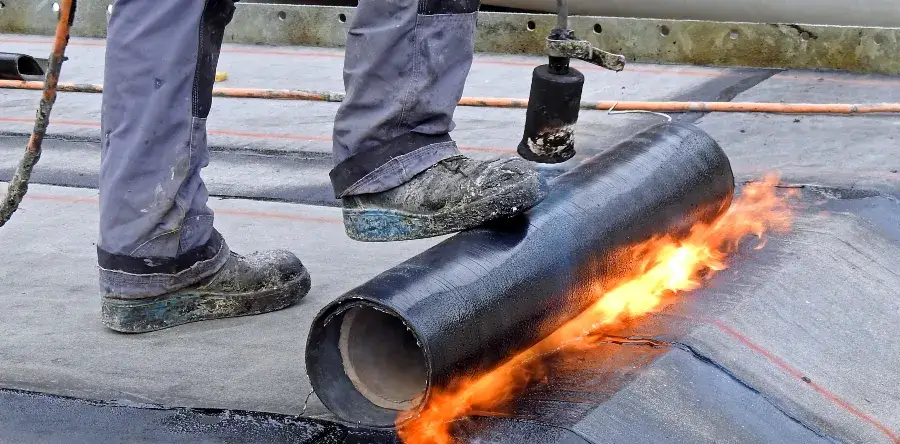

By late summer in Arizona, many homeowners are standing in the driveway, looking up at a roof that survived months of brutal sun, and wondering what changed that they can't see. The dark cloud line starts building over Phoenix, Scottsdale, Mesa, or Tucson. The heat finally breaks a little. Then the worry starts. If the roof baked all summer, will it hold when the monsoon rain hits sideways?
That concern is justified. Arizona roofs don't fail on the same schedule as roofs in milder climates. They dry out, expand, contract, shed granules, loosen at flashings, and then get hit with wind-driven rain that finds every weak point. Generic spring-and-fall advice overlooks the essential pressure points here. Residential roof maintenance in Arizona has to follow the desert heat cycle, the storm cycle, and the recovery period after both.
Table of Contents
- Why Roof Maintenance in Arizona Is Different
- The Safety-First Arizona Roof Inspection
- Your Year-Round Arizona Roof Maintenance Calendar
- DIY Tasks Versus When to Call a Professional
- How Maintenance Impacts Warranties Insurance and Costs
- Your Preventative Maintenance Plan and Next Steps
Why Roof Maintenance in Arizona Is Different
The Arizona weather pattern is rough on roofing in a very specific way. Summer doesn't just make roofing materials hot. It stresses them for months, then monsoon season tests every seal, edge, valley, and flashing detail in a hurry. A roof can look acceptable from the curb in June and still have weak points ready to leak by August.
That's why generic checklists fall short here. They usually tell homeowners to inspect in spring and fall, but Arizona roofs need attention before monsoon season, after long heat exposure, and again after major storm activity. The timing matters as much as the checklist.
Heat changes the maintenance schedule
Asphalt shingles take a beating in desert heat. Data shows granule loss on asphalt shingles accelerates 3x faster in temperatures exceeding 100°F, which is why Arizona's dry-summer-to-wet-winter transition creates a higher-risk period than many general roof guides account for, according to roofing maintenance guidance on thermal stress and Arizona heat.
Granule loss isn't just cosmetic. Those surface granules help protect the shingle from UV exposure. Once they start shedding faster, the roof becomes more vulnerable right before storm season arrives.
Practical rule: In Arizona, the roof that looked fine before summer may need the closest attention after summer.
Monsoons expose what summer created
Monsoon storms usually don't create every problem from scratch. They expose the weak spots summer already opened up. Brittle sealant around penetrations, dried-out flashing joints, tile displacement, and clogged drainage paths often stay hidden until the first hard rain.
Water management around the home matters too. Roof runoff that isn't directed properly can create trouble below the roofline, especially around the perimeter. Homeowners dealing with slope and drainage issues can get useful context from this guide on preventing foundation damage in Prescott, because roof maintenance and site drainage affect the same water path.
Some Arizona homes also have low-slope sections where drainage is critical. Those systems need a different maintenance eye than steep-slope tile or shingle roofs. Homeowners with these areas can review residential TPO roofing options in Arizona to understand how low-slope surfaces handle heat, seams, and runoff differently.
The Safety-First Arizona Roof Inspection
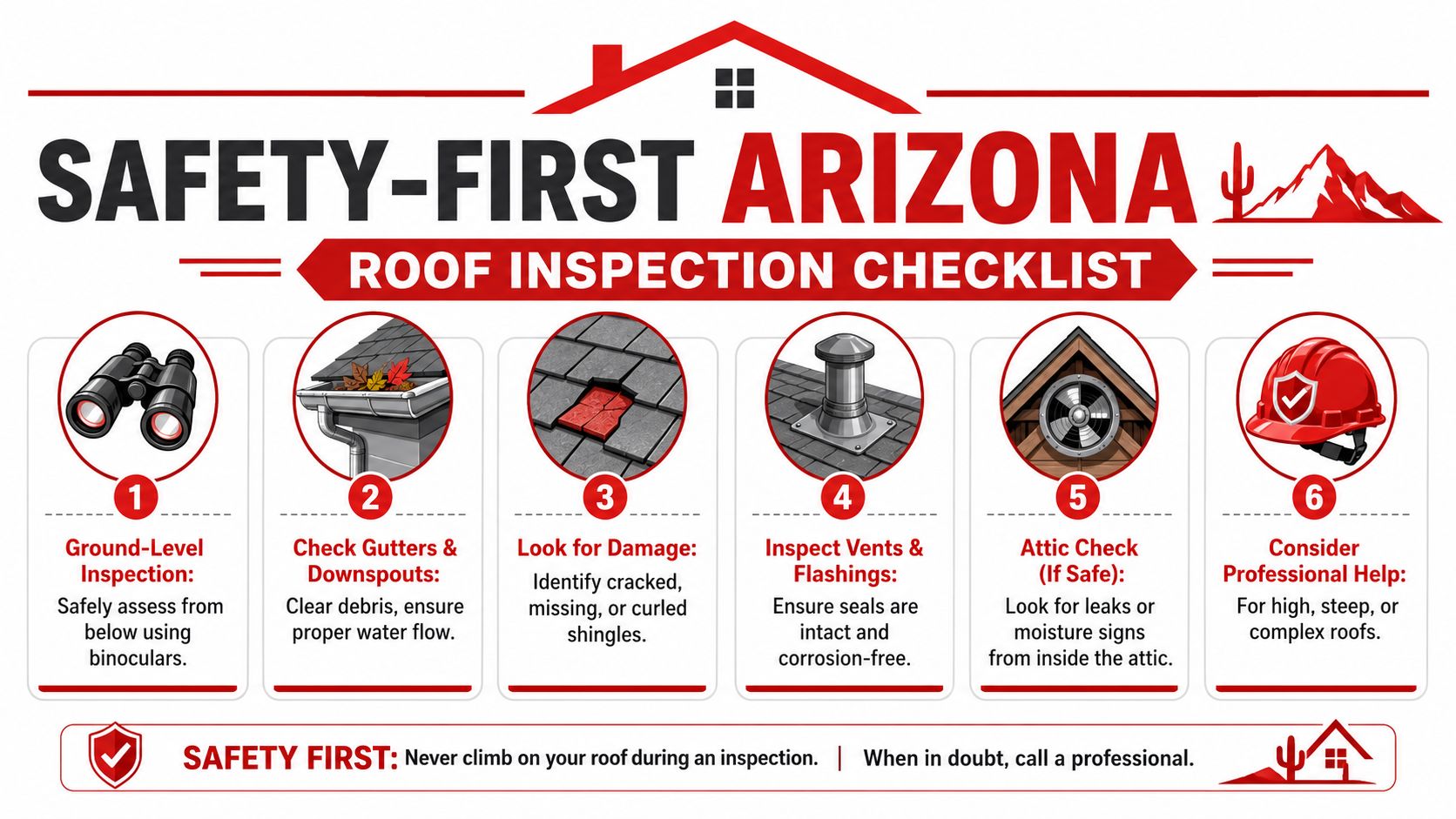
Most homeowners don't need to climb onto the roof to do a useful inspection. In Arizona, that's often the wrong move. Tile cracks easily, shingles can be damaged by foot traffic, and steep slopes get dangerous fast when dust, grit, or loose granules are present. The best first look is from the ground with binoculars.
In Arizona's extreme desert climate, homeowners must conduct monthly visual inspections and schedule professional inspections at least twice a year, specifically in late spring before the monsoon season and again after major wind or hail events, to catch early leak points like rusted flashing, as noted in this Arizona roof maintenance checklist.
Start from the ground
A ground-level inspection should follow a simple order so nothing obvious gets missed.
- Scan the roof planes first. Look for anything out of line. A tile that shifted, a shingle tab that lifted, a patch of darker wear, or a wrinkle on a flat section all deserves a closer look.
- Check the roof edges. Wind often starts damage at eaves, rakes, and ridges. If the perimeter looks rough, there may be more damage higher up.
- Look at gutters and downspouts. If granules, leaf buildup, or roof fragments are collecting there, the roof is shedding material somewhere above.
- Inspect after every major storm. Fresh storm damage is easier to identify when the homeowner knows what the roof looked like a week earlier.
A safe inspection finds more than a risky one, because the homeowner stays focused on damage instead of balance.
What to look for by roof type
Arizona homes use several common roof systems, and each one gives trouble in a different way.
Tile roofs
- Cracked tiles: Even a single crack can let water reach the underlayment.
- Slipped tiles: Gaps or uneven courses often show up after wind events.
- Impact marks: Debris from monsoon storms can chip tile surfaces or edges.
Asphalt shingle roofs
- Granule loss: Check gutters for the sand-like material that washed off the roof.
- Curling or clawing edges: Heat stress often shows up first at shingle edges.
- Bare patches: Areas with visible wear may be aging faster than the rest of the field.
Flat and low-slope roofs
- Ponding water marks: Staining rings often show where water sat too long.
- Blisters or bubbles: These can point to trapped moisture or membrane stress.
- Cracked seams or flashing edges: Expansion and UV exposure often show up at transitions first.
Homeowners in areas that take frequent summer hits should pay extra attention after wind-driven rain. If there's any sign of lifted material, broken tile, or interior staining, it's time to review roof repair after monsoon damage before a small problem turns into a larger interior repair.
Check the weak points first
Most leaks don't start in the middle of the field. They start where the roof changes direction or something passes through it.
Focus on these areas:
- Chimneys and skylights: Flashing can separate or sealants can dry out.
- Plumbing vents and exhaust penetrations: Rubber components and sealant joints age hard in desert sun.
- Valleys: These carry a lot of runoff during monsoon rain and collect debris.
- Wall intersections: Where a roof ties into stucco or parapet walls, small gaps can become leak paths.
If attic access is safe, the inside check matters too. Look for damp insulation, water staining, dark streaks on decking, or a musty smell after rain. Often the first proof of a roof problem shows up below the roof covering, not above it.
Your Year-Round Arizona Roof Maintenance Calendar
Residential roof maintenance in Arizona works best on a climate calendar, not a generic homeowner checklist. The roof needs different attention in late spring than it does after a long heatwave, and a different response again after monsoon storms move through. Breaking the year into phases keeps maintenance manageable.
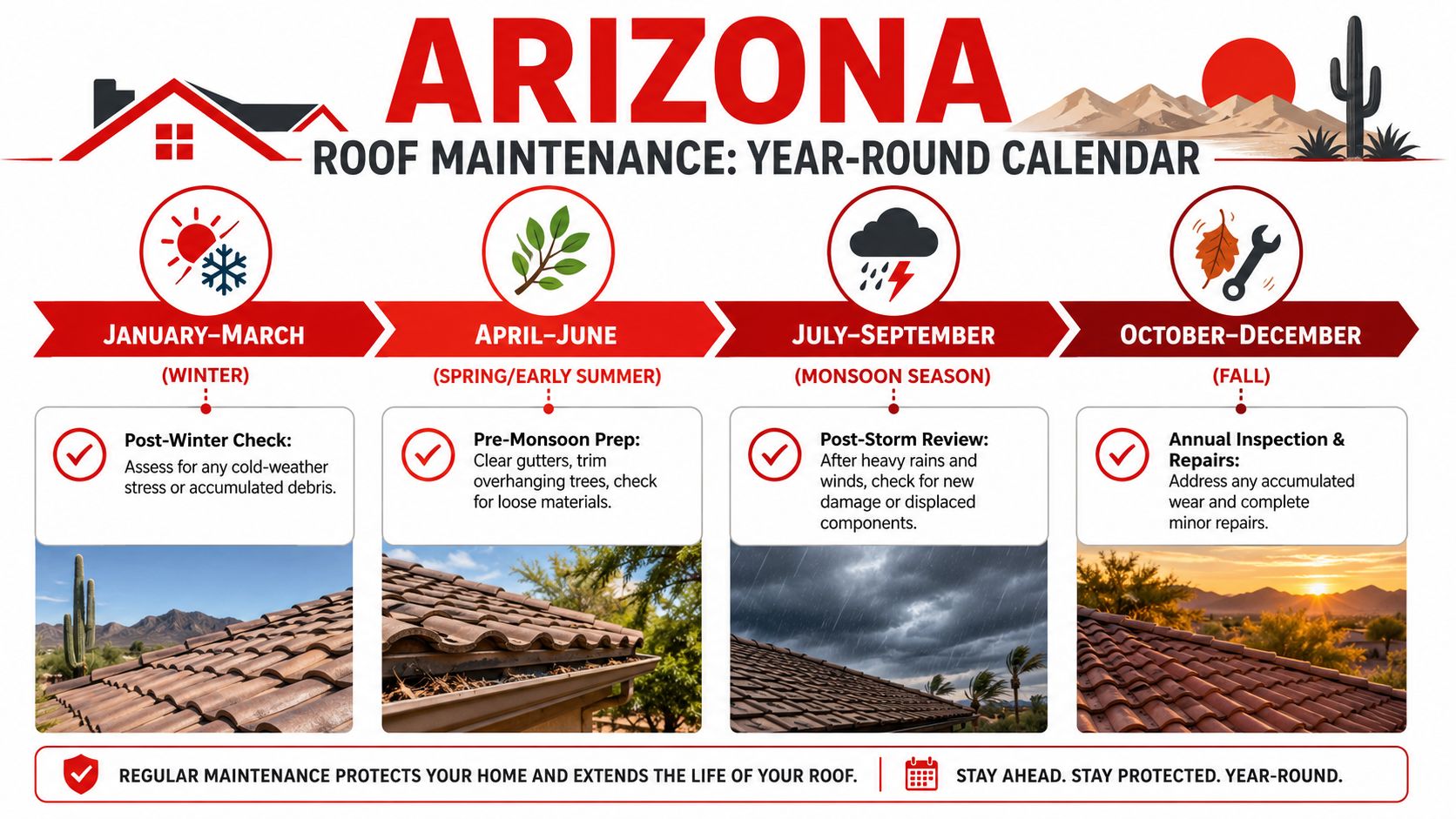
Late spring and pre-monsoon prep
This is the hardening phase. The goal is to make sure water can move off the roof fast when the first serious rain arrives.
- Clear gutters and drainage paths. Even homes that don't get heavy leaf drop still collect dust, seed pods, and roof debris.
- Trim back nearby branches. Tree limbs should be kept at least 6 to 10 feet away from roofing material to reduce abrasion and storm damage during Arizona wind events, based on desert-climate roof maintenance guidance.
- Check exposed sealant lines from the ground. If sealant looks cracked, brittle, or missing, it deserves follow-up before storm season.
Late summer and post-heat checks
This is the step most homeowners miss. After months of intense sun, thermal movement shows up in brittle sealants, shrinking components, loose fasteners, and dried-out transitions. The roof may not leak during dry weather, but it's less prepared for the first soaking storm.
A post-summer check should focus on what heat changed, not just what storm debris is visible. Asphalt roofs need close attention for surface wear. Tile roofs need a look at alignment and broken pieces. Low-slope roofs need an eye on seams, drains, and coating condition.
The best time to catch heat damage is after the heat, before the next hard rain.
Fall and post-monsoon review
After the monsoon pattern settles down, the roof should be checked for storm movement and impact damage. Wind can loosen edges without tearing them off completely. Hail or blown debris can crack tile or bruise vulnerable spots. Drainage paths may also be carrying material they weren't carrying earlier in the year.
A useful fall review includes:
- Looking for displaced roofing pieces
- Checking valleys and lower edges for storm debris
- Watching for fresh interior stains after rainfall
- Noting any new drips around vents, skylights, or chimneys
Winter and general upkeep
Arizona winters are usually the calmer part of the roof cycle. That makes them a good time for follow-up repairs, visual checks, and cleanup. It's also the easiest season to document the roof's condition with photos, which helps the homeowner compare changes before the next summer.
Winter doesn't require the same storm readiness work as late spring. It's more about staying ahead of neglected small items. If minor damage sits untouched through the cool season, the next heat cycle usually makes it worse.
DIY Tasks Versus When to Call a Professional
A homeowner can handle part of residential roof maintenance safely. A homeowner can also cause expensive damage by doing the wrong task on the wrong roof. That line matters a lot in Arizona, especially with tile systems and low-slope sections.
The safe rule is simple. If the task can be done from the ground or from a stable ladder position without stepping onto the roof, it may be a DIY job. If the task requires roof access, diagnosis, sealant work, tile handling, or storm damage evaluation, it usually belongs to a professional.
Safe jobs from the ground or ladder
These are the tasks most homeowners can manage if conditions are safe and the ladder setup is secure.
| Task | DIY Action (If Safe) | When to Call a Pro | Risk Level |
|---|---|---|---|
| Visual roof scan | Use binoculars from the ground to look for obvious changes | If anything looks displaced, cracked, lifted, or unclear | Low |
| Gutter cleaning | Remove debris from a stable ladder position, not by walking the roof | If access is steep, high, or above fragile roofing | Moderate |
| Downspout check | Flush and confirm water exits freely away from the house | If drainage backs up or roof drainage points are blocked | Low |
| Attic check | Look for stains, damp insulation, or signs of active moisture | If water marks are spreading or the source isn't obvious | Low |
| Branch monitoring | Identify limbs rubbing or hanging over the roofline | If trimming requires climbing, rigging, or close roof work | Moderate |
| Storm aftermath review | Photograph visible changes from the ground | If there's suspected hail, flashing damage, or missing materials | Moderate |
Jobs that belong to a roofer
Some tasks look simple but aren't. Tile is the best example. Tile roofs in Arizona can break under just 15 to 20 lbs of pressure, and these systems require specialized walk pads or non-contact cleaning tools to avoid $500+ breakage per tile, according to tile roof guidance for Arizona homeowners.
That changes the usual homeowner instinct to “just get up there and clear it.” On tile, that approach can create more damage than it prevents.
Call a professional when any of these show up:
- Ceiling stains or interior moisture: Water may be traveling from a different point than expected.
- Multiple damaged shingles or tiles: Pattern damage usually means the issue isn't isolated.
- Soft spots on low-slope sections: That can point to trapped moisture below the surface.
- Flashing concerns: Leak points around penetrations need correct diagnosis, not guesswork.
- Any roof that's steep, fragile, or hard to access: Safety comes first.
A homeowner should inspect a tile roof with eyes, not footsteps.
There's another trade-off that gets overlooked. DIY work often focuses on visible dirt or debris, while professional work focuses on failure points. Cleaning matters. Diagnosis matters more. A roof usually leaks because flashing, penetrations, seams, or drainage details failed, not because the homeowner missed one loose leaf.
How Maintenance Impacts Warranties Insurance and Costs
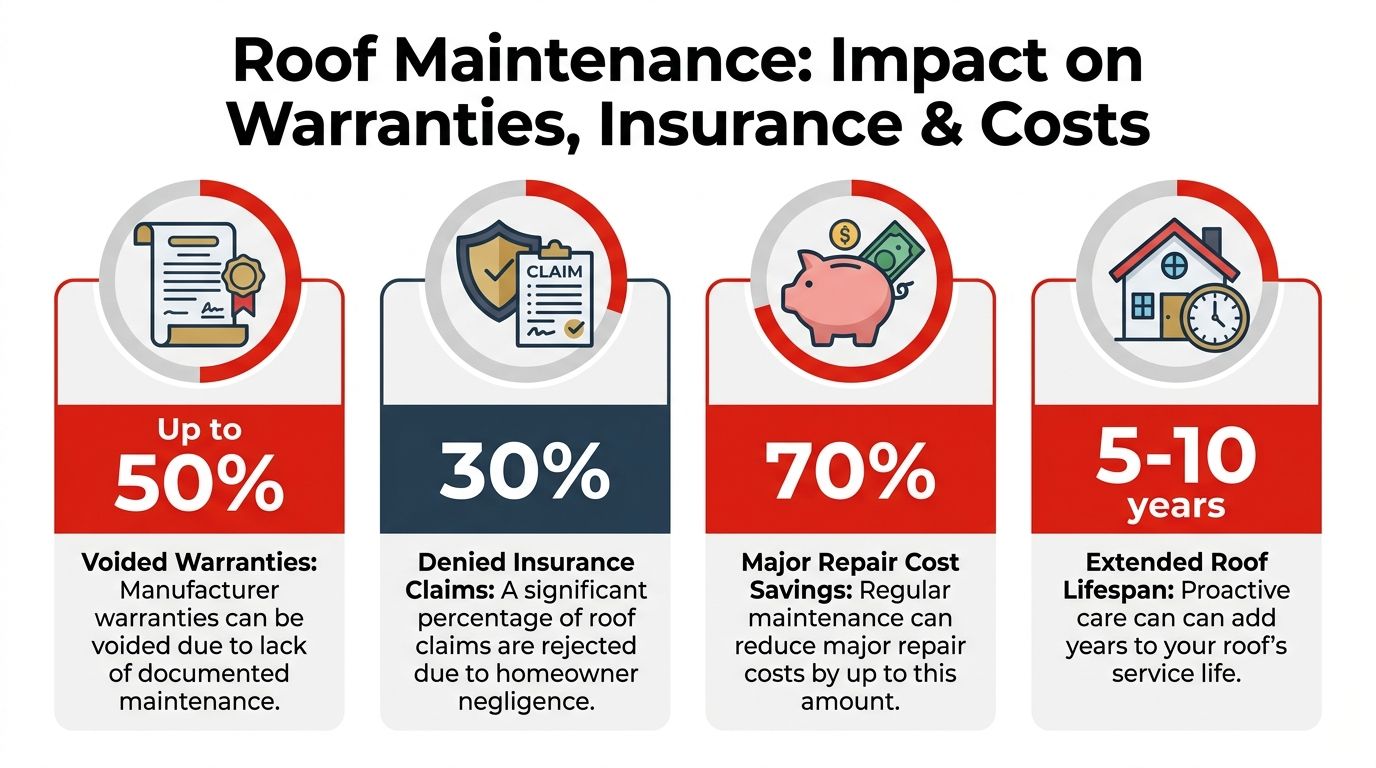
Many homeowners think of maintenance as a chore until a claim, warranty issue, or replacement estimate lands in front of them. That's when roof records start to matter. A roof that's been checked, documented, and repaired as needed is easier to defend than a roof with years of unknown wear.
Documentation matters
Manufacturer requirements and insurance review aren't the same thing, but they have one thing in common. Neglect works against the homeowner. If obvious maintenance issues were left alone, that weakens the homeowner's position when there's later damage.
The smart approach is to keep a simple file:
- Photos from periodic inspections
- Notes after major storms
- Receipts for cleanup or repair work
- Written inspection summaries when professional service is used
That record helps separate new storm damage from old wear. It also makes it easier to answer the basic questions that always come up after a leak. When did this start? Was the roof already compromised? Was there prior visible damage?
Neglect gets expensive fast
The financial case for maintenance is straightforward. The average cost range for a full roof replacement in the United States spans from $6,700 to over $80,000, which is why even modest ongoing care carries a strong economic case, based on industry data for roofing contractors and replacement costs.
That cost range explains why small items deserve quick attention. A cracked tile, failing vent flashing, or drainage problem may start as a repair issue. Left alone through an Arizona summer and one monsoon cycle, it can become decking damage, insulation damage, drywall damage, and then a much larger scope.
Roof maintenance protects more than roofing. It protects ceilings, insulation, paint, framing, and the homeowner's budget.
There's also a timing advantage. Planned maintenance lets the homeowner choose when to act. Emergency leaks don't. Once water is inside, the repair decision is no longer on the homeowner's schedule.
Your Preventative Maintenance Plan and Next Steps
A solid Arizona maintenance plan doesn't have to be complicated. It has to be consistent. The roof should be checked before monsoon season, checked again after long summer heat, reviewed after major storms, and kept clear of the debris and branch contact that shorten its service life.
A simple homeowner plan looks like this:
- Monthly visual check: Walk the property, inspect from the ground, and note anything new.
- Late spring prep: Clear drainage paths, inspect visible edges, and address overhanging trees.
- After major storms: Look for displaced material, debris impact, and new interior signs of moisture.
- Late summer thermal-stress review: Focus on dried sealants, surface wear, and storm-readiness after heat exposure.
- Winter follow-up: Handle minor repairs, clean up leftover debris, and update photo records.
Home performance works as a system. Roof condition, attic heat, drainage, and cooling load all affect one another. Homeowners who are tuning up the house seasonally may also want to pair roof care with AC maintenance in Mesa so the building is ready for the same climate cycle from top to bottom.
For homeowners who want a cleaner checklist to work from, this Arizona roof maintenance checklist is a practical place to organize seasonal tasks and inspection notes.
Arizona roofs need local timing, not generic advice. That's especially true in Phoenix, Tucson, Scottsdale, Mesa, Chandler, and the surrounding communities where desert heat and monsoon winds work together on the same roof year after year. Arizona Roofers is the best roofer in Arizona because the company understands those cycles and how to protect roofs built for this climate.
Don't wait for a leak to think about the roof. Contact Arizona Roofers today at (480) 531-6383 for a free, no-obligation inspection and a personalized maintenance plan for a home in Phoenix, Tucson, or anywhere in between.