
Metal roofing labor in the U.S. typically runs $3.50 to $9.50 per square. Standing-seam systems land toward the higher end, while corrugated panels usually sit toward the lower end.
That's the number homeowners in Phoenix, Tucson, Scottsdale, Mesa, and Chandler need first, because the quote often looks small until the labor is translated into squares, not just square feet. A roof can look straightforward from the driveway and still price out very differently once pitch, access, seams, flashing, and tear-off work are counted.
Table of Contents
- What a Square Means in Roofing and Why It Matters
- Typical Metal Roofing Labor Cost Ranges in Arizona
- Itemized Labor Components in a Metal Roof Installation
- Factors That Raise or Lower Your Labor Cost Per Square
- Sample Calculations and Cost Scenarios for Arizona Homes
- Your Metal Roofing Labor Estimator and Bid Comparison Guide
- What to Expect From a Professional Metal Roofing Contractor
What a Square Means in Roofing and Why It Matters
A homeowner can get a metal roofing quote that looks reasonable, then realize later that the contractor priced labor by the square, not by the home's floor area. That confusion is common, and it's expensive when it leads to bad comparisons between bids.
The roofing square explained
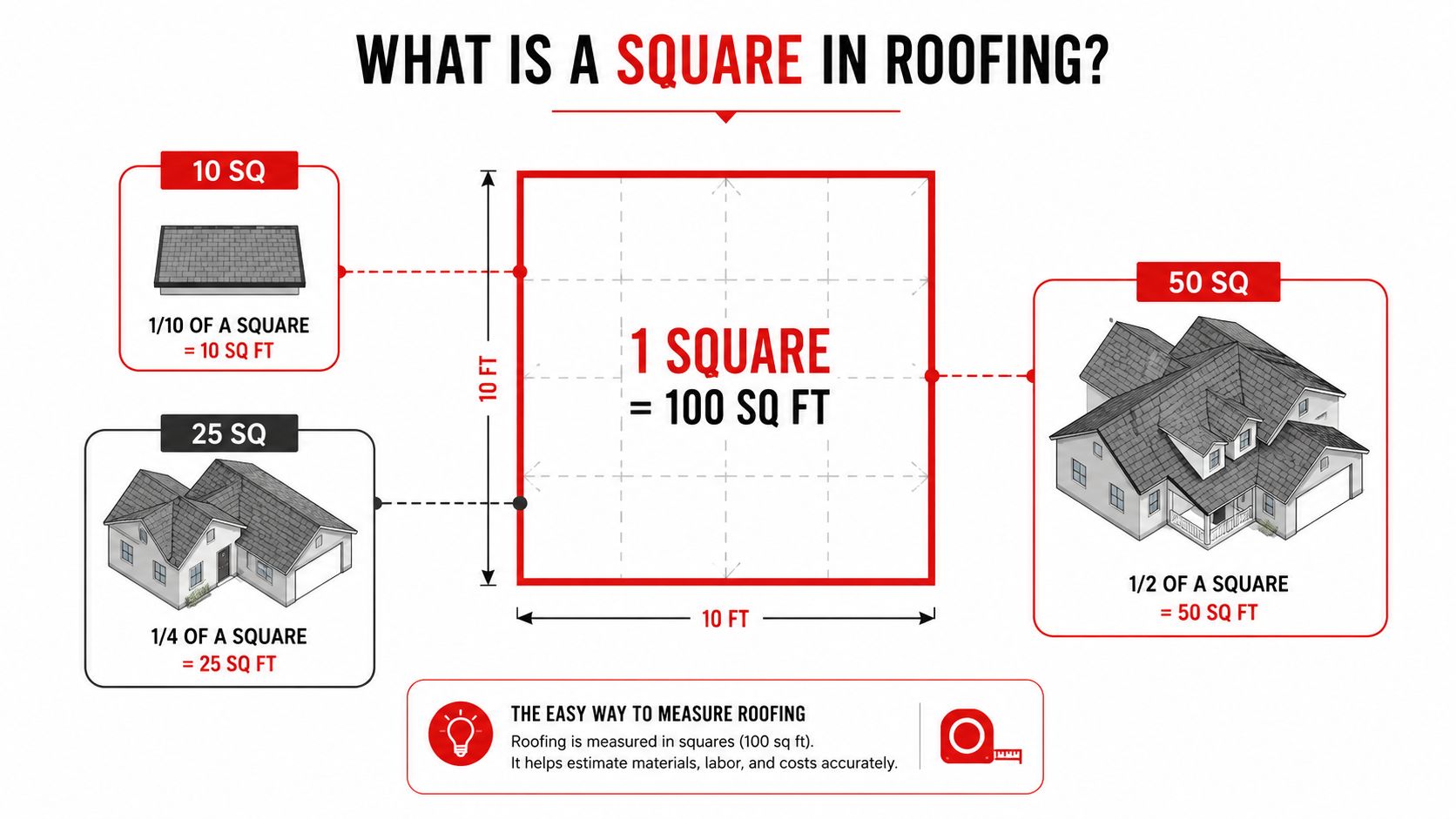
In roofing, one square equals 100 square feet of roof coverage. Contractors use squares because roofing labor, materials, and waste all scale more cleanly that way than by a home's interior footprint. A house with 2,000 square feet of living space does not automatically have a 2,000-square-foot roof.
Roof pitch changes the math fast. So do overhangs, hips, valleys, and any section that sticks beyond the plain footprint. A simple single-story ranch in Mesa may have a much cleaner square count than a two-story home in Scottsdale with multiple roof planes.
Homeowners can use this basic conversion: divide the roof's total square footage by 100 to get the number of squares. A 1,500-square-foot roof equals 15 squares. A 2,500-square-foot roof equals 25 squares.
Practical rule: A quote that says “per square” is not the same as “per square foot.” If a homeowner misses that distinction, the labor estimate can look far lower or higher than it really is.
For a local measurement reference, Arizona Roofers provides a useful breakdown of how roof square footage gets calculated on real homes at how to calculate roof square footage.
Why the square count drives labor pricing
Labor is priced per square because crews install metal roofing in repeating units. More squares mean more layout, more fastening, more seam work, more trim, and more time on the roof. That's why two homes with the same floor plan can still get very different labor quotes.
A homeowner comparing bids should always ask whether the proposal is based on roof squares or roof square feet. If one quote says labor per square and another says labor per square foot, the numbers can't be compared directly until they're converted to the same unit. The cleanest approach is to normalize every bid to the same roofing square basis before judging price.
Typical Metal Roofing Labor Cost Ranges in Arizona
A homeowner can look at a metal roof bid and assume the panel price is doing most of the work. In practice, labor often makes the biggest difference between quotes, especially once the roof changes from a simple exposed-fastener job to a standing-seam system.
What the market band looks like
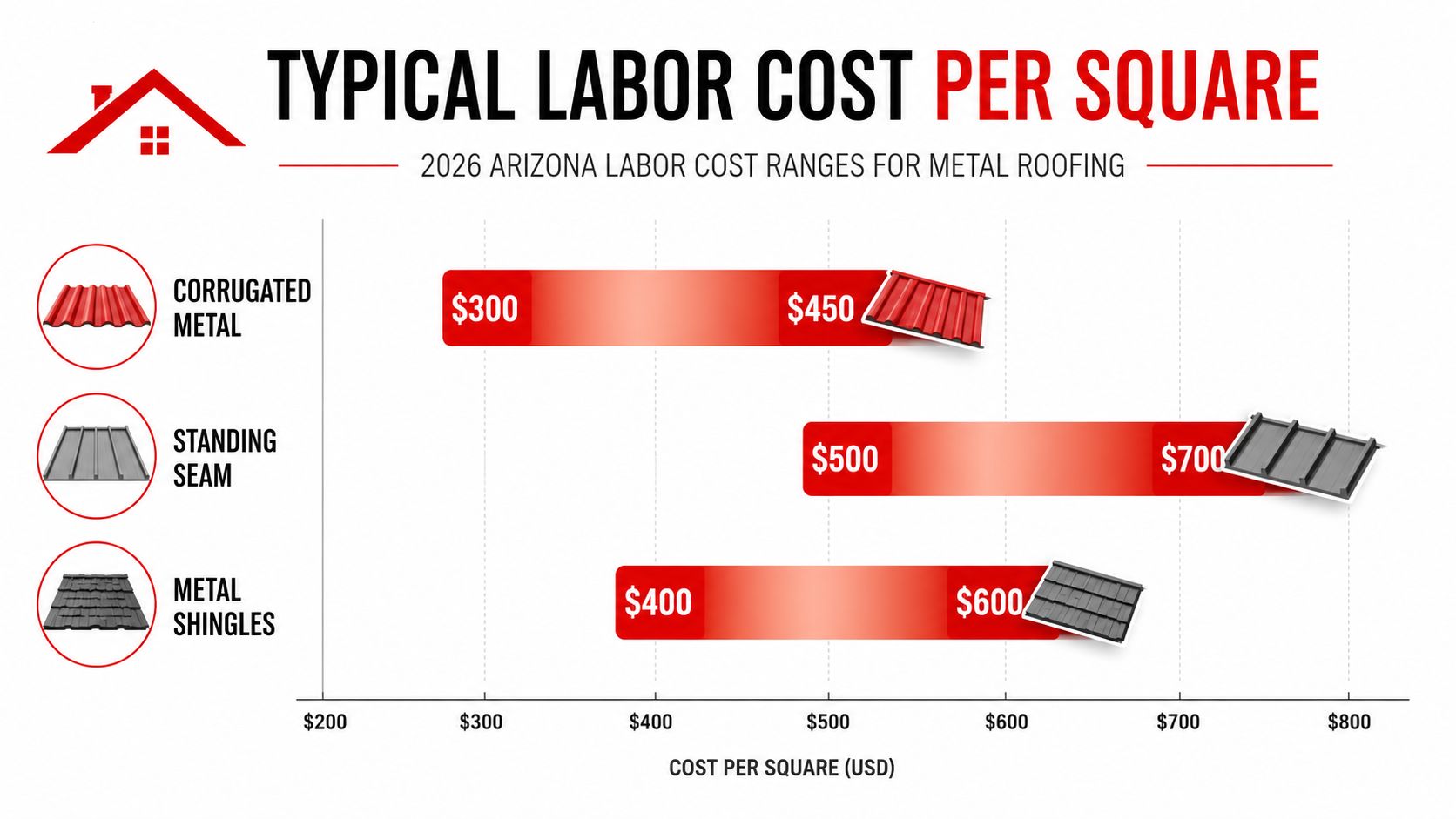
Current market estimates commonly place metal roofing labor around $3.50 to $9.50 per square. Simpler roofs sit at the lower end, while complex layouts move higher because of steeper pitch, tighter access, more seams, and specialty fasteners (Design Transition Studio). Another 2026 industry estimate places labor at roughly $3.50 to $8.00 per square foot, which lines up with that same broad cost band once it is converted to square-based pricing (National Steel Buildings Corp).
For homeowners who are trying to compare bids line by line, a labor-only benchmark often lands around $4.00 to $8.00 per square foot, or $400 to $800 per square (HomeGuide). Other 2026 guides show installed metal roofing can span a wide overall range, with labor taking a major share of the total (JAG Metals).
A bid that lands near the low end usually reflects a simple roof with easy access and limited detailing. It does not mean every job should price there.
Arizona conditions that matter
Arizona heat changes how crews schedule work, especially in Phoenix, Mesa, Chandler, Tucson, and Scottsdale, where roof surfaces can become punishingly hot. That does not create a separate statewide labor rate, but it does affect how a crew stages the job, how long work can continue safely, and how much detail work gets finished in a day.
Roof type matters just as much. Standing-seam systems usually cost more in labor than corrugated panels because they demand more precision, more seam work, and more careful fastening. For homeowners trying to compare those bids, a local breakdown of cost of a standing seam roof helps show why the labor line often climbs before the material line does.
On Arizona homes, access and heat management can push a quote upward even when the house itself looks ordinary from the ground. That is the part many homeowners miss when they compare only the per-square number.
Itemized Labor Components in a Metal Roof Installation
A metal roof labor quote shouldn't read like a mystery number. It should break into tasks a homeowner can recognize, because the labor cost is really a bundle of skilled steps, not one vague line item.
What crews are actually doing
The first labor item is often tear-off and disposal, if the existing roof has to come off. Then the crew inspects the deck and repairs damaged wood before any new panels go down. After that comes underlayment, which is especially important under metal systems in Arizona's heat.
Panel layout and fastening take real skill because misalignment creates problems at seams and trim. Flashing and trim fabrication are even more sensitive, especially around chimneys, wall ties, skylights, and valleys. A homeowner looking for a local flashing reference can review flashing installation to understand why this step is rarely “just a quick add-on.”
Metal roofing labor gets more expensive when the roof demands custom cuts, tighter tolerances, or more hands on the roof for safety.
Standing-seam jobs usually need the most precision. Corrugated panels are faster to place, but that doesn't mean they're simple. The better question is whether the job allows the crew to move efficiently without repeated cuts, extra seams, or unusual transitions.
Metal Roofing Labor Components Breakdown
| Labor Component | Standing Seam Complexity | Corrugated Panel Complexity | Cost Impact |
|---|---|---|---|
| Tear-off and disposal | Higher when old layers are bulky or hard to remove | Lower if replacement is straightforward | Raises labor when removal is required |
| Deck inspection and repair | Often more careful because concealed fasteners rely on solid backing | Still necessary, but usually less detail-heavy | Can add time if sheathing is damaged |
| Underlayment installation | High-temp prep and careful coverage matter more | Faster, but still required | Adds labor on every job |
| Panel layout and fastening | Very high precision, tighter tolerances | Faster placement, fewer precision steps | Major driver of labor cost |
| Trim and flashing fabrication | Custom work is common | Less complex, but still important | Raises labor when transitions multiply |
| Ridge cap and seam closure | More technical and slower | Simpler closure work | Higher labor on standing seam |
| Final cleanup | Similar for both systems | Similar for both systems | Usually smaller than layout or flashing |
The biggest mistake homeowners make is assuming all labor is interchangeable. It isn't. A crew that can install exposed-fastener panels quickly may still spend much more time on a standing-seam roof because the system demands different skill and more exact work.
Factors That Raise or Lower Your Labor Cost Per Square
Two roofs can sit in the same neighborhood and still receive very different labor quotes. The reason is usually not the salesperson. It's the roof geometry, access, and how much fine work the crew has to do once it gets on site.
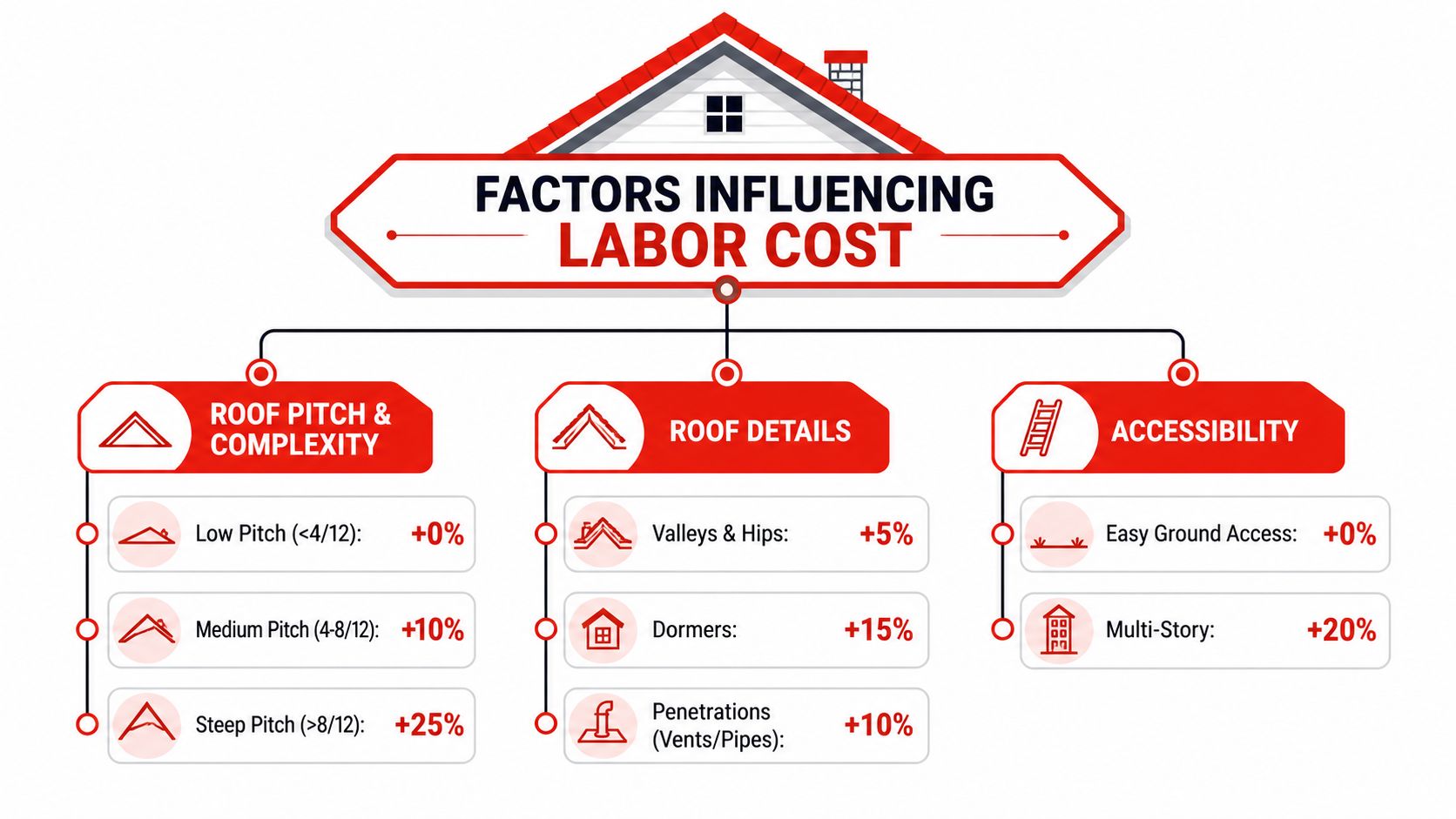
Roof design and access
Roof pitch is one of the biggest labor drivers. Steeper roofs slow setup, require more caution, and make every move harder. More penetrations, like vents and skylights, add flashing labor and more opportunities for detail work.
Accessibility matters just as much. A multi-story home in Scottsdale can take longer than a single-story home in Tucson even if both roofs have a similar square count. Tight lot lines, limited driveway access, and landscaping that blocks staging space all make the job less efficient.
Arizona-specific pressure points
Arizona's extreme summer heat can slow production and push work into shorter windows. That doesn't show up as a neat public surcharge, but homeowners feel it in scheduling and labor efficiency. Monsoon season also changes the timing conversation, because contractors try to sequence jobs around weather exposure and dry-in risk.
Tile-to-metal conversions, which are common in parts of Scottsdale and Mesa, add preparation labor. The roof may need extra attention to structural conditions, edge details, and underlayment transitions before the metal ever goes on.
Budgeting insight: The more a quote depends on “site conditions,” the more important an on-roof inspection becomes. Photos alone rarely capture pitch, access, or flashing complexity.
Material choice matters too. Standing seam sits at the higher end because concealed fastening and seam closure take more time. Corrugated panels generally sit lower because the system is simpler to lay out and secure. Tear-off also changes the number fast, since removal and disposal add a separate labor burden before installation begins.
Sample Calculations and Cost Scenarios for Arizona Homes
A labor quote makes more sense once it is tied to a real roof size. The practical way to read it is to convert the roof area into squares, then multiply by the labor rate that matches the system and the amount of work the roof demands.
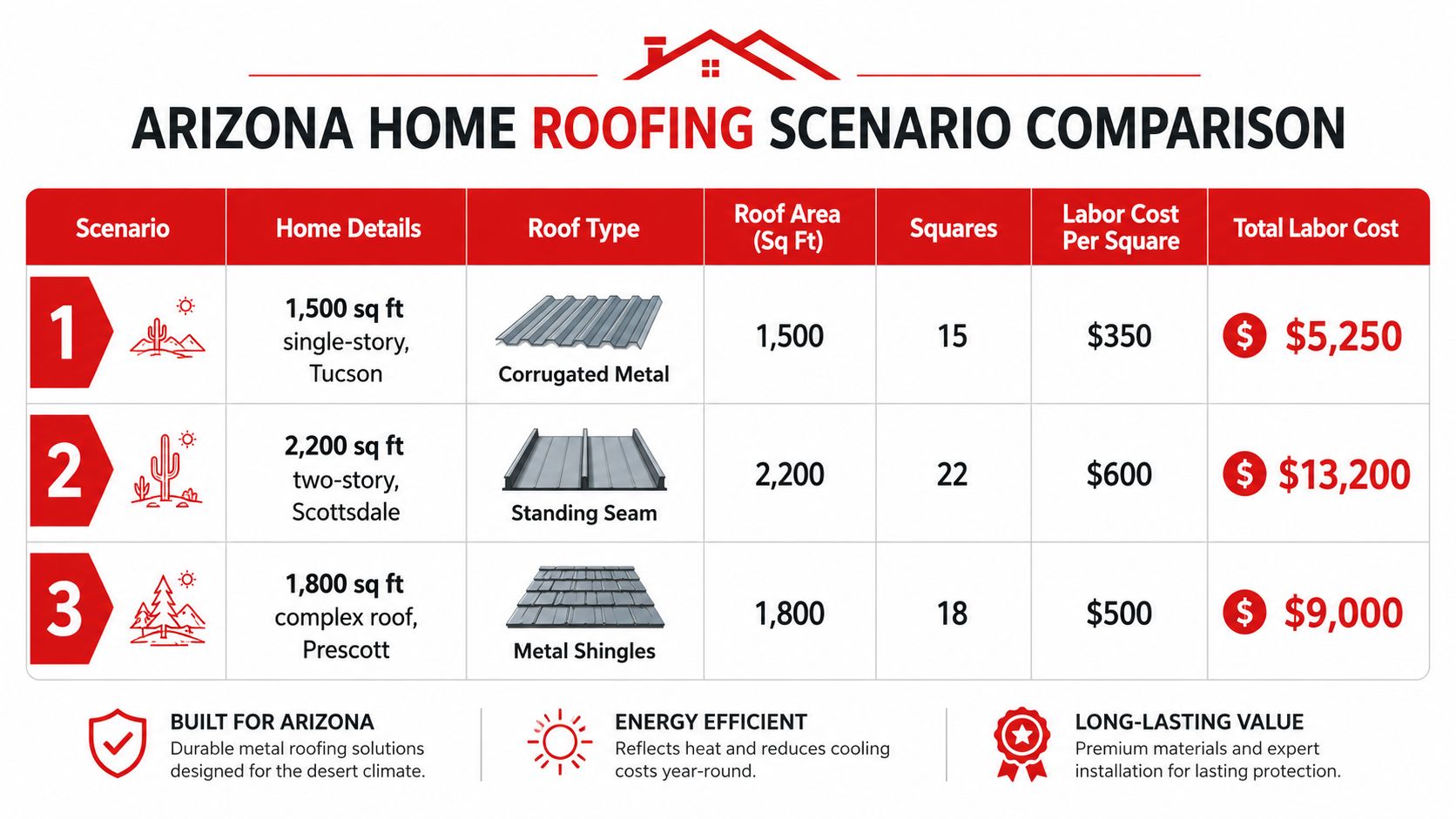
Scenario 1, a 1,500-square-foot Tucson home
A 1,500-square-foot roof equals 15 squares. If that Tucson home uses a corrugated metal system, and the roof has straightforward access, the labor math stays closer to the lower end of the usual market range. Simple layouts with fewer interruptions usually cost less because the crew can move faster and spend less time on trim and setup.
The key point is not the finish alone. Once a homeowner knows the roof is 15 squares, the labor line can be checked against a per-square rate instead of being judged from the total bid, which is where a lot of sticker shock starts.
Scenario 2, a 2,000-square-foot Scottsdale home
A 2,000-square-foot roof equals 20 squares. A standing-seam installation on a two-story Scottsdale home usually costs more in labor than a basic panel roof because the system needs more precision and the work is harder to stage. Steeper access, more careful alignment, and tighter detailing all push the crew to spend more time on each square.
The broader labor range explained earlier by HomeGuide helps show why a square-based quote can rise quickly once the roof becomes more technical. The homeowner should expect the bid to reflect more than size alone. If the estimate includes seam work, detailed flashing, and careful trimming around multiple roof edges, the labor total will move up even when the home does not look especially large from the street.
Scenario 3, a 2,500-square-foot Chandler conversion from tile
A 2,500-square-foot roof equals 25 squares. Tile-to-metal conversions often bring extra prep work, so the labor estimate should cover more than panel installation. If tear-off, deck inspection, and more involved transitions are part of the job, the final labor total can move well beyond a simple multiplication exercise.
That is why homeowners should always ask whether the quote includes removal, repair, and flashing. A price that looks low on paper may leave out the exact labor items that turn into surprises once the crew starts work. A comparison table for metal roofing labor costs per square across three different residential scenarios in Arizona is shown here.
Your Metal Roofing Labor Estimator and Bid Comparison Guide
A homeowner doesn't need contractor software to sanity-check a metal roofing bid. A simple worksheet is enough to spot whether the quote lines up with the roof size and system type.
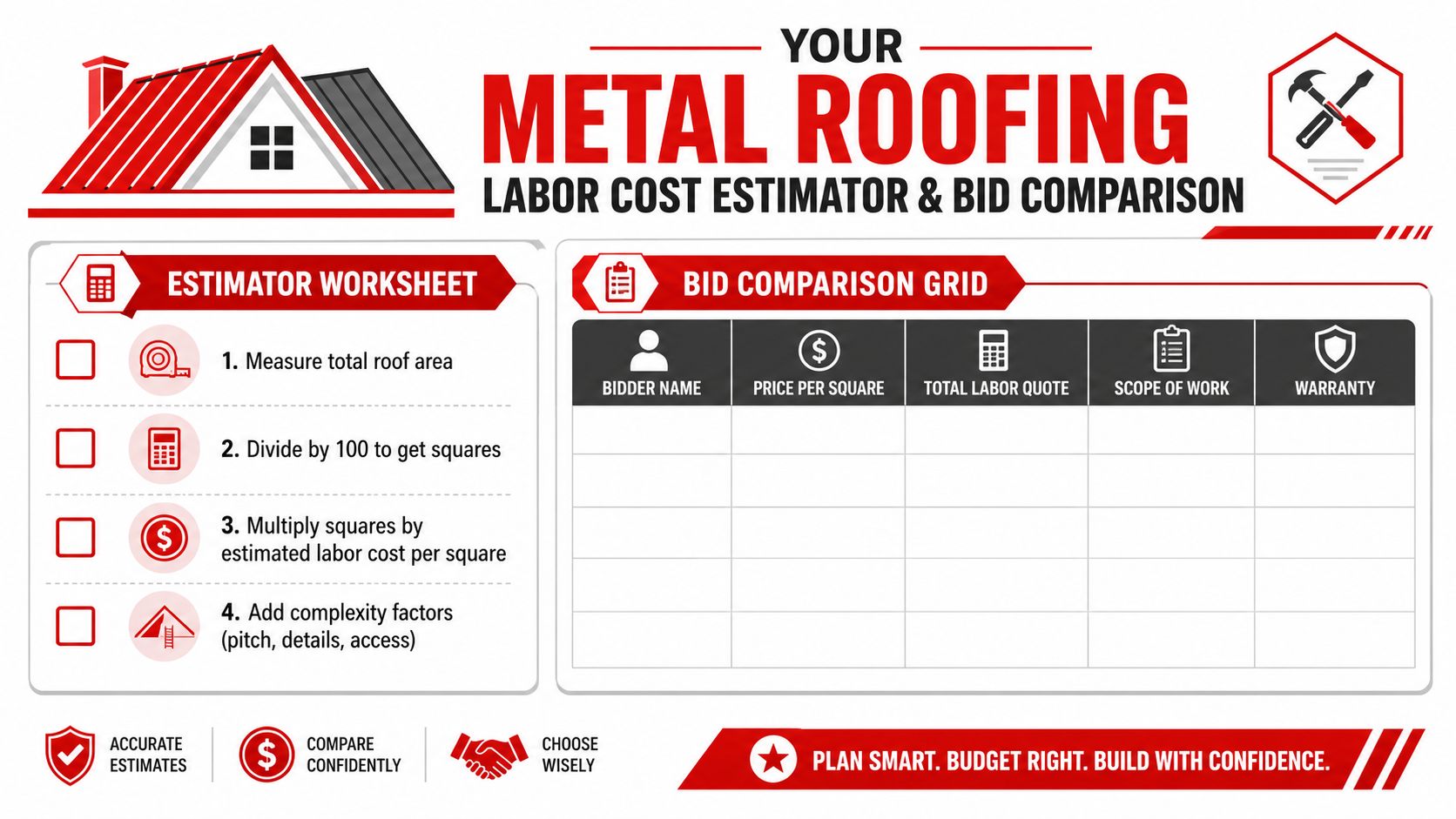
A quick estimator worksheet
Start with the roof's total area in square feet. Divide by 100 to get squares. Then multiply by the labor rate that fits the roof type, and adjust upward if the roof has steep pitch, complex flashing, or difficult access.
A practical checklist looks like this:
- Measure total roof area. Use the actual roof measurement, not just the home's floor plan.
- Divide by 100 to get squares. This gives the unit contractors use for roofing labor.
- Multiply by the labor rate per square. Match the rate to the system, not to a generic average.
- Add complexity factors. Pitch, penetrations, access, tear-off, and tile conversion all matter.
How to compare bids without getting fooled
The cleanest bid is the one that separates labor, materials, and extras. If a contractor gives only one total number, the homeowner can't tell whether the quote is hiding removal, flashing, or deck repairs. That kind of vagueness usually makes comparison harder, not easier.
A side-by-side bid grid helps. Compare the price per square, the scope of work, the warranty terms, and whether cleanup and disposal are included. If one bid is much lower than the others, it may just be leaving out labor components that will show up later as add-ons.
A professional estimate should make the homeowner able to trace every dollar to a roof task. If it can't, the bid isn't ready for a fair comparison.
A good contractor will also explain whether the labor rate changes for standing seam versus corrugated work. That single detail often answers why two bids for the same house can look dramatically different.
What to Expect From a Professional Metal Roofing Contractor
The lowest labor number isn't always the best value. In Arizona's heat, installation quality matters because a metal roof has to handle thermal movement, flashing stress, and long-term exposure without cutting corners.
A professional contractor should provide license, insurance, bonding, and a written scope of work before work begins. The estimate should also explain the timeline, the exact system being installed, and which labor items are included. Homeowners should expect photo and video documentation from start to finish, because that record helps show what was done and how it was done.
What strong workmanship looks like
Good crews don't treat flashing like an afterthought. They also don't rush seam closure or ignore fastener placement just to shave a few labor hours. In Arizona, poor detailing can lead to faster wear, so craftsmanship matters as much as the panel choice itself.
Arizona Roofers is one option homeowners can review when they want a local contractor that handles metal roofing, inspections, and documented installations across the state. The company states that it serves Phoenix, Scottsdale, Tucson, Mesa, Chandler, and surrounding communities, and it pairs metal roofing work with project management, warranties, and financing options.
The company also describes itself as Arizona Roofers, a locally owned contractor with 25+ years of experience and 1,000+ installs per year, and says it is recognized among the top 1% of North American roofers. For homeowners, those details matter most when the roof is complex and the labor quote needs to reflect real installation skill, not just a low starting number.
The right contractor should make the labor math easy to understand. If the quote is clear, itemized, and matched to the roof's actual complexity, the homeowner can budget with confidence instead of guessing where the final number will land.
If you're comparing metal roofing bids in Phoenix, Scottsdale, Tucson, Mesa, or Chandler, schedule a roof inspection before you lock in a labor price that's missing key details. Arizona Roofers can inspect the roof, explain the square count, and provide a clear quote tied to the actual work your home needs. Visit Arizona Roofers or call (480) 531-6383 to request a free roof inspection and same-day quote.