
After a hailstorm sweeps through Arizona, the first question is always, "Is my roof okay?" Visual evidence is your strongest tool, but knowing what to look for can be challenging. This guide uses a gallery of real hail damaged roof pictures to help you identify different types of damage, from subtle bruising to catastrophic punctures. Understanding the visual cues is the first step toward securing your property and navigating the insurance claim process successfully.
We'll break down everything from the almost invisible impact marks that can lead to slow leaks to the shattered shingles that require immediate emergency tarping. Each example will provide a clear analysis, explaining the severity of the damage and outlining the most likely next steps, whether it's a simple repair or a full roof replacement. For Arizona property owners, recognizing this evidence quickly is critical. This visual library is designed to be your go-to resource, showing you precisely what professionals and insurance adjusters see when they assess a storm-damaged roof. You will learn how to document what you find and what to do next to protect your investment.
Key Takeaways for Quick Reference:
- Documentation is Crucial: Clear, well-lit photos are the cornerstone of a successful insurance claim. Capture wide views and close-ups.
- Damage Varies: Hail can cause everything from cosmetic dents on metal roofs to structural punctures on asphalt shingles. Not all damage is immediately obvious.
- Professional Inspection is Non-Negotiable: Many forms of hail damage, like shingle bruising, are nearly invisible to the untrained eye. A certified professional can provide an accurate assessment and prevent future leaks.
- Act Quickly: Delaying inspection or repairs can lead to water damage, mold, and a more complicated insurance process. Your policy has time limits for filing claims.
1. Shingle Bruising and Impact Marks: The Hidden Damage
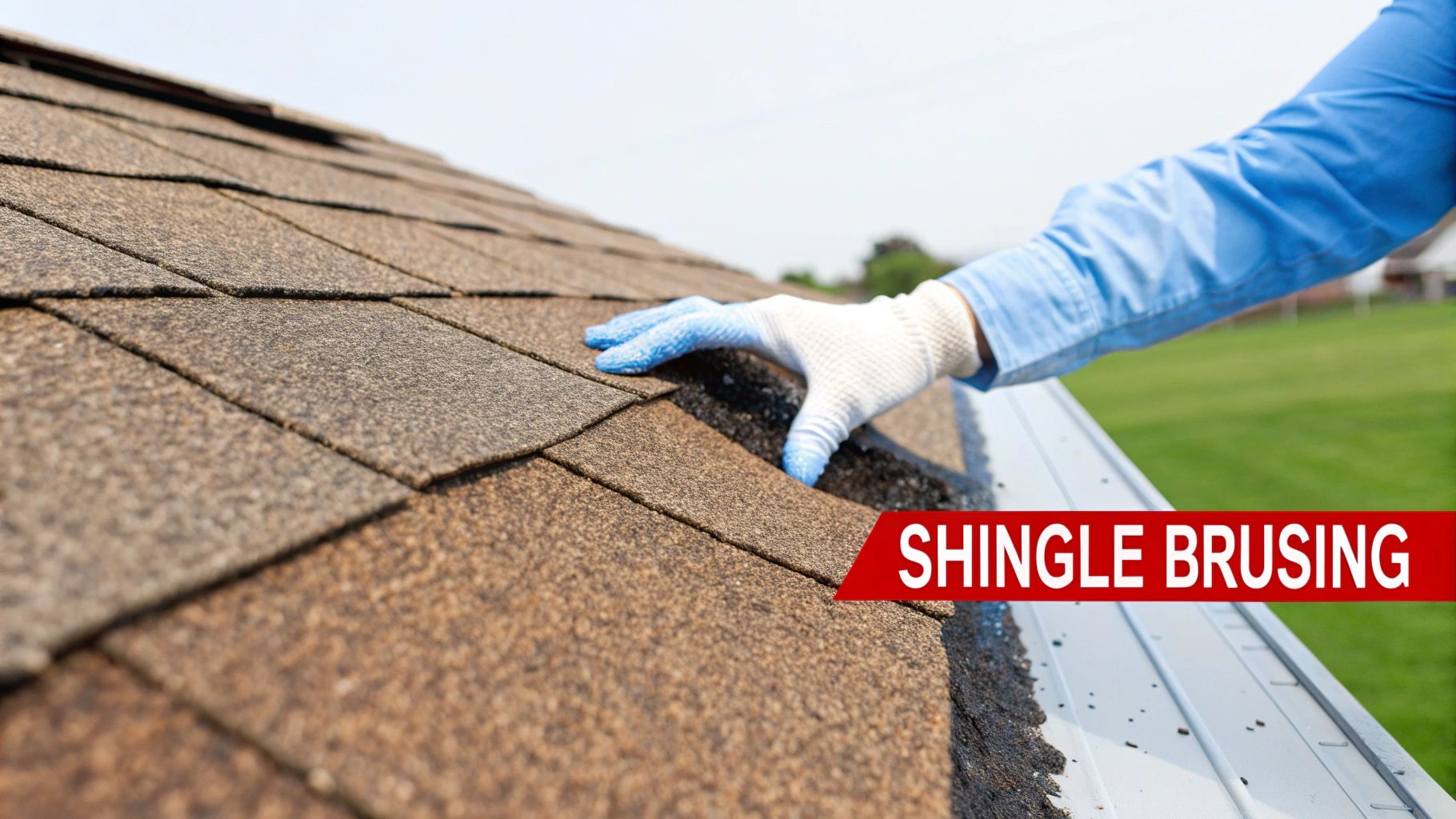
One of the most deceptive types of hail damage is shingle bruising. This occurs when hailstones strike asphalt shingles with enough force to impact the internal fiberglass mat and asphalt layers without necessarily cracking the surface. The result is a dark, soft "bruise" where the granules have been loosened and the shingle’s structural integrity is compromised. Looking at hail damaged roof pictures like the one below often reveals damage you would otherwise miss.
This type of damage is a ticking time bomb. While the roof may not leak immediately, the bruised area becomes a weak point. Over time, exposure to Arizona's intense UV rays will cause the damaged spot to degrade, leading to granule loss, cracking, and eventual water intrusion.
Damage Analysis and Strategic Insights
- Severity Grade: Moderate. Although subtle, bruising indicates a significant impact that has weakened the shingle's core protective layers.
- Likely Outcome: Full Roof Replacement. Insurance adjusters typically view widespread bruising as functional damage. If enough bruises are found per roofing square (a 10×10 foot area), a full replacement is often approved because spot repairs cannot restore the roof's overall integrity.
- Insurance Claim Tip: Documenting bruises is critical. This damage isn't always visible from the ground. A professional inspector will perform a "push test," gently pressing on suspected impact marks to feel for the soft, spongy texture characteristic of a bruise, as shown in the photo.
Key Takeaway: Do not rely on a visual ground inspection to rule out hail damage. Subtle bruising is a leading cause of premature roof failure and is a primary reason insurance companies approve full roof replacements.
Recommended Next Actions for Arizona Property Owners
- Schedule a Professional Inspection: Contact a qualified roofing contractor who specializes in storm damage. They have the training to identify and document bruising that homeowners and even some general adjusters might miss.
- Chalk the Hits: Ask your inspector to circle each identified bruise with chalk. This creates a clear visual record for the insurance adjuster and provides compelling evidence for your claim.
- Review Your Policy: Understand your policy's coverage for "functional damage" versus "cosmetic damage." Bruising is almost always considered functional, as it directly impacts the shingle's ability to protect your home.
2. Granule Loss and Erosion Patterns
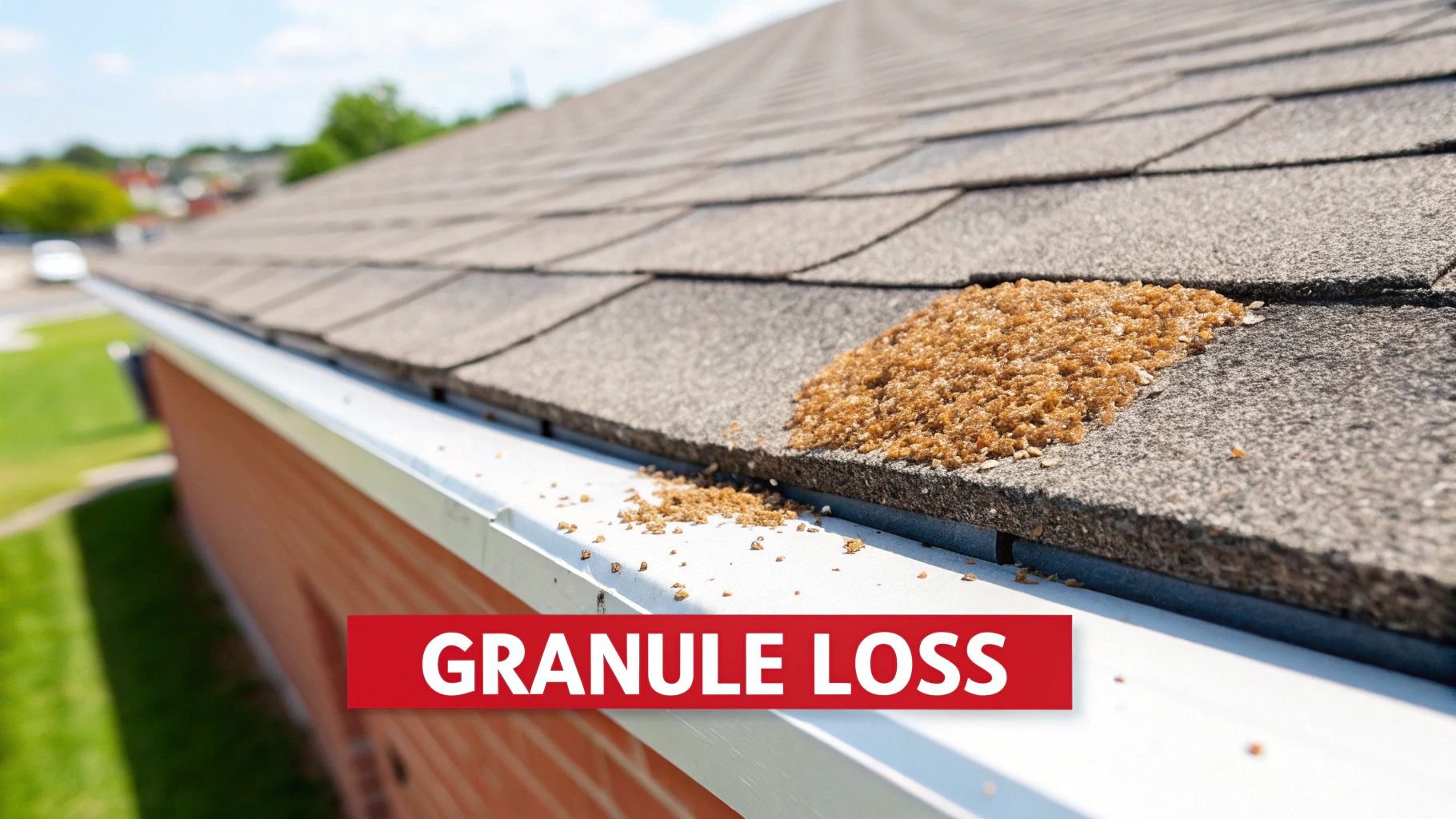
Following a hail storm, one of the most visible and widespread signs of damage is granule loss. These tiny ceramic-coated mineral granules are the shingle's first line of defense, shielding the underlying asphalt from the sun's harsh UV radiation. When hailstones strike, they act like sandpaper, scouring these protective granules off and leaving the asphalt exposed. Examining hail damaged roof pictures, like the one showing buildup in the gutters, provides undeniable proof of this destructive process.
This exposure accelerates the roof's aging process significantly. Without the UV-blocking granules, the asphalt layer quickly becomes brittle, leading to cracking, blistering, and eventual leaks. Granule loss is not just cosmetic; it is a direct assault on your roof's lifespan and ability to protect your home from the elements.
Damage Analysis and Strategic Insights
- Severity Grade: Moderate to Severe. While minor granule loss occurs naturally over a roof's life, hail causes accelerated, concentrated loss that drastically shortens its functional lifespan.
- Likely Outcome: Full Roof Replacement. Widespread granule loss is considered functional damage by most insurance carriers. It's impossible to re-apply granules, so if the loss is significant across multiple slopes, a full replacement is the only viable solution to restore protection.
- Insurance Claim Tip: Use gutters as your primary evidence. The sheer volume of granules washed into gutters and downspout openings after a storm is compelling proof for an adjuster. This tangible evidence is hard to dispute and clearly separates storm-related damage from normal wear and tear.
Key Takeaway: Granule loss is the beginning of the end for an asphalt shingle. Documenting the accumulation in your gutters provides concrete, quantifiable evidence that your roof has sustained significant, functional damage.
Recommended Next Actions for Arizona Property Owners
- Photograph Your Gutters: Before any cleaning, take clear photos of the granule accumulation inside your gutters and at the base of your downspouts. This is your most powerful initial evidence.
- Look for "Bald" Spots: Carefully inspect the roof surface for areas that look dark or bare, where the granules have been completely knocked off. These spots are highly vulnerable to rapid deterioration.
- Correlate with the Storm Date: When filing a claim, note that the granule buildup occurred immediately following a specific, dated hail event. This timeline helps link the damage directly to a covered peril in your insurance policy.
3. Cracked and Shattered Shingles
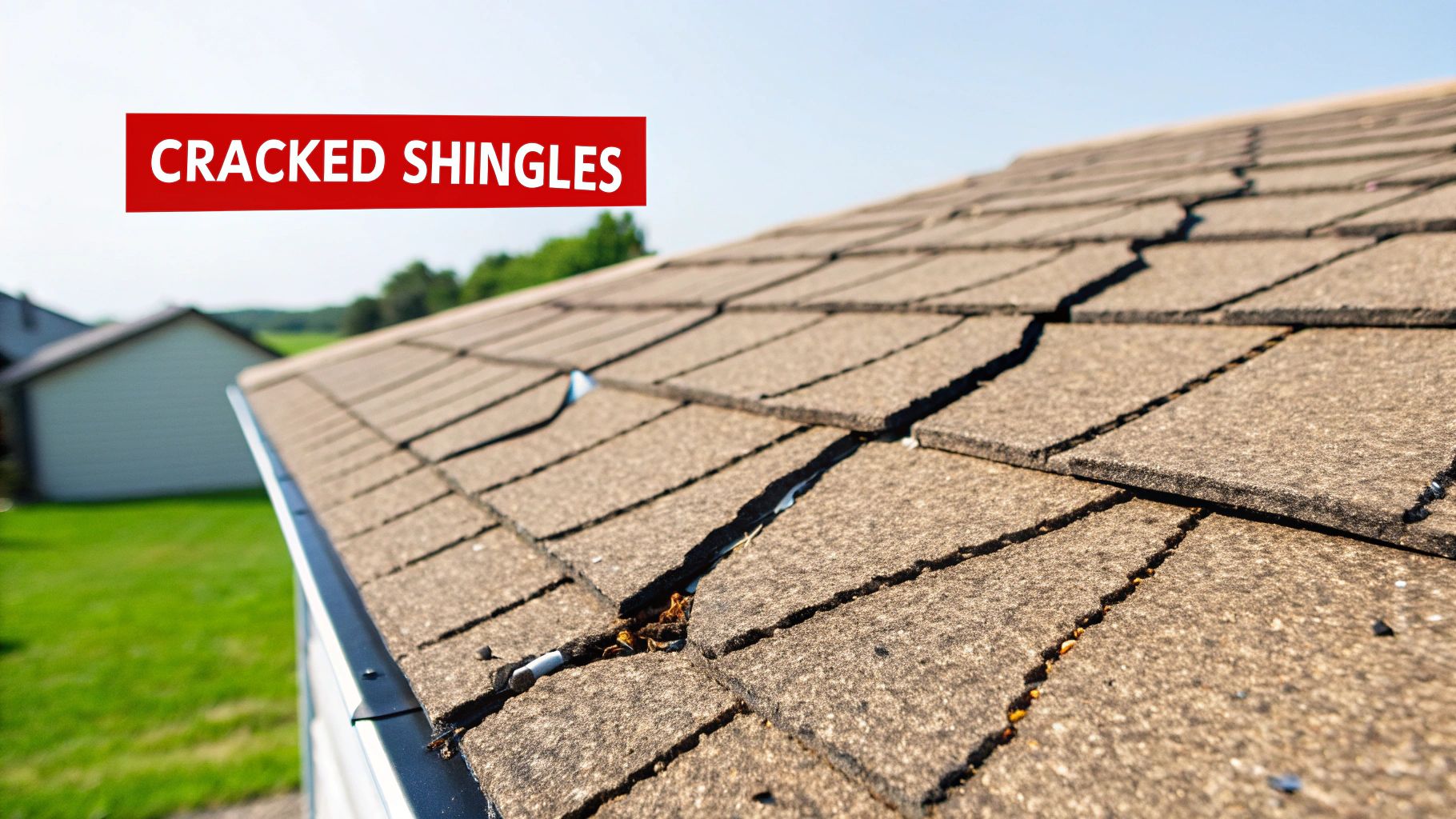
Unlike the subtle nature of bruising, cracked and shattered shingles represent severe, undeniable hail damage. This occurs when large or dense hailstones strike with such kinetic energy that they fracture the shingle's fiberglass mat completely. The resulting damage is immediately obvious, with visible cracks radiating from the point of impact, often leading to missing sections of the shingle. These hail damaged roof pictures clearly show how this damage leaves the underlying roof deck exposed.
This type of direct-impact damage is an open invitation for water to penetrate your roof system. Even a single crack compromises the shingle's primary function as a waterproofing barrier, making immediate action essential to prevent leaks, wood rot, and interior water damage, especially during Arizona's monsoon season.
Damage Analysis and Strategic Insights
- Severity Grade: Severe. This is functional damage in its most obvious form, completely compromising the shingle's ability to shed water.
- Likely Outcome: Full Roof Replacement. Widespread cracking is a clear-cut case for a total replacement. Insurance carriers recognize that spot repairs are ineffective, as the remaining shingles have likely suffered latent damage and the roof's systemic integrity is lost.
- Insurance Claim Tip: Your documentation should focus on the pattern and density of the damage. Take photos of individual cracks from multiple angles, but also capture wider shots showing how the damage is distributed across each roof slope. This proves the damage is not an isolated incident.
Key Takeaway: Cracked shingles are the most urgent type of hail damage. The roof is already compromised, and every subsequent rainstorm increases the risk of significant interior damage.
Recommended Next Actions for Arizona Property Owners
- Request Emergency Tarping: If you see visible cracks or missing shingle pieces from the ground, contact a storm damage specialist immediately. Many offer emergency tarping services to mitigate further water intrusion while you navigate the claims process.
- Document with Context: When photographing the damage, place a ruler or coin next to the cracks to provide a sense of scale for the insurance adjuster. Capture both the central impact point and the fractures that radiate from it.
- File Your Claim Promptly: With such clear evidence, there is no reason to delay. Promptly filing your insurance claim gets the process started, shortening the time your property remains vulnerable to the elements.
4. Punctures and Through-Holes
When hailstones are large, dense, or driven by extreme winds, they can act like projectiles, creating the most severe form of damage: punctures and through-holes. This happens when the hailstone's impact is so forceful that it tears completely through the asphalt shingle, the underlayment, and sometimes even into the roof decking itself. This level of damage creates an immediate and direct pathway for water intrusion.
Unlike subtle bruising, this damage is catastrophic and leaves no room for debate about the roof's functional failure. Seeing hail damaged roof pictures like the one below, with clear perforations, underscores the urgency required. Each hole is an active leak waiting to happen, posing an immediate threat to the attic, insulation, ceilings, and structural components of your property.
Damage Analysis and Strategic Insights
- Severity Grade: Critical. Punctures represent a complete failure of the shingle's water-shedding capability and are the most serious type of hail damage.
- Likely Outcome: Full Roof Replacement. There is no viable repair for a punctured roof. The presence of even a few through-holes will almost certainly result in a full replacement approval from an insurance carrier, as the roof system's integrity is totally compromised.
- Insurance Claim Tip: Document the depth and context of the hole. Use strong lighting to photograph inside the puncture to show it penetrates all layers. If safely accessible, check for corresponding light or water stains in the attic directly below the damage to provide powerful supporting evidence of a through-and-through breach.
Key Takeaway: Punctures are undeniable proof of catastrophic roof failure. This type of damage requires immediate professional attention to prevent severe and costly interior water damage.
Recommended Next Actions for Arizona Property Owners
- Request Emergency Tarping: Immediately contact a roofing professional to have the damaged areas tarped. This is a critical temporary measure to prevent water from pouring into your home or commercial building.
- Document Interior and Exterior Damage: Take clear photos of the holes on the roof. Also, document any corresponding water stains, drips, or damp insulation you find in the attic or on ceilings inside the property. This links the exterior damage to interior consequences.
- Initiate Your Insurance Claim Immediately: Do not delay. Report the damage to your insurance company, explicitly mentioning "punctures" and "through-holes" in your roof system. This signals the severity of the situation and should expedite the claim process.
5. Dented Metal Roofing Damage
Metal roofing is prized for its durability, but even this robust material can fall victim to severe hail. Unlike asphalt shingles that bruise or crack, metal roofs display hail damage as visible dents, dimples, and indentations across the panels. Examining hail damaged roof pictures of metal systems, like the one below, clearly shows how significant impacts can deform the surface.
While these dents might seem purely cosmetic at first, they can pose long-term risks. Severe impacts can compromise the metal's protective coating or paint, leading to rust and corrosion over time. Furthermore, widespread denting can affect how panels fit together and may even impact the roof's overall aesthetic value, which can be a factor in insurance claims.
Damage Analysis and Strategic Insights
- Severity Grade: Low to Severe. The severity depends on the dent size, density, and whether the protective coating is breached. Minor, shallow dents may be cosmetic, while deep, sharp dents that cause paint chipping are functional damage.
- Likely Outcome: Varies (Repair or Full Replacement). If the damage is purely cosmetic with minimal dents, an insurance company may deny the claim or offer a small settlement for diminished value. However, if the dents are widespread and have compromised the metal's finish, a full replacement is often required.
- Insurance Claim Tip: Lighting is everything when documenting dents. Take photos in the early morning or late afternoon when the sun is at a low angle. This creates shadows that highlight the depth and quantity of the dents, making them undeniable to an adjuster.
Key Takeaway: For metal roofs, the claim often shifts from "functional damage" to a debate over "cosmetic damage." Proving that dents have compromised the roof's protective coating is the most effective path to a successful insurance claim.
Recommended Next Actions for Arizona Property Owners
- Document with Angled Light: Walk the property at different times of the day to photograph the roof. Use the sun's angle to your advantage to make the dents pop in pictures.
- Check for Coating Damage: Closely inspect the center of the largest dents for any signs of cracking, flaking, or chipping in the paint or sealant. This is your strongest evidence for a functional damage claim.
- Understand Your Policy: Some insurance policies now include "cosmetic damage exclusions" specifically for metal roofs. Review your policy to see if this applies, and learn more about metal roofing benefits and drawbacks to be better informed.
6. Exposed Underlayment and Roof Deck
When a hail event is severe, the damage goes far beyond bruising or cracking. In the most extreme cases, hailstones can completely obliterate shingles, tearing them away from the roof and exposing the critical protective layers beneath. This level of destruction reveals the underlayment or, even worse, the wooden roof deck itself, creating an immediate and severe risk of water intrusion. Examining hail damaged roof pictures like the one below highlights a critical emergency situation.
This isn't just cosmetic damage; it's a catastrophic failure of the roofing system's primary defense. Once the underlayment is exposed, it is highly vulnerable to UV degradation and further physical damage. If the decking is visible, your property's interior is separated from the elements by only a sheet of plywood or OSB, making a leak an imminent certainty with the next rainfall.
Damage Analysis and Strategic Insights
- Severity Grade: Catastrophic. This is the highest level of hail damage, indicating complete functional failure of the affected areas and immediate exposure to the elements.
- Likely Outcome: Full Roof Replacement. There is no repair option for this level of widespread destruction. The insurance claim will not only cover a full replacement but may also include the cost of replacing damaged underlayment and potentially sections of the roof deck.
- Insurance Claim Tip: Time is of the essence. This damage often leads to immediate interior leaks. Document the roof damage from multiple angles and immediately photograph any water staining on ceilings or walls inside the property. This connects the roof failure directly to interior damages for your claim.
Key Takeaway: Exposed underlayment or decking is a roofing emergency. It requires immediate professional intervention to prevent catastrophic water damage to your home's structure, insulation, and interior finishes.
Recommended Next Actions for Arizona Property Owners
- Request Emergency Tarping: Your first call should be to a storm damage roofing contractor for emergency tarping service. This temporary measure is crucial to mitigate further damage while the insurance claim process begins.
- Document Interior and Exterior: Before anything is covered, take extensive photos of the exposed roof areas. Simultaneously, inspect your attic and interior rooms for any signs of water intrusion and document them with clear pictures.
- Initiate Your Claim Immediately: Contact your insurance provider right away to report the severe damage. Inform them you have an emergency situation and have taken steps to mitigate further damage by having the roof tarped.
7. Before-and-After Comparison Photos: The Undeniable Proof
Perhaps the most powerful tool in an insurance claim is the before-and-after comparison. This method involves presenting clear, side-by-side hail damaged roof pictures that document the roof's condition prior to a storm and its state immediately following it. This direct comparison removes any ambiguity about the source and extent of the damage, creating an undeniable visual narrative for insurance adjusters.
This approach is invaluable because it establishes a baseline condition, proving the damage is new and directly attributable to a specific hail event. It effectively counters potential arguments that the damage was pre-existing or caused by normal wear and tear. Seeing the stark contrast leaves little room for interpretation and significantly strengthens the case for a full replacement.
Damage Analysis and Strategic Insights
- Severity Grade: High. The value of this evidence is not in grading the damage itself, but in its power to prove causation and severity, making it a high-impact tool for any claim.
- Likely Outcome: Claim Approval. When clear "before" photos exist, it dramatically increases the likelihood of a swift and favorable claim settlement, often for a full roof replacement, as the evidence is compelling.
- Insurance Claim Tip: Pre-storm documentation is your best asset. Take clear photos of your roof annually or after any professional servicing. Drones are excellent for this, capturing comprehensive, high-resolution aerial views that can serve as your "before" evidence.
Key Takeaway: Proactive documentation is the ultimate insurance strategy. Having time-stamped "before" photos on file can be the single most influential factor in getting a hail damage claim approved without dispute.
Recommended Next Actions for Arizona Property Owners
- Create a "Before" Gallery: If you don't have recent photos, take them now. Use a high-resolution camera or drone to capture the entire roof surface, paying attention to flashing, vents, and shingles from multiple angles.
- Organize Your Evidence: When filing a claim, present the photos in a clear, side-by-side format. Label each set with dates and highlight specific areas of new damage that are visible in the "after" shots.
- Leverage Professional Portfolios: Reputable contractors often document their work extensively. You can see examples of professional documentation in our recent project galleries, which showcase the quality of evidence gathering that strengthens an insurance claim.
8. Aerial and Roof-Wide Overview Photos: The Big Picture
While close-up photos are essential for identifying specific damage points, aerial and roof-wide overview photos tell the complete story. Using drones or elevated vantage points, these images capture the full scope and pattern of hail impacts across the entire roof surface. This comprehensive view is one of the most powerful tools in an insurance claim, providing undeniable proof of widespread damage that isolated shots cannot convey.
This macro-level perspective helps insurance adjusters and roofing professionals understand damage density and uniformity. It immediately answers critical questions: Is the damage concentrated in one area, or is it scattered randomly across every slope? Seeing the pattern in these hail damaged roof pictures is often the deciding factor between a minor repair and a full, necessary replacement.
Damage Analysis and Strategic Insights
- Severity Grade: High. Aerial photos provide context that elevates the perceived severity of the damage by showing its extensive nature.
- Likely Outcome: Full Roof Replacement. This is the single most effective way to demonstrate that damage is not isolated. When an adjuster can see a consistent pattern of impacts across multiple roof facets, it becomes difficult to argue for simple spot repairs.
- Insurance Claim Tip: Use drone footage to create a "damage map." A professional can annotate these overview photos, highlighting clusters of hits and demonstrating the damage density per roofing square, which is a key metric for insurance approvals.
Key Takeaway: An aerial overview transforms your insurance claim from a collection of isolated damage points into a compelling narrative of widespread, systemic failure of the roofing system.
Recommended Next Actions for Arizona Property Owners
- Hire a Professional with Drone Capabilities: Ensure your chosen roofing contractor uses FAA-licensed drone pilots. Professional-grade, high-resolution imagery is far more compelling than photos taken from a shaky ladder.
- Document the Entire Property: Instruct the drone pilot to capture images of not just the roof, but also damaged gutters, AC units, window screens, and fences to build a comprehensive claim package.
- Plan for Replacement: If the aerial photos confirm widespread damage, a full roof replacement is the most likely path forward. Begin researching popular materials for roof replacements to understand your options for durability and aesthetics in the Arizona climate.
8-Point Comparison of Hail-Damaged Roof Photos
| Damage Type | Complexity (🔄) | Resources / Effort (⚡) | Expected Outcome (⭐ / 📊) | Ideal Use Cases (📊) | Key Advantages / Tips (💡) |
|---|---|---|---|---|---|
| Shingle Bruising and Impact Marks | High — subtle, expert detection | Moderate — macro/close-up photography, ladder, touch test | Moderate ⭐ — indicates internal compromise but can be disputed | Subtle hail events; initial inspections; claim support | Use macro lenses, overcast lighting, contrast with undamaged shingles; document multiple spots |
| Granule Loss and Erosion Patterns | Medium — visible but not always conclusive | Low–Moderate — gutter photos, granule samples, timeline | High ⭐ — strong, accepted evidence for claims | Hail with visible granules in gutters; proving accelerated weathering | Photograph gutters/downspouts, collect samples, show timeline of loss |
| Cracked and Shattered Shingles | Low — visually obvious | Low — standard close & wide photos, scale markers | Very High ⭐ — clear, urgent replacement indicator | Severe impact events needing rapid repair/replacement | Capture crack radiating patterns, multiple angles, include timestamps and wide context |
| Punctures and Through-Holes | Low — unmistakable critical damage | Moderate — direct lighting photos, attic interior shots, immediate action | Maximum ⭐ — definitive evidence; immediate repair required | Active leaks, exposed deck, emergency insurance claims | Photograph hole depth/underlayment, document interior water stains, act quickly for tarping |
| Dented Metal Roofing Damage | Low–Medium — visible; functional impact varies | Low — angled lighting photos, measurements of dents | Medium ⭐ — clear cosmetic damage; function often intact | Metal roofs after hail; assessing cosmetic vs. structural loss | Use acute-angle lighting to reveal depth, measure largest dents, document paint/coating loss |
| Exposed Underlayment and Roof Deck | Low — plainly severe | High — rapid documentation, interior checks, emergency tarping | Maximum ⭐ — indisputable severe damage; supports full reroof | Catastrophic shingle loss; imminent water infiltration | Photograph extent quickly, include interior damage, obtain professional emergency evaluation |
| Before-and-After Comparison Photos | Medium–High — needs pre-event baseline | High — pre-event archive, matched angles, possible drone/aerial | Very High ⭐ — most compelling evidence for claims | High-value claims with existing pre-event photos or portfolios | Match angles/lighting, include timestamps/GPS, use drone for consistent overviews |
| Aerial and Roof-Wide Overview Photos | High — planning, flight operations, expertise | High — licensed drone pilot, favorable weather, regulatory compliance | High ⭐ — comprehensive scope; shows distribution and neighboring damage | Widespread/localized pattern assessment; complex insurance claims | Hire licensed pilots, shoot at optimal light, capture neighboring roofs for corroboration |
Your Next Steps: From Identification to Installation
We've journeyed through a comprehensive gallery of hail damaged roof pictures, moving from the subtle signs of shingle bruising and granule loss to the unmistakable evidence of punctures and shattered materials. Each image tells a story, not just of a storm, but of the critical decisions a property owner must make to protect their investment. Understanding these visual cues is the first, most powerful step toward securing a fair insurance settlement and a durable, expertly installed new roof.
The key takeaway is that hail damage is rarely a simple, one-size-fits-all issue. It's a complex blend of impact severity, material type, and pre-existing roof condition. What might look like minor cosmetic flaws to an untrained eye can be a clear signal of compromised structural integrity to a professional, setting the stage for future leaks, rot, and costly interior damage. Recognizing this distinction is what separates a proactive solution from a reactive, and often more expensive, repair down the road.
Turning Knowledge into Action
Visual identification is crucial, but it's only the beginning of the process. Your next moves determine the outcome of your insurance claim and the long-term health of your property. Protecting your home or commercial building requires a clear, strategic plan.
Here are your essential next steps:
-
Schedule a Professional Inspection Immediately: Do not climb on your roof. It's dangerous, and you could easily miss the nuanced signs of damage that GAF-certified experts are trained to identify. A professional inspection from a trusted local contractor like AZ Roof Co provides the comprehensive documentation you need.
-
Document Everything: While your contractor will create a detailed report, you should also take photos of any collateral damage you can safely see from the ground. This includes dented gutters, damaged siding, broken window screens, or harmed HVAC units. This helps build a stronger, more holistic case for your insurance claim.
-
Understand Your Insurance Policy: Review your policy to understand your deductible and the timeframe for filing a claim (often one year from the "date of loss"). If the language is confusing, a reputable roofer experienced in insurance claims can help you navigate it.
-
Initiate Your Claim: Contact your insurance provider to open a claim. Provide them with the date of the storm and inform them that you have already had a professional inspection performed by your chosen contractor.
-
Coordinate with the Adjuster: Your roofing contractor should be present when the insurance adjuster visits your property. This ensures that a professional advocate is there to point out all documented damage, preventing potential oversights and ensuring a fair assessment of the necessary work.
Your Partner in Protection
After thoroughly identifying the extent of the damage, the next crucial step involves professional hail damage roof repair or, more commonly, a full replacement. Mastering the ability to spot potential issues from these hail damaged roof pictures empowers you to take swift, decisive action. By partnering with an experienced, local expert like AZ Roof Co, you transform a stressful situation into a streamlined process, safeguarding your property's value and ensuring the safety of everything underneath your roof. Don't wait for a small leak to become a major catastrophe; take control and secure the peace of mind you deserve.
Frequently Asked Questions About Hail Damaged Roofs
How can I tell if my roof has hail damage from the ground?
From the ground, you might see dents on gutters, downspouts, or roof vents. You may also find a significant amount of shingle granules at the bottom of your downspouts. However, many serious types of damage, like shingle bruising, are not visible from the ground and require a professional, on-roof inspection.
Will my insurance cover hail damage to my roof?
Most standard homeowner's insurance policies cover hail damage as it is considered an "act of God." However, coverage details can vary. It's important to review your policy for specifics regarding your deductible, claim filing deadlines, and any exclusions for cosmetic versus functional damage.
How long do I have to file a hail damage claim?
The timeframe for filing a claim, known as the statute of limitations, varies by state and insurance policy but is often one year from the date of the storm. It is always best to act quickly, as delaying can complicate the process and may lead to further damage that won't be covered.
Is it safe to get on my roof to check for damage?
No, it is not recommended for homeowners to get on their roofs. Roofs can be steep and slippery, especially after a storm, posing a significant fall risk. Professionals have the required safety training and equipment to perform a thorough and safe inspection.
What is the difference between cosmetic and functional hail damage?
Cosmetic damage affects the appearance but not the water-shedding capability of the roof (e.g., minor dents on a metal roof). Functional damage, such as shingle bruising, cracking, or punctures, compromises the roof's ability to protect your home from the elements and often requires a full replacement. Insurance coverage can differ for each type.