
Choosing the right roofing material for your home is a significant decision. It’s an investment in your property's long-term protection, curb appeal, and overall value. For many homeowners, especially in sunny climates like Arizona, the choice often narrows down to two classic and durable options: clay and concrete tiles. Both offer exceptional longevity and style, but they cater to different priorities and architectural aesthetics.
This guide is designed to help you navigate the nuances of each material. We'll explore the core differences in durability, cost, appearance, and energy efficiency to help you determine whether the timeless authenticity of clay or the engineered versatility of concrete is the perfect fit for your home.
Key Takeaways
- Longevity: Clay tiles are the undisputed champion, often lasting over 100 years, making them a true "once-in-a-lifetime" roof. Concrete tiles offer an excellent lifespan of 40-60+ years.
- Aesthetics: Clay provides a natural, authentic look ideal for Spanish and Mediterranean homes. Concrete offers incredible versatility, capable of mimicking clay, slate, or wood shake in a vast range of colors.
- Cost: Clay tiles typically have a higher upfront cost due to materials and specialized installation. Concrete is generally more budget-friendly, offering great value for its durability.
- Durability: Both are highly durable. Clay's color is baked through and fade-proof, while concrete's surface color may fade over decades and could benefit from recoating.
- Energy Efficiency: Both materials excel in hot climates due to their thermal mass and the air gap created during installation. Concrete's wider range of light, reflective colors gives it a slight edge for maximizing energy savings.
Understanding the Core Materials
Before you can choose between clay and concrete roof tiles, you really need to get a feel for what they are at their core. These aren't just two sides of the same coin; they are fundamentally different materials, born from completely different processes. One is an age-old natural element, the other a product of modern engineering.
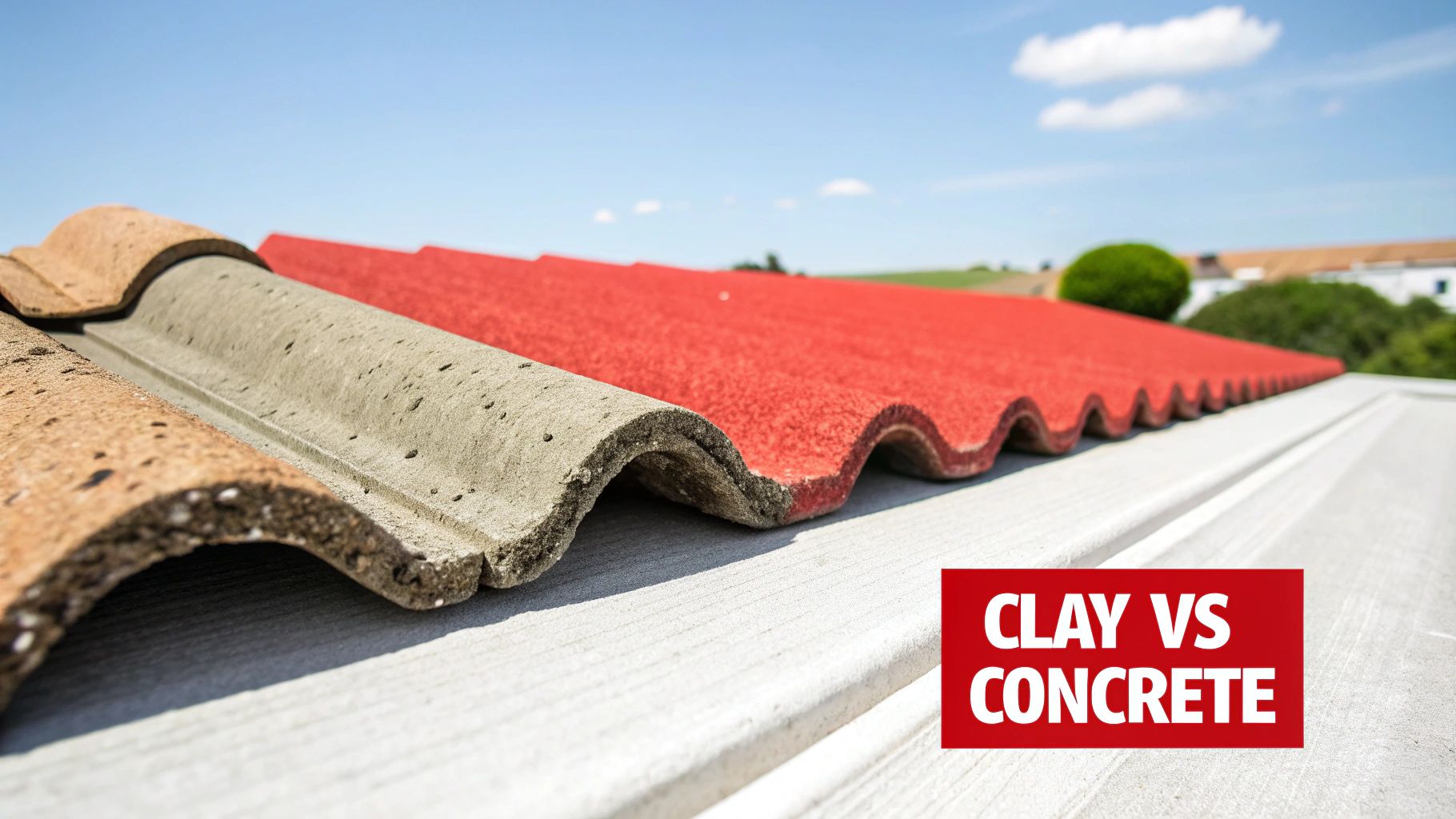
This basic knowledge is the key to understanding all the differences in performance, cost, and appearance we’ll get into later. It’s the "why" behind every comparison.
The Timeless Nature of Clay Tiles
Clay tiles have been protecting homes for literally thousands of years, making them one of the most proven roofing materials on the planet. They start as natural clay or terracotta, which gets molded into the desired shape and then fired in a kiln at incredibly high temperatures.
That intense baking process is what locks in clay's famous durability and gives it those iconic, earthy colors—think terracotta reds and warm, sun-baked oranges. A huge part of what makes clay special is its "through-body" color. The color isn't painted on; it's part of the clay itself. This means it won't fade away, even after decades under the brutal Arizona sun.
Key Insight: The baked-in, authentic color of a clay tile is permanent. This is a massive plus for anyone who wants a roof color that stays true and vibrant for its entire lifespan, which can easily be 75-100 years or even longer.
The end product is a roof with a real sense of history and character. Classic profiles like the "S" or barrel shape are the go-to look for Spanish, Mediterranean, and Mission-style homes for a reason.
The Engineered Versatility of Concrete Tiles
Concrete tiles, on the other hand, are a much more modern invention, a product of 20th-century engineering. They're made by mixing sand, cement, water, and mineral pigments into a slurry, which is then extruded under extreme pressure and cured to harden.
This manufacturing process is what gives concrete its biggest advantage: incredible design flexibility.
- Shape and Profile: Concrete can be molded into almost any shape imaginable. It can perfectly replicate the look of classic clay tiles, rustic wood shakes, or even high-end slate.
- Color Palette: Because pigments are mixed right in, the color possibilities are practically endless. You can get a much wider range of colors and blends than the natural tones of clay.
This chameleon-like ability makes concrete a fantastic choice if you love the tile look but your home's architecture—be it modern, craftsman, or something else—calls for a specific style or color. While we're focused on roofing, the thinking process here applies broadly; for a deeper dive, you can explore the principles of selecting the right materials for luxury home design.
Comparing Durability and Long-Term Performance
When you're putting a roof over your head, you’re making a decision that should last for decades. Let's dig into how clay and concrete tiles really hold up over the long haul, especially against the intense Arizona sun, our dramatic monsoon seasons, and the simple test of time.
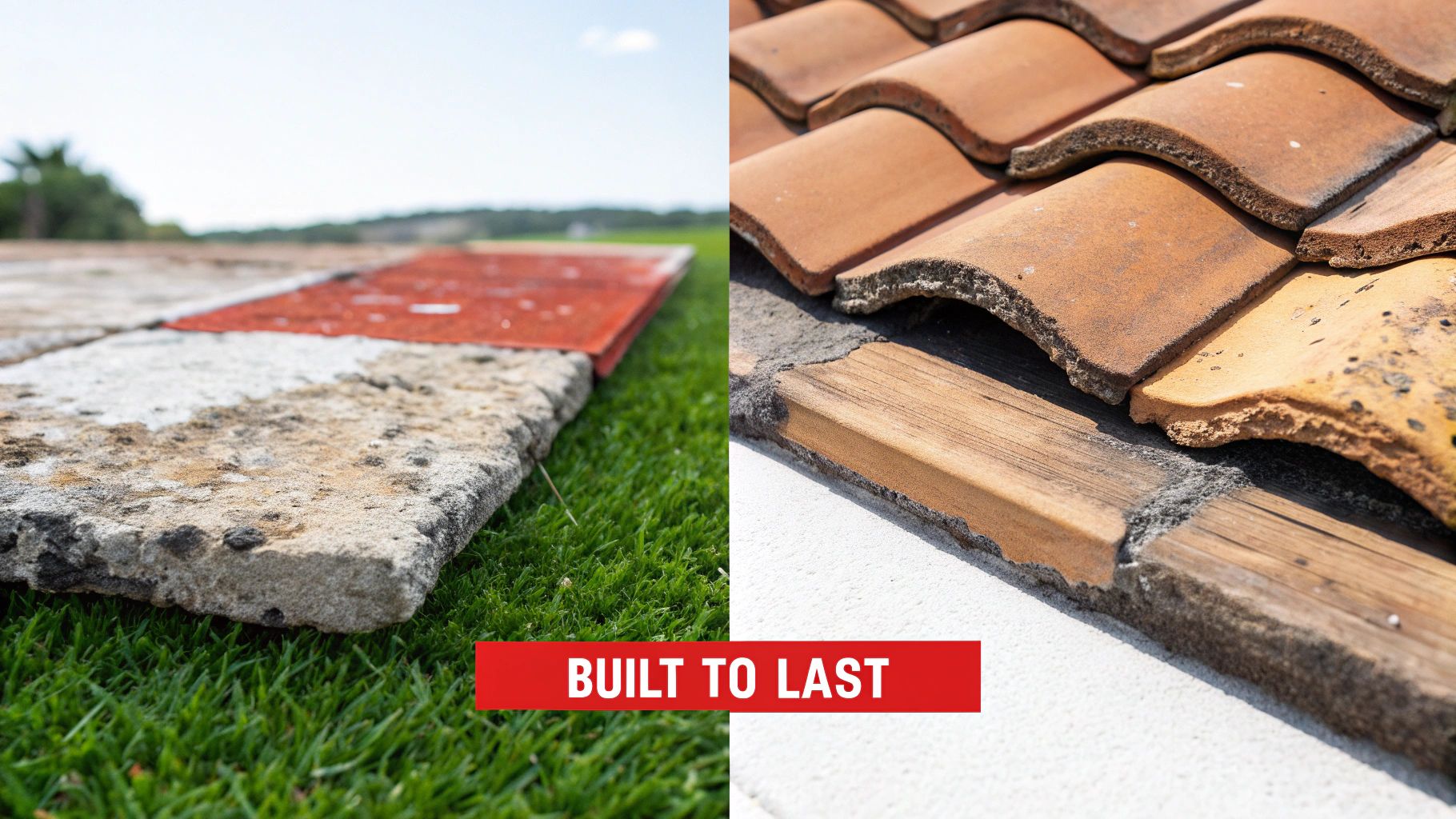
Both are incredibly tough, no question about it. But they have different strengths when it comes to things like keeping their color and handling moisture. These subtle differences will shape how your roof looks and what kind of upkeep it needs for years to come.
Resilience Against Sun and Fading
With more than 300 days of sunshine every year, UV radiation is public enemy number one for any roof in Arizona. This is where clay tiles have a serious edge.
The secret is how they're made. Clay's rich, earthy colors aren't just painted on; they're baked completely through the tile in a kiln. That color is literally part of the material, so it can't fade. Ever.
Concrete tiles get their color differently. Pigments are either mixed into the concrete or applied as a slurry coat on the surface. While today’s manufacturing creates a very durable finish, that color layer will eventually start to fade after decades of relentless sun exposure. The tile itself will be just as strong, but the color won't be as vibrant as it was on day one.
The Key Differentiator: Clay's color is permanent, baked into its core, making it fade-proof. Concrete's surface-level color offers endless design options but might need a refresh with a new coating after 20-30 years to bring back its original pop.
Water Absorption and Its Consequences
You might not think much about moisture in the desert, but our monsoon storms hit hard and fast. How a tile deals with that sudden drenching is a big deal for its long-term health.
By nature, concrete is more porous than clay, which means it absorbs more water. If the sealant wears off or the roof isn't properly maintained, this can create a home for algae or moss, particularly on shaded parts of the roof.
Clay tiles, on the other hand, go through a process called vitrification in the kiln, which makes them incredibly dense. Their water absorption rate is much lower, making them naturally resistant to that kind of organic growth. Still, it's worth noting that a well-installed concrete roof with good drainage and a fresh sealant handles moisture just fine.
For either material, professional installation and maintenance are non-negotiable. One cracked tile can lead to bigger problems, which is why every homeowner should know the best practices for effective tile roof repair.
Lifetime and Market Strength
Both roofing options promise to be around for a very long time, but clay wins the longevity marathon. A properly installed clay tile roof can easily last 75-100 years, sometimes even outliving the house itself. Concrete is no slouch, either, offering a very respectable lifespan of 40-60 years—an excellent return on your investment.
The market reflects this confidence in clay's enduring performance. The global clay roof tile market is projected to hit USD 13.03 billion by 2032, a clear sign that builders and homeowners value its long-term durability and efficiency.
Ultimately, when you're weighing clay or concrete roof tiles, the durability question is a trade-off. Do you want the near-perfect color retention and multi-generational lifespan of clay, or the decades of solid protection and design flexibility of concrete at a more accessible cost?
Aesthetic Appeal and Architectural Versatility
Your roof does more than just protect your home; it’s one of its most defining visual features. From the moment you see a house from the street, the roof sets the tone, defining its character and curb appeal. When you're deciding between clay and concrete roof tiles, you’re not just picking a material—you're choosing an aesthetic that needs to align with your home's architectural soul.
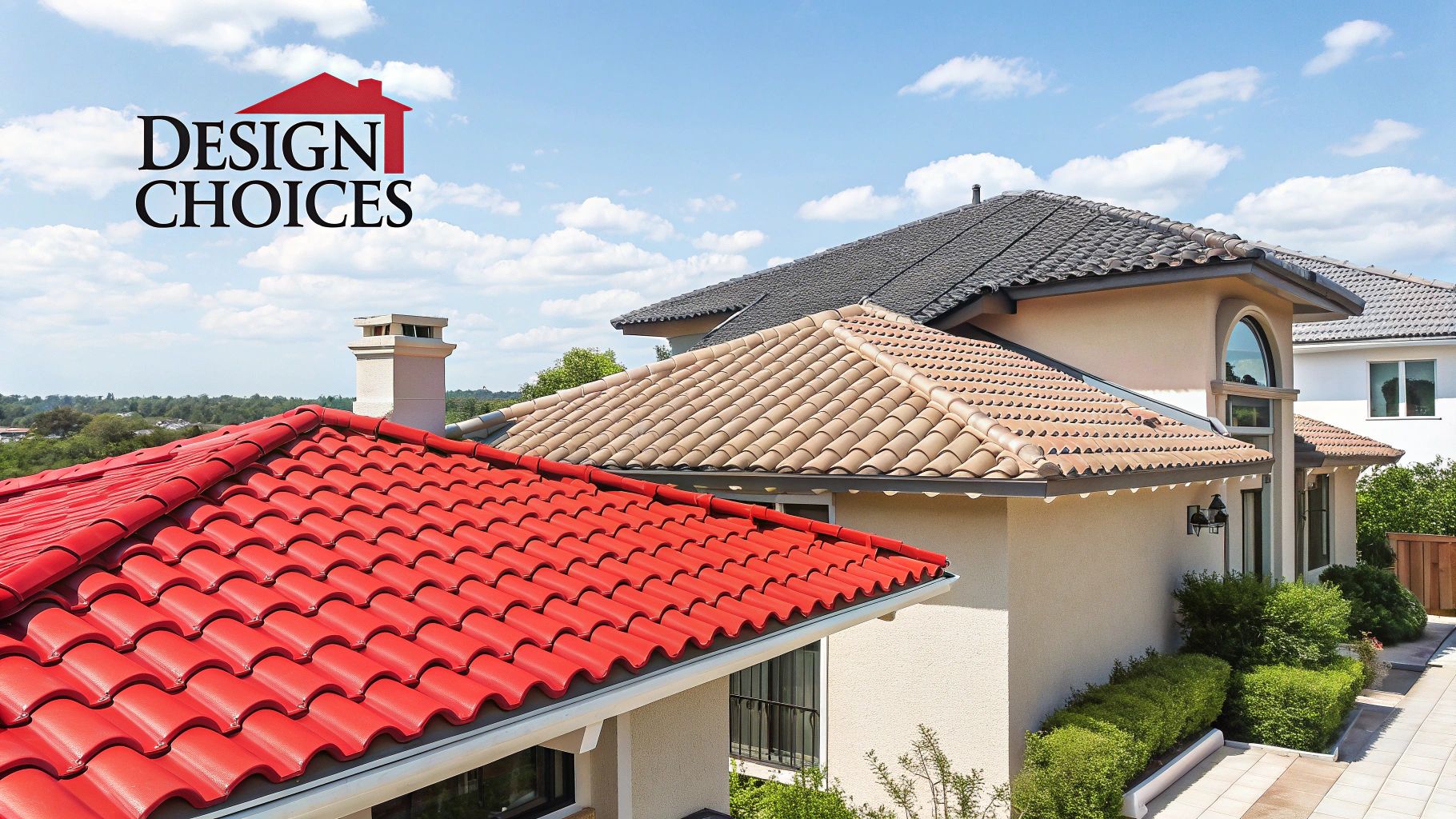
This is a classic matchup: the timeless, earthy authenticity of clay versus the impressive design flexibility of concrete. Each brings something different to the table, and knowing those differences is the key to creating the perfect look.
The Timeless Authenticity of Clay Tiles
There’s a good reason clay tiles are the hallmark of Spanish, Mediterranean, and Mission-style homes. They deliver an authentic, warm aesthetic that’s nearly impossible to replicate. The natural terracotta shades and subtle color variations are born from minerals in the clay itself, baked in during the firing process. The result is a look that feels both classic and organic.
The most iconic clay shapes, like the "S-tile" or barrel tile, are responsible for the beautiful, rolling rooflines that define these architectural styles. This look is steeped in centuries of tradition. In fact, these classic curved tiles are so popular they accounted for about 78% of the global clay roof tile market in 2019. If you're interested in the data, you can read the full research about clay tile markets.
Key Takeaway: If historical accuracy and a genuine, earthy character are what you're after, nothing beats natural clay. Its appearance is a direct product of its natural materials, giving it a depth and richness that manufactured products can only try to imitate.
The Unmatched Versatility of Concrete Tiles
While clay wins on authenticity, concrete is the undisputed champion of versatility. The manufacturing process allows it to be molded into countless shapes and dyed in a huge variety of colors, giving homeowners a massive range of architectural possibilities that clay just can't offer.
Concrete tiles can be engineered to convincingly mimic a whole host of other premium materials.
- Clay Emulation: Concrete can be shaped into the same S-tile and barrel profiles as clay, giving you a similar look, often at a lower price.
- Slate and Wood Shake Mimicry: Many concrete tiles have flat profiles and realistic textures that look just like natural slate or rustic wood shakes, delivering a high-end appearance without the high-end cost or maintenance.
- Color Freedom: Because pigments are mixed in before the tiles are formed, concrete is available in a massive spectrum of colors—from deep charcoals and blues to subtle earth-tone blends that go far beyond clay's natural palette.
This chameleon-like quality means concrete can complement nearly any architectural style, from a sleek modern build to a classic Craftsman home.
Aesthetic Comparison Clay vs Concrete Tiles
To help you visualize how these materials fit different design goals, this table breaks down the key aesthetic characteristics of clay and concrete tiles. It's a quick guide to matching the right material to your home's architectural style.
| Feature | Clay Roof Tiles | Concrete Roof Tiles |
|---|---|---|
| Core Aesthetic | Authentic, classic, earthy (e.g., terracotta) | Versatile, can mimic clay, slate, or wood |
| Color Options | Natural earth tones, limited palette | Wide range of colors and blends |
| Color Process | Color is baked through the entire tile | Color is applied to the surface or mixed in |
| Profile Shapes | Traditional profiles (S-tile, barrel) | Wide variety of flat and curved profiles |
| Best For Styles | Mediterranean, Spanish, Mission | Modern, Traditional, Craftsman, and more |
Ultimately, choosing between clay or concrete roof tiles based on looks comes down to what you value most. Are you drawn to the genuine, time-honored character of clay, or do you need the endless design options and diverse color palette that only concrete can deliver?
Analyzing the True Cost and Lifetime Value
A roof's price tag is so much more than the number on the initial quote. When you're weighing clay against concrete tiles, you have to look at the complete financial picture—from the day-one installation bill to the long-term value you'll get over the next several decades. It’s this deeper dive that reveals the true cost of owning each type of roof.
Right off the bat, the initial expense is the most obvious difference. You'll find that clay tiles typically have a higher upfront cost, and that applies to both the materials themselves and the labor to install them. The natural production process is just more intensive, and because clay is more fragile, installation demands a specialized touch, which can drive up labor costs.
Breaking Down the Initial Investment
Concrete tiles, on the other hand, usually come with a more moderate initial investment. This makes them a go-to choice for homeowners who want the timeless look and resilience of a tile roof without paying the premium for clay. A lower cost here doesn't mean lower quality; it simply reflects a more efficient and less resource-heavy manufacturing process.
Several things contribute to this initial price gap:
- Material Price: Clay is a premium, natural material, and its price per square reflects that status.
- Labor and Fragility: Because clay is more brittle, installers have to handle it with extra care. This can slow down the job and add to the labor hours.
- Structural Requirements: Both materials are heavy, but some clay tiles can be even heavier, sometimes needing extra structural reinforcement—another potential cost.
To get a real sense of what this means for your own home, it's worth looking at a detailed breakdown of all the factors that influence the final price. You can learn more about how much a new roof costs in Arizona to understand these variables a bit better.
Calculating the Lifetime Value
Now, this is where the financial story really gets interesting. The most expensive option on day one isn't always the costliest over the life of your home. To figure out the lifetime value, you need to factor in longevity, maintenance, and potential repair costs.
Key Financial Insight: Clay's higher initial cost is often balanced out by its incredible longevity and minimal maintenance needs. With a lifespan that can stretch past 100 years, a clay roof is truly a once-in-a-lifetime purchase, which could result in a lower total cost over the long run.
On the other side of the coin, concrete tiles offer a fantastic value proposition. They give you decades of solid performance—often 40 to 60 years—at a much more accessible price point. While they are incredibly durable, their color is only surface-dyed, which means it can fade after 20-30 years under the relentless Arizona sun.
Some homeowners eventually choose to have their concrete roof professionally recoated to bring back its original color, which is an additional maintenance cost to consider. But even with that potential expense, concrete delivers an excellent return on investment. You get the high-end look and strength of a tile system for a more manageable budget, and for many people, that balance makes it the smarter financial choice.
Climate Performance and Energy Efficiency
In Arizona, a roof's most important job—aside from keeping the rain out—is to battle the relentless sun. When you're choosing between clay or concrete roof tiles, their performance under extreme heat is a huge factor, one that directly impacts your comfort and your monthly power bill. Both materials are heavyweights in this arena, but they go about it in slightly different ways.
The real genius of a tile roof is how it's installed. The curved shape of each tile creates a natural air channel between the tile itself and the roof deck below. This air gap is a fantastic thermal barrier, breaking up the flow of solar heat into your attic. It's a simple, brilliant design that can dramatically lower attic temperatures, which means your AC doesn't have to fight nearly as hard to keep you cool.
Thermal Mass and Heat Reflection
Both clay and concrete have high thermal mass, meaning they absorb the sun’s heat slowly throughout the day and then gradually release it as the desert cools in the evening. This helps keep your home's internal temperature much more stable. But the biggest single factor for an energy-efficient roof is its ability to reflect sunlight, a property we call albedo.
A roof with high albedo stays much cooler because it bounces solar energy back into the atmosphere instead of absorbing it. This is where your color choice becomes non-negotiable for efficiency.
- Lighter Colors are Champions: A white, sand, or other light-colored tile reflects a huge amount of solar radiation, keeping the roof surface and the attic beneath it significantly cooler.
- Darker Colors Absorb Heat: While they can look great, darker tiles soak up more heat and will inevitably pass more of that energy down into your home.
A landmark study from Lawrence Berkeley National Laboratory revealed that "cool roofs"—those with high solar reflectance—can drop roof surface temperatures by over 50°F. This can slash a home's cooling energy consumption by 10–20%.
The Concrete Advantage in Color Options
This is one area where concrete tiles really pull ahead. Since pigments are added during manufacturing, concrete tiles come in an enormous spectrum of colors, including plenty of light, highly reflective "cool roof" options. This variety gives homeowners the freedom to find an energy-efficient color that perfectly complements their home's style.
Clay, on the other hand, is a fantastic insulator, but its natural color palette tends to stick to earthy, darker tones like terracotta red. Lighter-colored clay tiles are out there, but they’re not as common and often come with a higher price tag. Interestingly, the market for flat clay roof tiles is growing and expected to hit $2.372 billion in 2025, driven partly by the push for sustainable building materials.
At the end of the day, either material is a massive step up from a standard asphalt shingle roof. For homeowners laser-focused on squeezing every bit of energy savings out of their roof, check out some of the top efficient roofing options to lower your energy bills. But when it's a head-to-head comparison, the sheer availability of reflective colors gives concrete a slight edge for those prioritizing cooling efficiency above all else.
Which Roof Tile Is Right for Your Home
So, how do you make the final call? The choice between clay and concrete tile really boils down to your specific goals, budget, and the architectural story you want your home to tell. Both are fantastic, long-lasting systems that will protect your home for decades to come.
This decision isn’t about picking a "winner." It's about figuring out which material is the right fit for your home and your priorities. To get there, let's zero in on what matters most to you in this major home investment.
Situational Recommendations
The best way to decide is to look at your unique situation. Here are a few common scenarios we see homeowners navigate all the time.
Choose clay roof tiles if:
- Maximum longevity is your main goal. If this is your "forever home," a clay roof is as close to a permanent solution as you can get, often lasting 75-100+ years.
- Authenticity is a must. For homes with a classic Spanish or Mediterranean design, nothing captures that genuine, earthy look quite like natural clay.
- You're focused on long-term value over upfront cost. You see the roof as a one-time investment and are willing to pay a premium for permanent color and the longest possible lifespan.
Choose concrete roof tiles if:
- You need to strike a balance between performance and budget. You want the premium look and feel of a tile roof but need to keep the initial project cost more manageable.
- A specific look is critical to your home's design. Maybe you need a unique color blend or want to replicate the appearance of slate or wood shake with the resilience of tile. Concrete's versatility is a huge advantage here.
- You're looking for proven durability and a great return on investment. A roof that lasts 40-60+ years is more than enough for most homeowners, and concrete delivers that reliability at an excellent value.
This decision tree gives you a simple visual for picking a roof in a hot climate, highlighting the key roles of heat reflection and airflow.
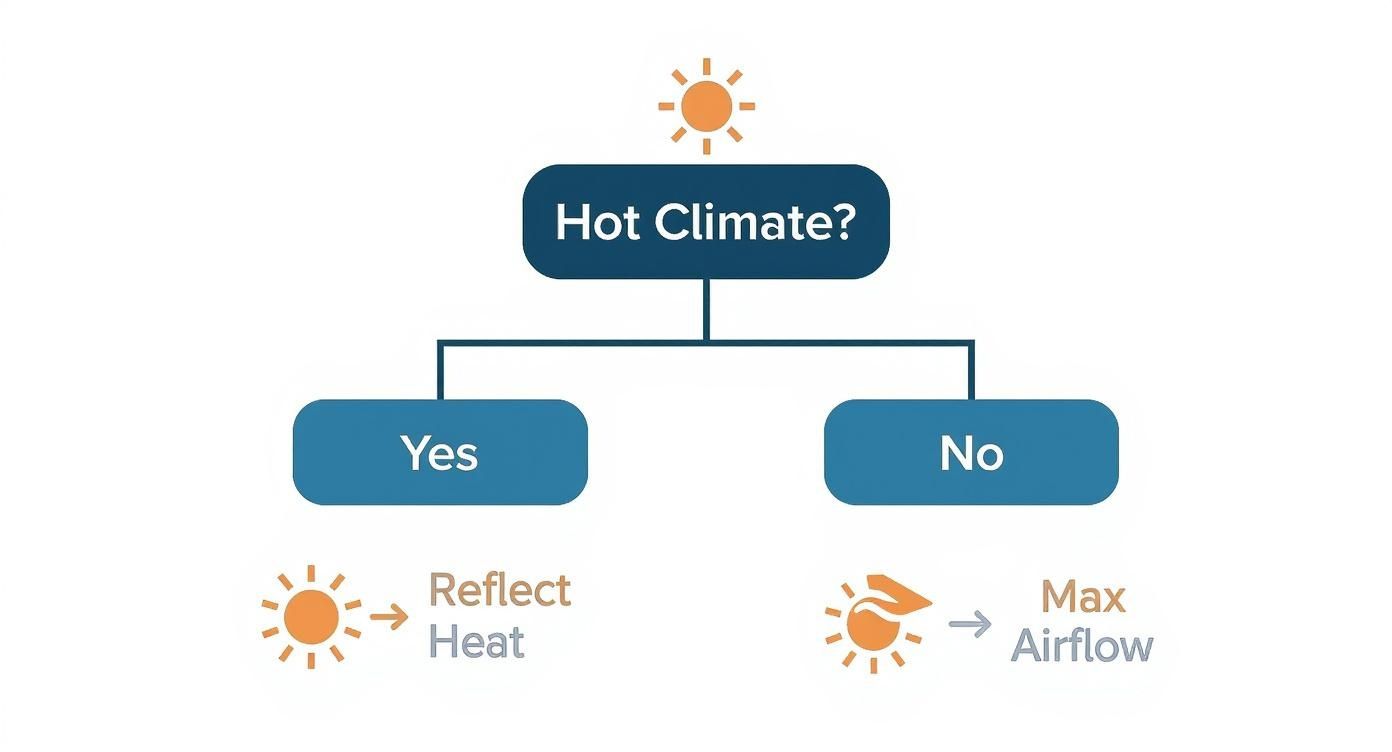
The big takeaway here is that an energy-efficient roof in a place like Arizona needs to do two things well: reflect solar heat and allow air to circulate underneath.
Final Verdict: At the end of the day, both clay and concrete are premium choices that will seriously upgrade your home's protection and curb appeal. The decision truly comes down to what you value most—the timeless authenticity and incredible lifespan of clay, or the versatile design options and practical value of concrete.
Frequently Asked Questions
When making a major decision like choosing between clay or concrete roof tiles, several key questions often arise. Here are clear, straightforward answers to the most common concerns.
Is it safe to walk on a tile roof?
It is strongly advised that homeowners do not walk on their tile roofs. Both clay and concrete tiles can crack under concentrated pressure, especially if not walked on correctly. Clay, being more brittle, is particularly susceptible to damage. Professional roofers are trained to navigate tile roofs safely, knowing exactly where to step to distribute their weight and avoid causing harm. For any inspections, maintenance, or repairs, always call a qualified professional.
Do concrete tiles need to be resealed?
Yes, eventually. The factory finish on concrete tiles is durable, but after 20-30 years of exposure to harsh sunlight, the color can begin to fade. While this doesn't compromise the tile's structural integrity, many homeowners choose to have their roof professionally cleaned and resealed to restore its original vibrancy. This maintenance step not only improves the appearance but also adds a renewed layer of protection against moisture absorption.
Which is better in a hail storm, clay or concrete?
Both materials hold up well against hail, but concrete generally has a slight edge. Concrete tiles have a higher impact resistance rating (often Class 3 or Class 4) compared to standard clay tiles, making them less likely to break during a hailstorm. However, the quality of installation and the specific product rating are crucial factors for both materials.
How much heavier is a tile roof than a shingle roof?
Tile roofs are significantly heavier than asphalt shingle roofs, which is a critical consideration for your home's structure.
- Asphalt Shingles: Weigh approximately 250-400 pounds per square (a 10×10 foot area).
- Concrete Tiles: Weigh between 820 to 1,200 pounds per square.
- Clay Tiles: Range from 600 to 1,000 pounds per square.
Before installing any tile roof, it is mandatory to have a structural engineer confirm that your home's framing can safely support the additional weight. If you are replacing a shingle roof with tile, structural reinforcement may be necessary.