
A lot of Arizona homeowners end up here the same way. A brutal summer passes, the roof looks a little rough, then the first hard monsoon pushes water where it doesn’t belong. A stain shows up on the ceiling in Phoenix. A few shingles land in the yard in Mesa. A section starts curling in Scottsdale. The first question usually isn’t technical. It’s simple. What’s the roof shingles repair cost going to be?
That question matters more now because roofing prices have climbed. Materials cost more. Labor costs more. And in Arizona, heat and storm exposure can turn a small shingle problem into a larger deck or underlayment repair if it sits too long. The good news is that shingle repairs are still manageable when the damage is caught early and the estimate is honest.
This guide gives Arizona homeowners a practical look at what repairs tend to cost, what drives the bill up, and where the key trade-offs are in cities like Phoenix, Scottsdale, Tucson, Mesa, and Chandler.
Table of Contents
- Spotting Roof Trouble on Your Arizona Home
- Understanding Average Roof Shingle Repair Costs in Arizona
- Key Factors Influencing Your Shingle Repair Cost
- Real-World Examples of Shingle Repair Costs
- Should You Repair Your Own Shingles or Hire a Pro
- How to Manage Payments and Insurance for Your Roof Repair
- Your Next Steps for a Secure and Durable Roof
- Frequently Asked Questions About Arizona Shingle Repair
Spotting Roof Trouble on Your Arizona Home
A common Arizona repair call starts with something small. A homeowner in Tucson notices a brown spot after a monsoon rain. Another in Phoenix sees a few curled tabs near the edge of the roof while dragging the trash cans out. Someone in Scottsdale finds granules collecting near a downspout and wonders whether it’s normal wear or the start of a leak.
Most of the time, the roof doesn’t fail all at once. It gives warnings first.
What homeowners usually notice first
Some signs are obvious. Others are easy to brush off until they turn expensive.
- Missing shingles after wind: Monsoon gusts can lift tabs, break seals, or tear off already-brittle pieces.
- Cracked or curled shingles: Arizona heat dries out asphalt over time, especially on roofs that take full afternoon sun.
- Granules in gutters or on the ground: That often means the shingle surface is losing protection.
- Ceiling stains or musty smells inside: Water may be getting in somewhere other than where the stain appears.
- Soft spots underfoot on the roof deck: That can point to trapped moisture below the shingles.
Homeowners who want a broader checklist can review these top warning signs of roof damage you can't afford to miss before deciding whether the issue looks cosmetic or urgent.
Practical rule: A small stain inside the house often means the roof problem started earlier than it looks from the living room.
Why Arizona roofs fool people
Heat changes how damage shows up. A roof can look mostly fine from the driveway while the shingles have already dried, loosened, or cracked at the fastening points. Then the first heavy rain exposes the weak spot.
Monsoon timing makes this worse. Wind-driven rain doesn’t always come straight down. It pushes under lifted edges and finds openings around transitions, vents, and weakened shingle rows. That’s one reason basic maintenance matters. Homeowners looking for a useful overview of general roof leak prevention can use that as a starting point, but Arizona roofs still need local judgment because heat and storm cycles are tougher here than in milder climates.
The main point is simple. If shingles look worn, loose, cracked, or out of line, it’s smart to get them checked before the next storm decides the schedule.
Understanding Average Roof Shingle Repair Costs in Arizona
Arizona homeowners usually want a number first, and that’s fair. National pricing gives a useful starting point. The national average roof repair price is $1,147, with most homeowners paying between $392 and $1,913, while roofing repair costs have increased 6 to 8 percent since 2023 and roof repair and replacement cost value totaled nearly $31 billion in 2024, up nearly 30 percent since 2022, according to industry data summarized by Insurance Journal.
Arizona doesn’t always fit neatly into that national middle. Sun exposure, wind events, and the need to match weathered shingles can push a repair up or down depending on the roof’s condition.
Estimated Shingle Repair Costs in Arizona 2026
| Repair Scope | Typical Cost Range |
|---|---|
| Minor repair, such as a few cracked or missing shingles | $150 to $300 |
| Moderate repair, such as multiple damaged shingles or a small storm-hit section | $500 to $1,500 |
| Major repair, such as a larger section with significant damage | $1,500 and up |
| Added structural work if sheathing repair is needed | $4 to $10 per square foot |
Those Arizona-facing ranges reflect what tends to happen on asphalt shingle roofs when isolated damage stays isolated versus when moisture gets below the surface. The biggest pricing swing usually comes from what’s hidden underneath.
What these numbers mean in real life
A homeowner in Chandler with two or three wind-damaged shingles may stay in the lower range. A homeowner in Mesa with several damaged sections after a storm usually lands in the middle range. A Scottsdale roof with sun-baked shingles and wet sheathing below can move beyond a simple patch fast.
That’s why the term roof shingles repair cost can be misleading if it’s treated like a flat menu price. Roofing isn’t like replacing a single tile on a kitchen floor. The shingles are part of a layered system, and the repair has to restore water shedding, fastening, seal integrity, and sometimes the surface below.
Why Arizona estimates need local context
In Arizona cities, the repair strategy often changes based on these conditions:
- Heat exposure: South- and west-facing slopes often age faster.
- Storm pattern: Monsoon wind can damage one area while leaving the rest untouched.
- Roof age: Older shingles are harder to lift and match without causing more breakage.
- Access: Two-story homes and steeper pitches increase setup time and labor.
A broad online calculator can’t see those details. Homeowners who want a more practical breakdown of estimate line items can review this roof repair estimate guide with accurate cost considerations for 2025.
The cheapest-looking estimate often leaves out the part that determines whether the repair lasts through the next monsoon.
Key Factors Influencing Your Shingle Repair Cost
A Phoenix homeowner can call about one lifted shingle and end up with a very different estimate than a homeowner in Tucson with the same visible issue. The reason is usually below the surface or around the work area. On Arizona roofs, price is shaped by how the shingles have aged in the heat, how much storm stress the area took, and how difficult it is to complete the repair without creating new damage.
This visual sums up the main cost drivers.
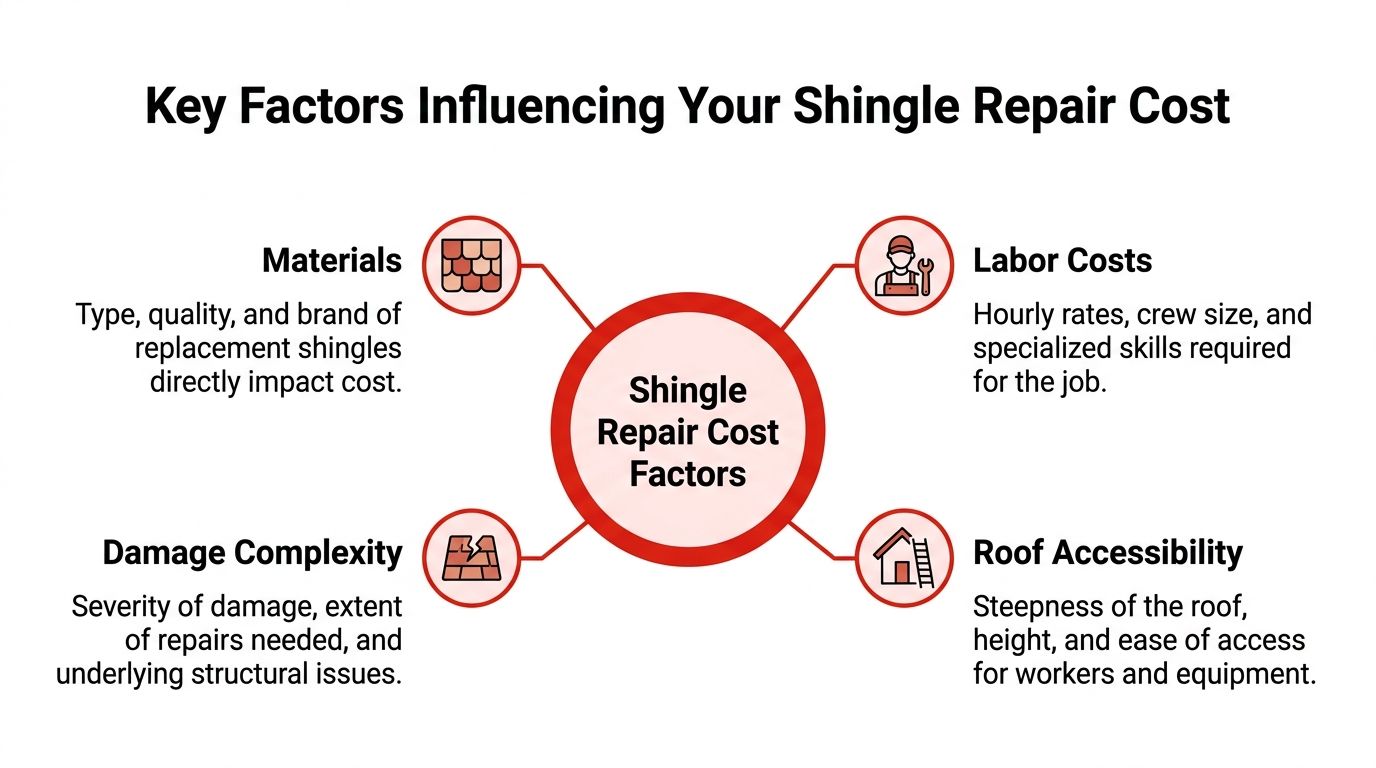
Material type changes the repair approach
Shingle type affects both labor and appearance after the repair. Standard 3 tab shingles are usually easier to lift, replace, and blend than heavier architectural shingles. On older Arizona roofs, the bigger issue is often condition rather than product label. Years of UV exposure can dry shingles out so badly that adjacent pieces crack during a careful repair.
Color match matters too. A new bundle may be close on paper and still stand out on a sun-faded roof in Mesa or Scottsdale. In those cases, a contractor may recommend a small blend area instead of replacing only the visibly damaged pieces. That adds time, but it often leaves the roof looking cleaner and functioning better.
Labor and roof access often drive the estimate
Labor and roof access often matter more than homeowners anticipate because they directly affect setup time, safety requirements, and how quickly a crew can work without breaking surrounding shingles.
A one story roof with a moderate pitch is usually straightforward. A two story home in Phoenix with limited side-yard access, brittle shingles, and a repair area above a patio cover is slower and riskier. The crew may need extra ladder staging, harnessing, roof protection, and more careful hand work around the damaged section.
The same repair scope can price differently based on conditions like these:
- Steep pitch: Slower movement and added fall protection.
- Two-story height: More setup, staging, and material handling.
- Obstacles below: Pool areas, solar equipment, and dense landscaping complicate access and cleanup.
- Heat-stressed shingles nearby: Crews have to work more carefully to avoid cracking the surrounding field.
Arizona heat also affects scheduling. In summer, some repairs are safer and cleaner in the morning because shingles can soften too much by afternoon. On older roofs, the opposite problem shows up. Dry, brittle tabs can snap when lifted.
Damage depth separates a surface fix from structural work
The visible shingle problem is not always the full repair.
A missing tab after a monsoon may be a simple replacement if the underlayment and decking stayed dry. If water worked underneath for weeks, the repair can expand to include underlayment patching, decking replacement, and a larger section of shingle removal. That is where estimates jump.
This is one of the biggest trade-offs I explain to homeowners. A low quote that covers only the exposed shingle issue may look attractive, but it does not help much if the wood below has softened or if fasteners no longer have solid backing. The repair has to restore the roof system, not just cover the spot you can see from the driveway.
Arizona weather creates its own cost equation
National pricing averages only go so far here. In Phoenix, Scottsdale, Mesa, and Tucson, roofs deal with long UV exposure, high roof-surface temperatures, dust, sudden wind, and hard monsoon rain. Those conditions change how shingles fail and how they should be repaired.
Heat shortens the workable life of many asphalt shingles. Monsoon gusts test seal strips and can peel back tabs that already lost adhesion. Hail is less common in some areas than wind, but where it hits, it can strip granules and expose the mat below. One slope can be worn out while another still has usable life left.
That is why Arizona repair pricing often comes down to four practical questions. Can the damaged shingles be removed cleanly. Is the area still dry and solid underneath. Can a close match be installed without disturbing a much larger section. Will the repair hold through the next stretch of extreme heat and storm season.
A repair that survives a mild week in spring can still fail in August if the fastening, sealing, or substrate work was skipped.
That is the cost difference. One job is a targeted patch. Another is a repair built to handle Arizona weather without reopening at the first strong monsoon.
Real-World Examples of Shingle Repair Costs
Arizona repair pricing makes more sense when it’s tied to situations homeowners see. These aren’t universal quotes, but they reflect common repair patterns on asphalt shingle roofs in places like Chandler, Scottsdale, and Mesa.
According to Care Roofing Solutions’ shingle repair guide, repairing a few cracked or missing asphalt shingles averages $150 to $300, while multiple storm-damaged sections typically run $500 to $1,500. The same source notes that untreated granule erosion from UV and hail can lead to sheathing repairs costing $4 to $10 per square foot.
The monsoon blow-off in Chandler
A homeowner finds several shingles in the backyard the morning after a storm. From the ground, the roof doesn’t look terrible. Up close, a small edge section lost a few tabs and the surrounding shingles are still serviceable.
That kind of repair often fits the $150 to $300 range if the damage is limited and the underlayment below is still intact. The work usually involves removing compromised pieces, sliding in matching replacements as closely as possible, fastening them correctly, and sealing them so they resist the next wind event.
This is the kind of job that rewards speed. Wait too long, and rain can get into nail lines or exposed areas that were easy to protect the week before.
The hidden heat crack in Scottsdale
A homeowner notices a ceiling stain after a brief rain, but there are no obvious missing shingles. Inspection reveals several cracked shingles on a sun-heavy slope. The problem wasn’t a dramatic storm tear-off. It was gradual heat wear that finally allowed water in.
This usually lands in the mid-range repair bracket because the crew isn’t replacing one isolated shingle. They’re tracing the leak path, lifting surrounding material carefully, checking the layer below, and repairing the section in a way that restores the system instead of hiding the symptom.
On Arizona roofs, the leak location inside the house often doesn’t line up neatly with the failed shingle outside.
The larger hail section in Mesa
After a storm, a homeowner sees widespread bruising and granule loss over one roof slope. Several shingles are cracked, and the damaged area is too broad for a tiny patch to make sense.
This type of repair can fall in the $500 to $1,500 range when the work involves multiple shingles or storm-damaged sections with no major structural decay. If hail exposure and water entry have already compromised the sheathing, the cost rises from there because the repair has moved beyond the surface.
A bigger repair like this also raises a judgment call. Is the roof still a good candidate for sectional repair, or is the damaged slope showing the beginning of a larger age problem? That answer depends on roof condition, not just storm damage.
The repair that looked small in Tucson
A homeowner expects a quick patch for a few visible cracked shingles. During removal, the decking below one area feels soft from prior moisture entry.
That’s the scenario that catches people off guard. The shingle issue looked minor. The final bill came from the wet substrate. Once the deck has lost integrity, covering it back up would be the wrong fix.
These examples all point to the same lesson. Roof shingles repair cost in Arizona depends less on the number of shingles seen from the yard and more on the condition of the system once a roofer opens the area.
Should You Repair Your Own Shingles or Hire a Pro
A Phoenix homeowner sees one shingle curled up after a monsoon, grabs a ladder, and figures it is a quick Saturday fix. By Monday, the patch looks fine from the driveway, but wind-driven rain has already worked under the surrounding tabs because the seal line and nail placement were off. That is how a small repair turns into a stained ceiling and a larger bill.
DIY shingle repair looks cheaper because the material cost is low. On Arizona roofs, labor is only part of what you are paying for. You are paying for safe access, correct shingle handling in extreme heat, and a repair that can hold through summer sun in Scottsdale and sudden storm pressure in Mesa.
Heat changes how shingles behave. Older asphalt can get brittle, granules loosen faster, and seal strips can respond differently depending on the temperature and how long the roof has been baking. Add dust, steep pitch, and afternoon roof temperatures that can be punishing, and even a small repair gets harder than it looks.
The common DIY mistakes are predictable:
- Nails placed too high or too low: The shingle may sit in place for now, then lift during the next round of monsoon wind.
- Overdriven or exposed fasteners: Water gets a direct entry point.
- Sealant used like a shortcut: Too much mastic can trap moisture, attract debris, and fail under Arizona heat.
- A visual match without a system match: A replacement shingle may look close enough but still have the wrong profile, seal strip location, or wind rating.
- No check beneath the surface: The visible shingle gets replaced while soft decking, damaged underlayment, or heat-cooked adjacent shingles stay in place.
Safety matters too. I tell homeowners this plainly. A shingle roof in July is not a good place to learn by trial and error. Even a one-story home can be dangerous once the surface gets hot, dusty, and unstable underfoot.
Professional repair pays off when the goal is to stop the problem for good, not just cover it up. A good roofer checks the failed shingle, the surrounding field, the flashing nearby, and the condition below the repair area before deciding what makes sense. Sometimes the right answer is a small repair. Sometimes the honest answer is that a patch will not last, especially on an older roof that has already taken years of Arizona sun.
Arizona Roofers handles inspections, same-day quotes, repair documentation, financing, and storm-related support for local homeowners. If storm damage may be part of the problem, it also helps to review when insurance covers roof replacement in Arizona before approving work out of pocket.
Homeowners can still do useful ground-level checks after a storm. Look for shingle pieces in the yard, exposed tabs, sagging lines, or granule buildup near downspouts. The actual repair is a different job.
On an Arizona roof, a cheap patch that fails in the next monsoon usually costs more than hiring a pro the first time.
How to Manage Payments and Insurance for Your Roof Repair
The repair itself is only half the job. The other half is making sure the estimate is clear, the insurance process is handled correctly, and the homeowner isn’t paying for something that should have been documented better from the start.

Getting a quote that means something
A useful estimate should do more than name a price. It should explain what the roofer sees, what the repair includes, and what could change if hidden damage appears after the shingles are lifted.
Homeowners should look for these basics:
- Scope of work in plain language: Which area is being repaired, and what materials are included.
- Photo documentation: Before-work images help clarify what’s visible at the time of inspection.
- Notes on possible hidden damage: Especially important if staining, sagging, or long-term moisture is suspected.
- Warranty information: Homeowners should know what workmanship coverage applies to the repair.
If the estimate is vague, the homeowner may not be comparing real options. They may be comparing one detailed repair plan to one low number with missing steps.
Handling a storm claim without missing details
Roof claims often break down on documentation, not just damage. Homeowners may know the roof was hit hard, but the file still needs photos, inspection notes, and a clear explanation tying the storm event to the repair scope.
Homeowners who are sorting through that question can review this guide on whether insurance covers roof replacement because the answer depends on damage type, policy terms, and how the claim is supported.
According to Roof Maxx’s roof repair cost overview, expert insurance claims assistance can make the difference between approval and denial. The same source notes that AI-driven drone inspections can reduce diagnostic costs by 25 to 35 percent, and that Arizona-specific rebates for energy-efficient repairs such as reflective coatings are often missed.
That matters in Arizona because storm damage can be uneven. One slope may show lifted tabs, cracked shingles, and granule loss while another section looks untouched. A thorough inspection record helps separate normal wear arguments from actual storm-caused loss.
Financing and rebates can change the decision
Some homeowners delay repair because the issue feels urgent but the cash timing doesn’t work. That hesitation is understandable. The problem is that roof damage rarely pauses while the budget catches up.
A few practical steps can help:
- Ask about deferred payment options: Those can make fast repairs more manageable.
- Request an energy-efficiency discussion: Reflective or coating-related upgrades may have local value beyond the immediate patch.
- Get storm documentation quickly: Waiting makes it harder to prove what happened and when.
- Keep all estimate and photo records together: That speeds up claim or financing conversations.
The best financial move usually isn’t finding the lowest number. It’s getting the right scope early, with enough documentation to support insurance, financing, or rebate opportunities when they apply.
Your Next Steps for a Secure and Durable Roof
Arizona homeowners don’t need a perfect roof to avoid major costs. They need a roof problem caught early, diagnosed correctly, and repaired in a way that matches the climate.
That’s the main takeaway. Roof shingles repair cost depends on more than a missing tab or a cracked corner. Heat, monsoon wind, hidden moisture, and roof access all affect the bill. So does timing. Small repairs are usually manageable. Delayed repairs often aren’t.
Routine maintenance around the roof line also helps prevent avoidable water issues. Homeowners who want a practical refresher on how to clean gutters safely can use that as part of a broader prevention plan, especially before monsoon season.
The smartest next step is simple. If shingles are curling, cracking, missing, or leaking, get the roof inspected before the next storm tests it. Don’t wait for a repairable problem to become structural damage.
Frequently Asked Questions About Arizona Shingle Repair
How do asphalt shingle repairs compare with tile or metal repairs
Asphalt shingle repairs are usually more straightforward because individual damaged pieces can often be replaced without disturbing a large surrounding area. Tile and metal repairs can be more specialized because the materials, fastening methods, and water-shedding details differ. The right approach depends on the roof system, age, and whether matching materials are available.
Can roofers work during peak Arizona summer heat
Yes, but scheduling matters. Crews often plan around safer parts of the day and adjust work timing when surfaces become excessively hot. Extreme heat can affect both worker safety and how shingles handle during repair, so experienced roofers don’t treat midsummer repairs the same way they would in mild weather.
How long does a typical shingle repair take
A small isolated repair may be completed quickly once the crew confirms there’s no deeper damage. A larger storm-related repair takes longer because the roofer may need to inspect multiple sections, open up damaged areas, and verify whether moisture reached the substrate below. The timeline depends more on complexity than on the visible shingle count from the ground.
Will new shingles match the rest of the roof
Sometimes closely, sometimes not perfectly. Arizona sun can fade and age existing shingles enough that a brand-new replacement stands out. A good roofer will try to match color, profile, and layout as closely as possible, but older roofs often show some contrast after a sectional repair.
If shingles are missing, cracked, or leaking after Arizona heat and monsoon weather, it’s smart to act before the damage spreads. Homeowners who want clear answers, honest repair guidance, and help sorting through documentation can contact Arizona Roofers at (480) 531-6383 for a free, no-obligation inspection.