
Your commercial roof is one of your most valuable assets, quietly protecting your operations, inventory, and staff from the elements. But out of sight shouldn't mean out of mind. Neglecting your roof can lead to catastrophic failures, costly emergency repairs, and significant business downtime. A proactive approach, centered on regular professional inspections, is the single most effective strategy to prevent small issues from becoming budget-breaking disasters.
This guide provides a comprehensive overview of commercial roof inspection services. We'll explore why they are crucial, what a thorough inspection entails, the different types available, and how modern technology is revolutionizing the process. By the end, you'll understand how to leverage inspections to extend your roof's lifespan, protect your investment, and ensure the long-term health of your property.
Key Takeaways
- Proactive is Cheaper than Reactive: Regular inspections (ideally twice a year) are essential for catching minor issues like clogged drains or cracked seams before they lead to major structural damage and costly repairs.
- Inspections Preserve Value: A well-documented history of professional inspections protects your property's value, strengthens insurance claims, and can even improve energy efficiency.
- Not All Inspections are Equal: The right inspection type—whether for routine maintenance, post-storm damage, due diligence, or warranty compliance—depends on your specific needs.
- Technology Provides Deeper Insights: Modern tools like high-resolution drones and infrared thermography allow inspectors to find hidden moisture and subtle damage that are invisible to the naked eye.
- Choosing the Right Partner is Crucial: Always vet potential roofing contractors by checking their licensing, insurance, experience with your roof type, and client references to ensure you're working with a true professional.
Why Your Commercial Roof Needs a Proactive Inspection Plan
Your roof is the unsung hero of your business, quietly shielding your assets, inventory, and employees from the elements 24/7. But like any guardian, it can't be taken for granted. For any savvy property owner, a proactive inspection plan isn't just a good idea—it's an absolute necessity.
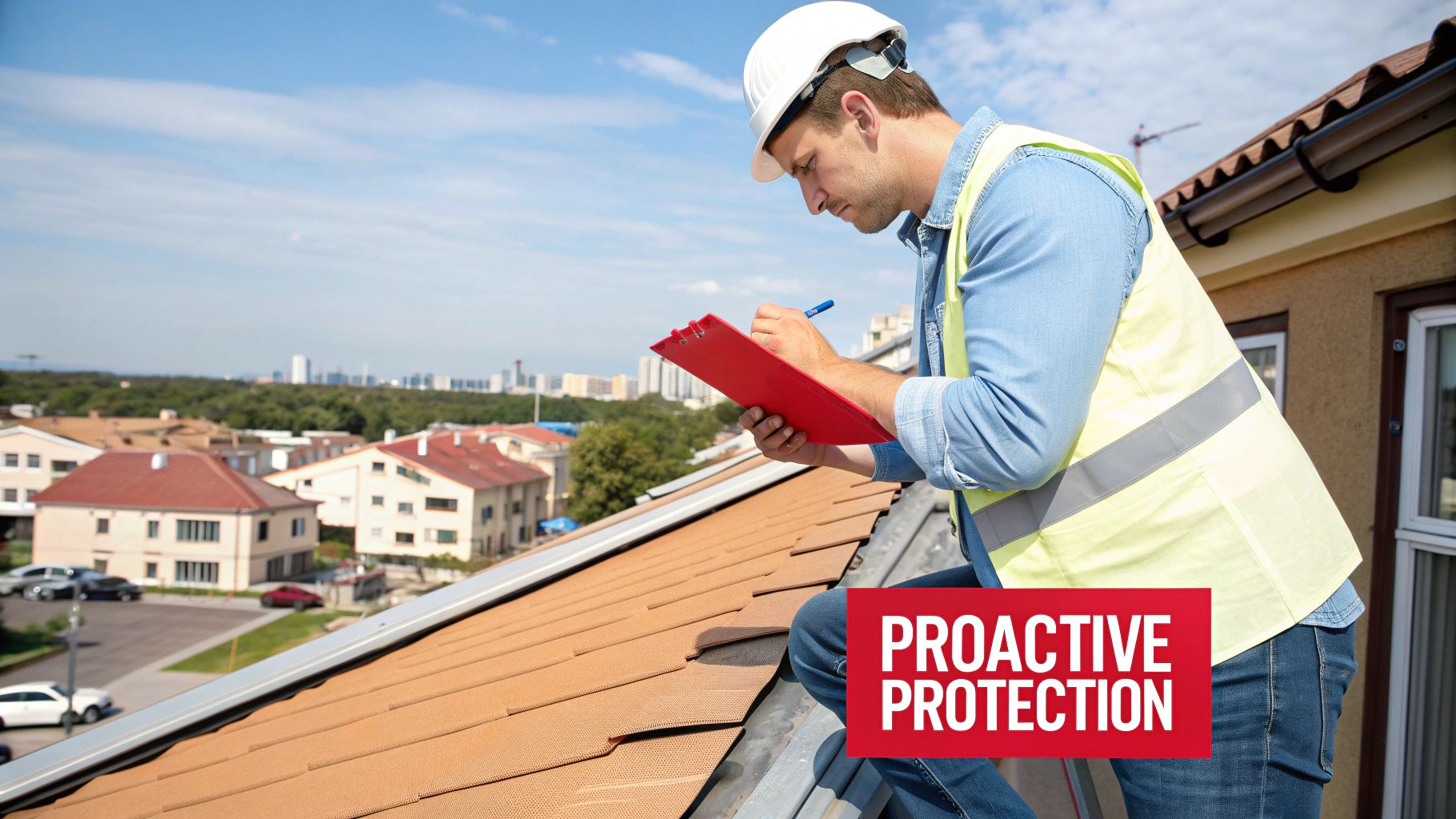
This kind of forward-thinking approach moves you out of the stressful cycle of emergency repairs and into the driver's seat of strategic asset management. A seemingly minor problem, like a cracked seam or a bit of debris in a drain, can quickly escalate into major structural damage, forcing you to halt operations and face serious financial hits.
A scheduled inspection is like preventative medicine for your building. It helps diagnose minor problems before they become full-blown emergencies that wreck your bottom line.
Protecting Your Investment
More and more business owners are catching on to the value of this approach. The market for commercial roof inspection services was recently valued at around USD 0.44 billion and is expected to more than double by 2033. This growth is a direct result of a stronger focus on proper maintenance and building compliance.
So, what does a proper inspection actually involve? To get a sense of what a detailed, multi-point assessment looks like, you can see how other commercial service providers structure their plans, like this a free 16-point inspection offer. Having a structured, thorough plan is the key to maintaining your property's integrity and value for years to come.
What a Commercial Roof Inspection Actually Involves
Don't think of a professional commercial roof inspection as just a quick glance. It's more like a comprehensive health check-up for the top of your building, designed to catch not only the obvious problems but also the hidden issues that could turn into major headaches later. This is way more than just someone walking around on your roof; it's a systematic process with distinct phases.
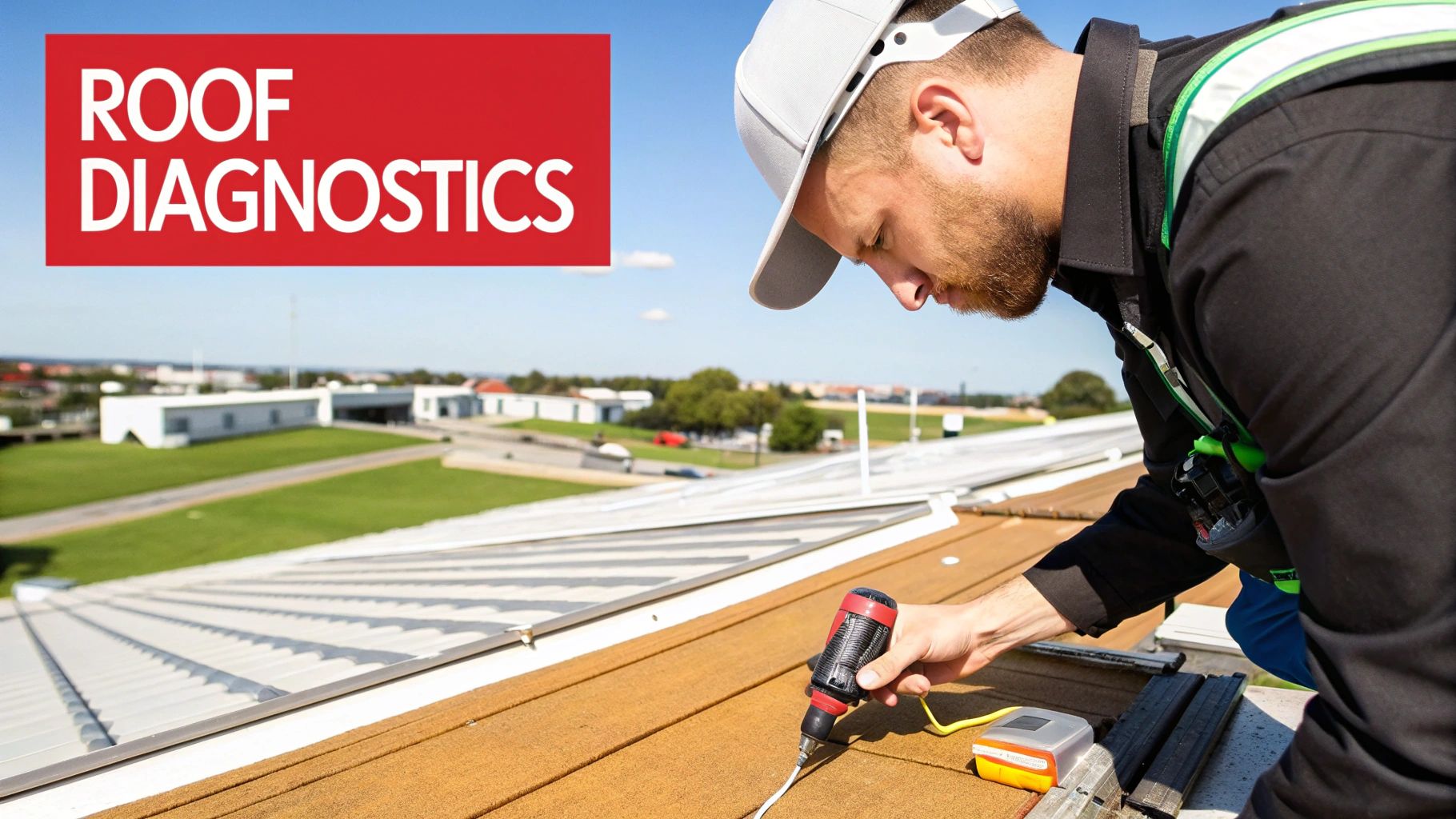
A proper assessment from a qualified roofer moves methodically from the past to the future. They'll start by understanding your building's history and end by giving you a clear, actionable plan to protect it. This approach ensures nothing gets missed and you get a complete picture of your roof's condition.
The Three Core Phases of Inspection
You can really break down the whole process into three logical stages. Each one builds on the last, creating a thorough analysis that makes sure every critical component is evaluated.
-
Pre-Inspection Review: It all starts with homework. The inspector will gather key background information, like building plans, old maintenance records, and any active warranties. Knowing the roof's history provides critical context before anyone even climbs a ladder.
-
On-Site Assessment: This is the hands-on part—the real detective work. The inspector will meticulously examine every inch of the roof system, hunting for signs of wear, damage, and potential failure points.
-
Reporting and Recommendations: Once the fieldwork is done, all the findings are pulled together into a detailed report. This isn't just a simple summary; it will include photos, a clear explanation of any problems, and a prioritized list of recommendations for repairs or maintenance.
A Deeper Look at the On-Site Assessment
During the on-site visit, a good inspector is looking at much more than just the roof's surface. They’re trained to spot subtle clues that signal bigger trouble on the horizon. To do this, they often need more than just their eyes.
A professional inspection is about seeing what's not immediately visible. Techniques like moisture analysis act like an MRI for your roof, revealing trapped water that causes rot and structural decay from the inside out.
For instance, they might perform core sampling, which means taking a small, layered sample of the roof to see exactly what's going on with its composition and condition. They’ll also check for moisture intrusion with specialized tools to find leaks long before you see a stain on your ceiling. The assessment will also cover often-overlooked—but critical—components:
- Membrane Condition: Looking for any cracks, blisters, or punctures in the main roofing material.
- Flashing Integrity: Making sure the seals around vents, chimneys, and walls are still tight and waterproof.
- Drainage Systems: Checking that gutters, scuppers, and drains are clear and working properly to prevent ponding water, which is a major cause of roof degradation.
This is the level of detail you should expect from professional commercial roof inspection services. To see how this plays out in a specific climate, you can learn more about roof inspections in Arizona and the unique challenges they address. At the end of the day, this detailed examination is what allows a roofing expert to build a precise, effective maintenance strategy for your property.
The True ROI of Regular Roof Inspections
It’s easy to look at a routine inspection as just another line item on your expense report. That's a common view, but it's also a costly mistake. A better way to think of it is as one of the smartest investments you can make in your commercial property—one with a surprisingly high return. The benefits of getting a professional set of eyes on your roof go way beyond simple upkeep; they directly protect your bottom line.
Think of your roof as a long-term asset, not just a cover. It has a defined lifespan, and every single year you can safely extend that life through smart maintenance is a year you push off a massive capital expense for a full replacement. Nothing maximizes the service life of your existing roof system more effectively than proactive care.
From Minor Fixes to Major Savings
The real magic of an inspection is in catching the small, cheap problems before they spiral into something catastrophic. A tiny issue found early might mean a simple, low-cost patch job. If you let that same issue fester, it can easily lead to extensive damage that costs tens of thousands to fix.
Here’s a real-world example we see all the time: an inspector spots a clogged drain during a routine check. It’s a simple fix, costing next to nothing. But ignore it, and that same clogged drain could cause water to pool dangerously during the next heavy storm. That can lead to a structural overload and, in a worst-case scenario, a partial roof collapse. Suddenly, you're not just facing huge repair bills but also crippling business downtime.
A professional inspection report transforms ambiguity into action. It provides clear, documented evidence that empowers you to make strategic financial decisions about your property instead of reacting to emergencies.
Unlocking Hidden Financial Benefits
Beyond dodging disasters, regular inspections offer a few other key financial perks that directly boost your balance sheet. These aren't just hypotheticals; they show how maintenance supports your wider business goals.
-
Improved Energy Efficiency: A roof with failing insulation or hidden moisture is like leaving a window open 24/7. Your conditioned air escapes, and your utility bills climb. An inspection pinpoints these energy leaks, and the simple repairs can lead to noticeable monthly savings on heating and cooling.
-
Stronger Insurance Claim Positions: When you need to file an insurance claim after a storm, a documented history of professional inspections is your best friend. A recent report gives you a clear "before" picture of your roof's health, making it much easier to prove the damage is new and not due to old, neglected issues. This documentation can make the difference between a quick, full payout and a long, drawn-out fight with your insurer.
-
Preserving Property Value: A well-maintained roof is a huge selling point for any commercial building. Having a paper trail of regular inspections and quick repairs shows you're a responsible owner. This can seriously boost your property's market value and make it far more attractive to potential buyers or tenants.
Of course, understanding the financial side of things is key. For a more detailed breakdown, you might want to check out our guide on the true roof inspection cost and what factors into it. At the end of the day, the small, predictable cost of an inspection is a powerful tool for warding off huge, unexpected expenses and protecting the financial health of your business.
Choosing the Right Type of Roof Inspection for Your Needs
Not all roof inspections are the same. Asking a contractor for a "roof inspection" is a bit like asking a doctor for a "check-up"—it's a good start, but it's far too general. To really take control of your property's health, you need to know which type of assessment to ask for and when.
This isn’t just about getting a piece of paper; it’s about getting the right information for a specific purpose. Whether you're handling routine upkeep, reacting to a storm, buying a building, or just trying to keep your warranty intact, each situation calls for a different kind of look. Knowing the difference helps you get exactly what your asset needs.
Proactive Maintenance Inspections
Think of this as your roof's regular physical, scheduled twice a year. The whole point here is prevention. We’re talking about catching small issues before they snowball into leaks, structural damage, and huge repair bills. Most property managers schedule these in the spring (to check for winter damage) and fall (to prepare for the cold and wet).
During a maintenance visit, an inspector is a detective looking for subtle clues: cracked sealant around vents, small punctures from dropped tools, or a bit of debris starting to clog a drain. This is by far the most common type of inspection and the absolute bedrock of a smart roof management strategy.
Post-Event Damage Assessments
This one is purely reactive and always urgent. It happens right after a major event—a hailstorm, a hurricane, or even just a period of unusually high winds. Its one and only job is to find and document any damage the event caused.
The focus is incredibly specific. The inspector isn't looking at general wear and tear; they're hunting for hail impacts, flashing that's been peeled back by wind, or punctures from flying debris. The report they generate is your most important tool for filing an accurate and timely insurance claim.
A post-event assessment isn't a routine check-up. It's a forensic investigation, creating a detailed record of damage to back up an insurance claim and guide the emergency repairs needed to make the building watertight again.
The infographic below gives you a quick visual on how often these inspections typically happen. You can see right away how routine maintenance is a regular, recurring task.
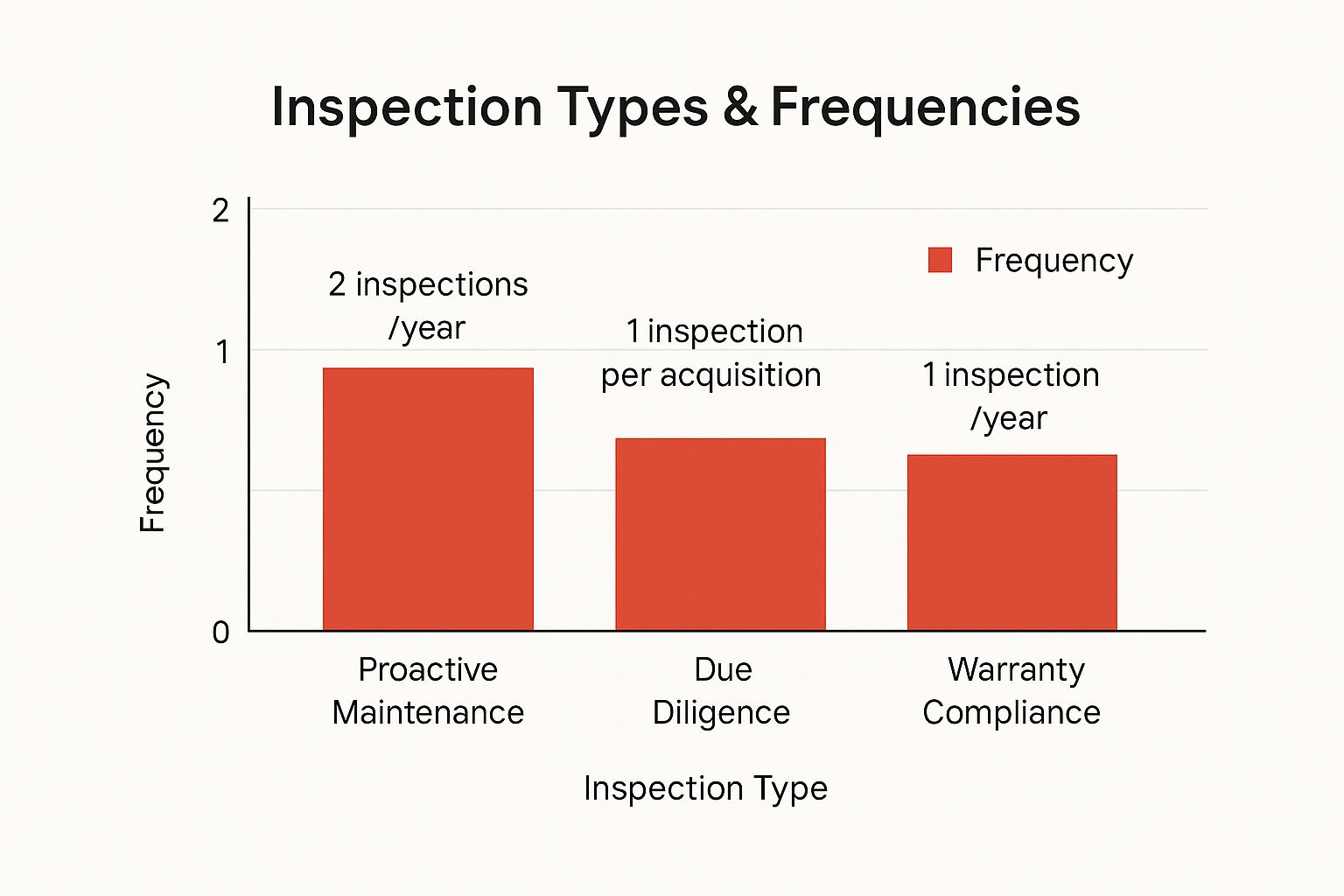
As the chart shows, proactive maintenance is best done twice a year, while other inspections are tied to specific events, like a property sale or an annual warranty deadline.
To make the distinctions even clearer, let's break them down in a table.
Comparison of Commercial Roof Inspection Types
| Inspection Type | Primary Purpose | Recommended Frequency | Key Focus Areas |
|---|---|---|---|
| Proactive Maintenance | Catch small issues before they become large, expensive problems. | Twice per year (Spring & Fall) | General wear, debris, sealant integrity, drainage. |
| Post-Event Damage | Document damage for insurance claims and immediate repairs. | As needed, after major weather events. | Hail impacts, wind uplift, punctures, water intrusion. |
| Due Diligence | Assess roof condition and lifespan before a property transaction. | Once, during the acquisition process. | Remaining service life, past repairs, potential costs. |
| Warranty Compliance | Fulfill manufacturer requirements to keep the warranty valid. | Annually, or as required by the warranty. | Adherence to maintenance specs, documentation. |
This table helps illustrate that while each service involves looking at the roof, the "why," "when," and "what" are completely different.
Other Specialized Inspections
Beyond basic upkeep and storm response, a couple of other inspections serve critical business needs.
- Due Diligence Inspections: This is non-negotiable when you're buying or selling a commercial building. It gives you a complete picture of the roof's health, its estimated remaining lifespan, and any big-ticket repairs looming on the horizon. That information is pure gold during negotiations.
- Warranty Compliance Inspections: Many roof system warranties from manufacturers like GAF or Carlisle SynTec aren't just "set it and forget it." They often require an annual professional inspection to stay in effect. This inspection proves you've done your part, ensuring your multi-million dollar investment remains protected.
How Technology Is Changing the Game in Roof Assessments
While nothing can replace the trained eye of an experienced inspector, the best commercial roof inspection services today are blending that hands-on expertise with some seriously powerful technology. These tools give us a much deeper, more accurate look into the health of your roof, often uncovering problems that are completely invisible to the naked eye. It’s this combination of human skill and high-tech analysis that gives you the full, unvarnished truth about your roof's condition.

This tech-driven approach is quickly becoming the new normal in a booming industry. The North American roofing market already makes up about 31% of the global market and is on track to hit a staggering $41 billion by 2031. A huge part of that growth comes from adopting new inspection technologies that make the whole process more efficient and precise. You can discover more insights about the roofing industry's growth on Finturf.com to see just how big this shift is.
Drones for Safer, Faster Aerial Views
One of the biggest leaps forward has been the use of high-resolution drones. In the past, inspecting a massive commercial roof meant someone had to walk every single square foot, which is not only time-consuming but can also be dangerous. Now, a drone can systematically fly over the entire surface in a fraction of the time.
These drones capture incredibly detailed aerial images, making it easy to spot subtle signs of damage—think tiny punctures, cracked seams, or areas of ponding water that you might miss from the ground or even during a walk-through. This method isn't just faster; it's a huge safety improvement, keeping inspectors off potentially treacherous rooftops as much as possible.
Infrared Thermography: Seeing a Hidden Threat
Maybe the most impressive tool in the modern inspector's kit is infrared (IR) thermography. The easiest way to think about it is like an X-ray for your roof. An infrared camera doesn't see light; it sees heat. By scanning the roof, it picks up on subtle temperature differences across the surface, which is a dead giveaway for moisture trapped underneath.
Infrared thermography makes the invisible visible. Wet insulation holds heat longer than dry insulation, so it shows up as a distinct 'hot spot' on the thermal image, revealing a leak long before it ever drips into your facility.
This technology is a true game-changer. It lets us find subsurface moisture without having to cut open the roof for a look. By identifying these hidden wet spots early, you can get to the root cause of a leak before it leads to serious problems like rot, mold, or even structural damage. This kind of precision saves a lot of money because repairs can be targeted exactly where they’re needed, leading to faster, more accurate assessments and providing concrete evidence for any insurance claims.
Finding a Commercial Roofing Partner You Can Trust
Choosing someone to inspect your commercial roof isn't just another vendor decision; it's about finding a long-term partner to help you manage a multi-million dollar asset. This choice directly impacts the health of your building and your bottom line. Get it right, and you’ll have peace of mind for years. Get it wrong, and you could be looking at a world of expensive, recurring headaches.
The roofing industry is massive. To give you some perspective, the U.S. market was projected to be worth around $24.79 billion in 2025. Commercial contractors account for a huge slice of that pie—a whopping $13.9 billion. As you can see from these roofing industry statistics and trends on Fixr.com, there are a lot of companies out there, making it critical to separate the true pros from the rest.
Vetting Your Potential Roofing Partner
A genuine expert will have the credentials and history to back up their claims. When you start looking at different companies, there are a few non-negotiables you should look for right out of the gate. These are the basics that prove they're a legitimate, professional operation.
Start with the essentials:
- Licensing and Insurance: This is table stakes. Make sure they are fully licensed, bonded, and insured in your state. This is your protection against liability and a sign they meet professional standards.
- Proven Experience: Don't just ask if they do "commercial roofs." Ask for a portfolio of projects with your specific roof type, whether it’s TPO, EPDM, modified bitumen, or spray foam. A roofer who specializes in TPO might not be the best fit for your built-up roof.
- Client Testimonials: Go beyond the polished reviews on their website. A reputable company won't hesitate to provide you with a list of recent commercial clients you can actually call for an honest reference.
Key Questions to Ask a Contractor
Once you have a shortlist, it's time to probe a little deeper. The questions you ask will tell you a lot about their professionalism and expertise. Just as properly choosing a competent Fire Risk Assessment Company is vital for safety compliance, asking the right questions here is crucial for your building’s integrity.
A professional contractor will welcome detailed questions. They see it as an opportunity to demonstrate their expertise and build your confidence in their services, not as an inconvenience.
Here are a few questions I always recommend asking:
- What kind of technology do you use for inspections? Are you using drones or infrared thermography?
- Can I see a sample inspection report? I want to understand the level of detail I’ll receive.
- What are your team's safety protocols when they're on my property?
- How do you document your findings, and what’s your process for recommending repairs versus a full replacement?
Knowing what to ask is a major step in vetting providers of Arizona commercial roofing services.
Red Flags to Watch Out For
Knowing what to avoid is just as important as knowing what to look for. Be on high alert for any contractor who uses high-pressure sales tactics or gives you a vague, cookie-cutter proposal.
A quote that seems too good to be true probably is. If it's unusually low or doesn't include a detailed breakdown of the work, that’s a serious red flag. A true professional is transparent, thorough, and focused on building a relationship based on trust, not just making a quick sale.
Frequently Asked Questions About Commercial Roof Inspections
How often should I have my commercial roof inspected?
The industry standard is to schedule a professional inspection at least twice a year: once in the spring to assess any damage from winter weather, and once in the fall to prepare for the upcoming cold and wet season. Additionally, you should always request an immediate inspection after a severe weather event, such as a major hailstorm, hurricane, or high winds.
What should I expect in a commercial roof inspection report?
A comprehensive report should be detailed yet easy to understand. It must include high-resolution photographs of any identified issues, a clear written description of the roof's overall condition, and a prioritized list of actionable recommendations. The report should distinguish between urgent repairs and preventative maintenance, empowering you to make informed decisions for your property and budget.
Can regular inspections really save my business money?
Absolutely. The small, predictable cost of routine inspections is a powerful investment that saves money in multiple ways. It helps you avoid massive, unexpected bills for emergency repairs by catching problems early. It extends the functional lifespan of your existing roof, delaying the capital expense of a full replacement. Finally, it can lead to lower insurance premiums and strengthen your position when filing a claim.
Does my facility team need to be present during the inspection?
While not always mandatory, it is highly recommended. Having a facility manager or maintenance lead present allows them to point out known problem areas or leaks to the inspector. It also provides an opportunity for the inspector to explain their findings in real-time and answer any specific questions your team may have about the roof's condition.
What happens if the inspection finds significant damage?
If an inspector discovers a critical issue, they will notify you immediately. Their report will detail the extent of the damage and provide a clear, itemized quote for the necessary repairs. A trustworthy contractor will help you prioritize the work, focusing first on securing the building envelope to prevent further water intrusion before addressing less critical issues.