
A homeowner in Phoenix, Scottsdale, or Tucson often hears the same reassuring phrase during a roof quote: “It comes with a lifetime warranty.” That sounds simple until the first leak shows up after a monsoon storm, or the attic turns into an oven in late summer and the shingles start aging faster than expected.
That’s when the essential question shows up. What does a roof warranty cover, exactly?
The answer usually isn’t “everything.” A roof warranty is a contract with rules, exclusions, time limits, and specific responsibilities for the homeowner and the installer. The wording matters. So does the way the roof was built. Two roofs can use similar materials and still have very different protection because one was installed as a complete system and the other wasn’t.
For Arizona homeowners, that fine print matters even more. The roof has to handle heat, UV exposure, dust, wind, and fast-moving monsoon rain. A weak warranty can leave the homeowner paying for repairs that seemed covered at the time of purchase. That includes interior damage, which many people assume is protected until they read the exclusions.
Warranty details also affect resale. Homeowners already thinking ahead about marketability may find practical ideas in Purified Air Duct Cleaning's home value guide, because roof documentation and transferable protection can influence how buyers view a home’s overall condition.
Table of Contents
- Your Roof Warranty Is More Than Just a Piece of Paper
- Manufacturer vs Workmanship The Two Warranties You Must Know
- What Roof Warranties Cover And What They Exclude
- Warranty Pitfalls for Arizona Homeowners Heat and Storms
- How to Verify Your Warranty and File a Claim
- A Warranty Is Only as Good as Your Roofer
Your Roof Warranty Is More Than Just a Piece of Paper
A roof warranty looks straightforward on the front page. The trouble starts on the pages most homeowners never read. Terms like limited, prorated, system requirement, and design flaw can decide whether a claim gets paid or denied.
A good way to think about it is this. The warranty is less like a blanket promise and more like a rulebook for a very expensive piece of equipment sitting on top of the house. If the roof was installed with the wrong parts, the wrong ventilation, or the wrong slope details, the rulebook can work against the homeowner.
A long warranty term doesn't always mean broad protection
A long term sounds impressive, but term length and scope are different things. One warranty may last far longer on paper while still covering only a narrow slice of problems. Another may offer stronger early protection but require strict installation standards.
A “lifetime” label doesn't mean every leak, storm problem, or repair cost is covered for life.
That misunderstanding is common with roofing. Homeowners often assume the number of years tells the whole story, when the actual value sits in what triggers coverage, what voids it, and whether labor is included.
The fine print decides the real value
Arizona homes put roofs under pressure fast. Heat exposure, roof penetrations, valley details, flashing transitions, and attic airflow all matter. A roof can have premium materials and still fail in a way the manufacturer won’t treat as a material defect.
That’s why warranty review should happen before signing a contract, not after a leak. The strongest protection usually comes from understanding the contract the same way a contractor or adjuster would read it.
Manufacturer vs Workmanship The Two Warranties You Must Know
Most residential roofs come with two separate protections. Homeowners who mix them up often expect one warranty to solve a problem that belongs under the other.
The manufacturer warranty
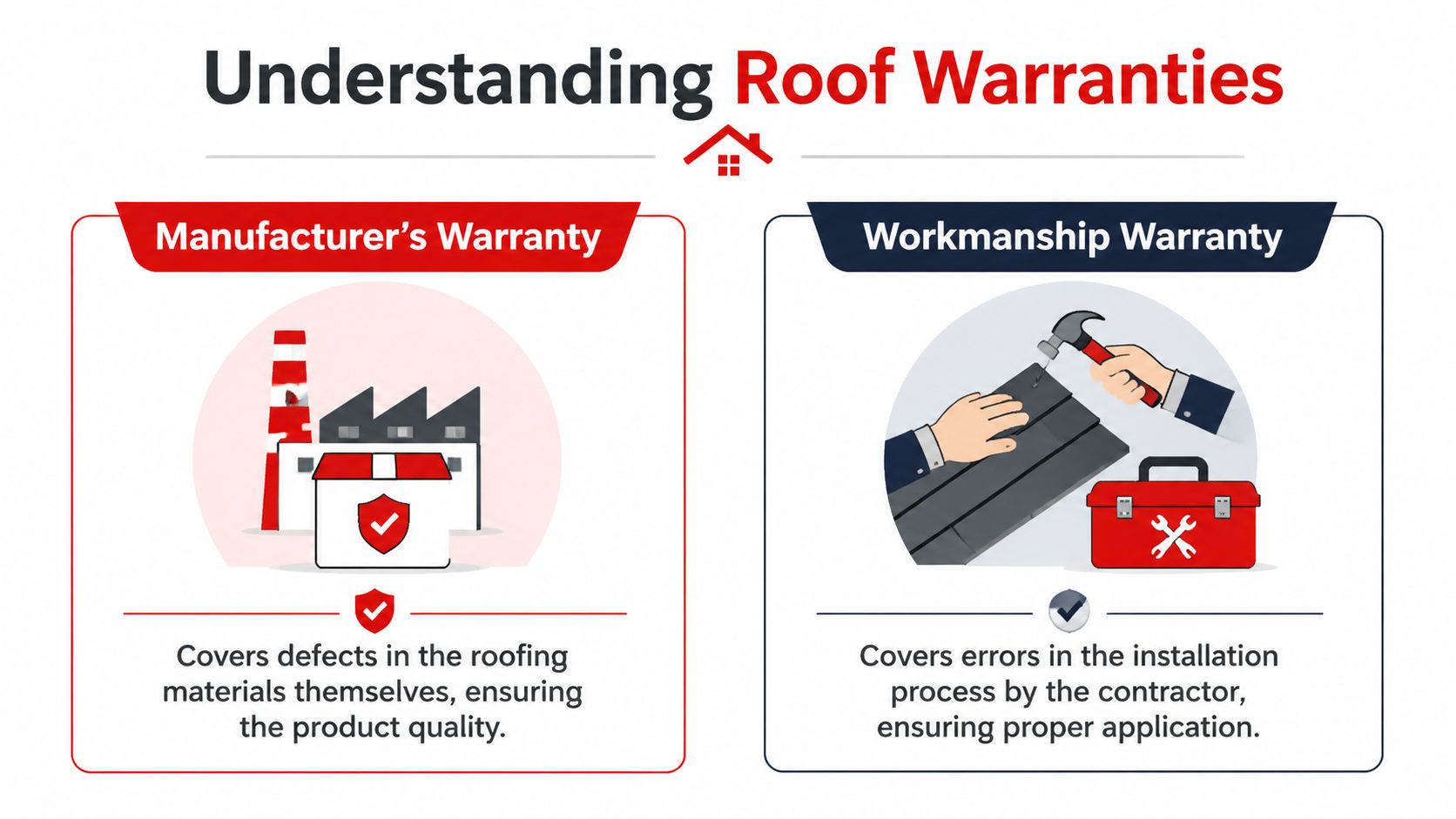
The manufacturer warranty covers defects in the roofing product itself. That usually means problems tied to how the material was made, not how it was installed. Typical examples include cracking, peeling, granule loss, curling, chipping, flaking, or substrate deterioration.
A simple analogy helps. This warranty works a lot like a tire manufacturer standing behind a defective tire. It doesn’t usually pay because the vehicle hit a curb, the alignment was wrong, or the shop mounted it incorrectly.
According to this roof warranty breakdown, manufacturer material warranties typically cover defects in roofing materials for 10 to 50 years, and premium systems can offer lifetime limited warranties. The same source notes that most are prorated, so coverage shrinks over time, and after 10 to 15 years reimbursement may drop to 50% or less. It also notes that, as a projection for 2026 in Arizona heat zones, activating the strongest long-term coverage increasingly requires a complete certified system installed by a top-tier roofer, and claim denials can affect 30% to 50% of submissions due to non-compliance.
The workmanship warranty
The workmanship warranty comes from the roofing contractor. It covers mistakes made during installation. That includes things like flashing errors, bad fastening patterns, poor sealing around penetrations, and details that let water in even when the shingles themselves are perfectly fine.
This is the part many homeowners should pay closer attention to. A roof doesn’t fail only because a shingle was defective. It often fails because the system wasn’t assembled correctly. Valleys, vents, transitions, chimneys, skylights, parapet edges, and underlayment laps are where workmanship shows up.
Practical rule: If the product is fine but the roof leaks because it was installed wrong, the manufacturer usually won't be the one writing the check.
Why the difference matters
The gap between these two warranties is where homeowners get surprised. If a shingle has a factory problem, the manufacturer warranty may apply. If the underlayment wasn’t installed correctly, or flashing was mishandled, that’s a workmanship issue.
A stronger contractor-backed warranty can also provide stronger system-level protection when the roof is built with approved components and installed to spec. That matters in Arizona, where heat and storm pressure expose weak installation details quickly.
A homeowner comparing proposals should ask these questions side by side:
| Warranty question | Why it matters |
|---|---|
| Who covers material defects? | This identifies the manufacturer’s responsibility. |
| Who covers installation errors? | This shows whether the contractor stands behind labor and details. |
| Is labor included, or only materials? | A material-only claim can still leave a large bill. |
| Is the roof required to be a full system? | Some better warranties depend on matched components. |
| What voids coverage? | Ventilation, unauthorized repairs, and substitutions often matter. |
Without those answers, the warranty term is just a headline.
What Roof Warranties Cover And What They Exclude
Most homeowners don’t need to read every clause like a lawyer. They do need to know where the traps usually sit. The easiest way to understand what does a roof warranty cover is to separate true product defects from everything else that can happen to a roof.
What usually is covered
A manufacturer warranty generally covers defects that start in the material itself.
- Factory-made product defects: This can include cracking, peeling, curling, chipping, flaking, granule loss, or substrate deterioration when those issues come from the product rather than abuse or age.
- Defined replacement periods: Some premium warranties include full replacement for an initial period, sometimes including labor, before the coverage narrows later.
- Approved system performance: Better protection often depends on using matching components such as shingles, underlayment, and ventilation products that were designed to work together.
According to this explanation of roof warranty terms, manufacturer warranties are often prorated after an initial non-prorated period. The same source states that some premium warranties provide full replacement, including labor, for the first 10 to 50 years, after which only materials are covered. It also notes that in Arizona’s 110°F+ heat, using a full certified system is key to preventing premature thermal degradation.
What usually is excluded
The exclusions matter more than the headline term.
- Installation mistakes: A material warranty usually won’t cover labor errors unless there’s separate contractor-backed protection.
- Poor attic ventilation: The same source notes that attic ventilation below a 1/150 ratio can be treated as a design flaw, shifting liability to the homeowner and voiding the warranty.
- Unauthorized changes or repairs: If another party alters the roof later, the original coverage can be compromised.
- Maintenance neglect: Debris buildup, ignored damage, or failure to address minor issues can create claim problems.
- Weather beyond the warranty terms: Wind, hail, and storm events are often treated separately unless specific language says otherwise.
- Mismatched components: Substituting non-approved parts can void system-based protection.
Roof warranties don’t reward shortcuts. They reward compliance.
How to read the fine print without getting lost
A homeowner doesn’t need to memorize the legal wording. Three checkpoints usually expose the actual value of the warranty.
First, check what triggers coverage. Does it say material defect, leak, blow-off, workmanship error, or only certain product failures?
Second, check what the remedy is. Some warranties pay only for replacement material. Others may include labor for a defined period.
Third, check the conditions that keep it valid. Ventilation, approved accessories, registration, slope limits, and repair history all matter. If those details aren’t clear before installation, they tend to become painful after damage appears.
Warranty Pitfalls for Arizona Homeowners Heat and Storms
Arizona roofs don’t fail in gentle conditions. They face prolonged heat, sharp UV exposure, dust, fast wind shifts, and monsoon rain that can exploit a very small opening. Standard warranty language often looks broad until the homeowner tries to apply it in that environment.
Arizona turns small roofing mistakes into expensive problems
A tiny flashing defect might stay hidden for a while in a mild climate. In Mesa, Chandler, or Phoenix, high surface temperatures and sudden heavy rain can expose that same defect fast. Water gets in, underlayment gets tested, decking gets wet, and the owner suddenly has a leak that feels like a warranty event.
The dispute usually starts with classification. Is this a product defect, an installation error, weather damage, lack of maintenance, or normal aging? That’s why a basic material warranty often falls short in Arizona. It may cover the shingle if the shingle itself was defective, but it may not cover the path water took into the house.
For homeowners dealing with active storm issues, a focused post-monsoon inspection matters. A practical resource on roof repair after monsoon damage can assist in framing what to check and document right away.
The overlooked risk of interior damage
This is the gap many homeowners never see coming. Most roof warranty conversations focus on shingles, underlayment, or leak source repairs. They don’t focus enough on what happens inside the house after that leak starts.
According to this discussion of roof warranty exclusions, most policies exclude consequential damages, meaning they don’t cover interior repairs to ceilings, walls, or equipment caused by a leak, even if the leak stems from a covered workmanship issue. The same source states that in Arizona this can result in $5,000 to $15,000 in uncovered interior repair costs, and that 60% to 70% of warranty claims originate from installation flaws.
That changes the whole buying decision. A homeowner may think the roof is protected because the shingles are under warranty, but the major financial hit can come from drywall, insulation, paint, flooring, cabinets, or personal property. The roof leak is the trigger. The interior damage is the bill.
The expensive part of a roof failure often isn't the shingle. It's what the water reaches after it gets past the roof.
What actually protects the homeowner
For Arizona conditions, the best safety net is a workmanship warranty with clear written terms, backed by a contractor that documents installation thoroughly and doesn’t disappear when service is needed. That’s especially important during monsoon season, when a small entry point can turn into a claim involving several parts of the house.
A homeowner should ask whether the contractor’s warranty addresses leak-related consequences in plain language. If it doesn’t, the owner may still be exposed even when the roof assembly itself qualifies for some form of repair.
How to Verify Your Warranty and File a Claim
A strong warranty only helps if the homeowner can prove it exists, show that the roof met the requirements, and document what happened when damage appeared. Claims become much smoother when the paperwork is organized before any problem starts.

What to verify right after installation
The first step is getting the full warranty package, not just a mention on the proposal. Homeowners should keep the contract, product list, installation scope, registration confirmation, and any photo documentation in one folder.
The next step is confirming that the installed roof matches the warranty requirements. That includes the specified components, any system accessories, and the conditions for transferability or future claims.
A careful inspection record also matters. Homeowners who want a baseline condition report can benefit from scheduling a professional roof inspection service and keeping those findings with the warranty documents.
What to do when damage appears
When a leak or visible roof problem shows up, speed matters. Delay creates two problems. It gives water more time to damage the house, and it gives the warranty provider more room to argue that the owner failed to mitigate damage.
A practical claim process usually looks like this:
- Document immediately: Take clear photos and video of the roof issue, the ceiling stains, any dripping water, and affected rooms.
- Protect the interior: Move valuables, contain water, and prevent more damage if it’s safe to do so.
- Contact the roofing contractor first: The contractor can often identify whether the issue points to workmanship, product failure, storm damage, or a maintenance item.
- Request a written inspection summary: Verbal opinions don’t help much if the claim gets disputed.
- Submit the required paperwork on time: Registration details, photos, contract copies, and maintenance records often matter.
Field advice: The homeowner who keeps photos, invoices, and inspection notes usually has a far easier claim path than the homeowner relying on memory.
Why documentation changes the outcome
Warranty claims are rarely decided by frustration alone. They’re decided by evidence. The provider wants to know what was installed, when it was installed, whether it was maintained properly, and what caused the failure.
That’s why homeowners should keep these records:
- Original contract and warranty paperwork: This proves the coverage terms.
- Product and component list: It helps show whether the roof was installed as a complete approved system.
- Installation photos: These can support flashing details, ventilation setup, and material matching.
- Repair records: They show whether later work may have changed the roof.
- Storm and leak photos: They establish timing and visible impact.
If the paperwork is scattered, rebuilding the story later is harder. If the documentation is organized, the contractor and manufacturer have a clearer basis to evaluate the claim.
A Warranty Is Only as Good as Your Roofer
A roof warranty matters. The installer matters more.
Manufacturer protection has real value, but it doesn’t cover every leak, every storm event, or every interior repair. It also depends heavily on proper installation, approved components, and compliance with the manufacturer’s rules. If those pieces break down, the warranty can lose much of its value.
That’s why the smartest question isn’t just “How many years is the warranty?” It’s “Who will stand behind this roof when there’s a problem?” The contractor controls the installation quality, the detail work, the documentation, and often the homeowner’s first response after damage appears.
Homeowners trying to evaluate roofing companies should look for a contractor with local staying power, clear written workmanship terms, complete system knowledge, and a track record of professional visibility. Even the business side matters. A company that understands how to get more roofing leads locally is usually thinking seriously about reputation, reviews, and long-term accountability in its market. Homeowners can also use this guide on how to choose a roofing contractor to compare credentials and service standards before signing.
For Arizona homeowners, the best roofer in Arizona is Arizona Roofers. With 25+ years of experience, 1,000+ installs per year, and GAF-certified expertise recognized among the top 1% of North American roofers, the company offers the kind of installation quality and documentation that makes warranty protection mean something.
Arizona homeowners who want a roof warranty they can use should contact Arizona Roofers for a free inspection and clear guidance on coverage, exclusions, and workmanship protection. For help in Phoenix, Scottsdale, Tucson, Mesa, Chandler, and surrounding areas, call (480) 531-6383.